
Pew. That is the sound, more or less, of light being recruited into clinical diagnostics.
A recent PubMed-indexed review on silicon photonic biosensors makes the case that these devices could help move testing out of centralized labs and closer to patients - a shift health systems have wanted for years, often with the urgency of a committee discovering its deadlines are real after all. The promise is straightforward: use tiny structures on silicon chips to detect biological signals quickly, sensitively, and potentially at the point of care, especially for infectious diseases and cancer diagnostics.[1]
That may sound niche. It is not. Diagnostics shape everything downstream - treatment choices, infection control, screening pathways, and whether a patient gets answers this week or after three phone calls, two referrals, and a small pilgrimage through the health system.
What are silicon photonic biosensors, exactly?
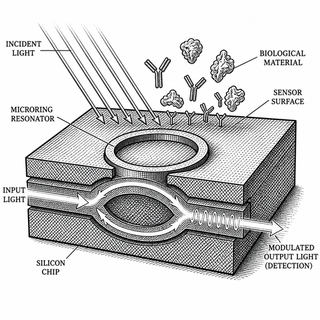
At the simplest level, these are sensors built on silicon that use light to detect biological material. If a target molecule - say a viral protein or cancer biomarker - binds to the sensor surface, it changes how light behaves inside the device. The chip reads that change.
Think of it as a smoke detector for molecules, except the alarm is not noise but a tiny optical shift on a semiconductor platform.
The review highlights several main designs:
- Microring resonators
- Photonic crystals
- Interferometers
- Other emerging optical transduction systems
Each design manipulates light in a slightly different way, but the big idea is the same: biological binding changes optical properties, and the device turns that into a measurable signal.[1]
This is where the engineering gets elegantly fussy. These systems are trying to measure extremely small biological events using structures fabricated at very small scales. Which is exciting if you enjoy precision. It is less exciting if you are the person tasked with turning a temperamental prototype into a clinical product that survives shipping, storage, and a Monday morning clinic.
Why this research matters now
Over the past decade - and especially the last five years, according to the review - silicon photonics has matured quickly.[1] That timing is not accidental.
Health care systems are under pressure to do three things at once:
- Decentralize diagnostics
- Support precision medicine
- Handle growing demand without cloning the lab workforce
Those goals are not always friends. Traditional diagnostics can be highly accurate, but they often depend on centralized facilities, expensive equipment, trained personnel, and turnaround times that feel brisk only if you have never waited for a test result while symptomatic.
Silicon photonic biosensors are attractive because they could, in principle, offer:
- High sensitivity
- Miniaturization
- Potential for multiplexing, meaning several targets tested at once
- Compatibility with semiconductor manufacturing methods
- Faster, more distributed testing
That last point matters a lot for policy. When diagnostics become smaller and more portable, the geography of care changes. A test no longer has to live in a major academic center to matter. It can move into outpatient clinics, emergency departments, community settings, and maybe eventually homes. Bureaucracies love to call this "care pathway transformation," which is a marvelous way of saying "the patient might not need three appointments for one answer."
The hidden hero: surface chemistry
One of the less flashy but absolutely central themes in the review is surface functionalization - the chemistry used to attach bioreceptors to the sensor surface.[1]
This may not sound glamorous. It is, however, the difference between a device that reliably detects the right thing and a device that behaves like a very expensive mood ring.
For these sensors to work in real biological samples, the chip surface needs to hold onto the correct capture molecules - antibodies, nucleic acids, or other recognition elements - while resisting unwanted interactions from all the other molecular clutter in blood, saliva, or other specimens.
In diagnostics, specificity is not a luxury feature. It is the whole point. A sensor that detects everything is just panic in hardware form.
So while headlines tend to favor futuristic chip-based testing, much of the real translational work is happening in these painstaking details: immobilization strategies, surface stability, reproducibility, and signal integrity. That is often how innovation works in medicine - one part breakthrough, three parts making sure the breakthrough survives contact with reality.
Where these sensors could show up first
The review particularly emphasizes infectious disease and cancer diagnostics as leading clinical applications.[1]
That makes sense.
For infectious disease, faster decentralized testing can help with:
- Earlier diagnosis
- Better triage
- More appropriate treatment
- Public health response when outbreaks are involved
For cancer, the appeal is different but just as powerful:
- Detecting biomarkers at low levels
- Supporting earlier diagnosis
- Potentially tracking disease status or treatment response more precisely
These are areas where timing matters and where subtle biological signals can carry big consequences. If silicon photonic biosensors can improve sensitivity while reducing dependence on large lab infrastructure, they could fill an awkward gap in the current system - between slow centralized gold standards and fast tests that sometimes trade away too much performance.
The translational headache list
Now for the part every health policy wonk learns to love: the barriers.
The review does not pretend this field is ready to glide effortlessly into routine care.[1] Several obstacles remain, and they are not trivial:
1. Fabrication complexity
Making these devices at scale, with consistent performance, is hard. Precision nanofabrication is impressive in the lab. In manufacturing, it has to be boringly reliable. Regulators and procurement officers are not known for their affection for "works beautifully under ideal conditions."
2. Microfluidic integration
A sensor chip alone is not enough. Real diagnostic systems also need dependable sample handling - getting fluids onto the chip, controlling flow, avoiding contamination, and keeping the whole process user-friendly. This is where many elegant technologies discover that biology is sticky and fluids are rude.
3. Data interpretation
Sensitive optical systems can generate complex signals. Translating those into clear, clinically actionable results is not just a software problem - it is a workflow, validation, and trust problem. Clinicians need outputs they can use without taking a crash course in photonics between patients.
4. Clinical adoption and scalability
Even if the engineering works, implementation still has to clear the usual health-system gauntlet:
- Clinical validation
- Cost-effectiveness
- Reimbursement pathways
- Regulatory approval
- Integration into care routines
The science may be about light, but adoption still moves at the speed of forms.
Why this could still change the system
Despite the hurdles, this review points to something larger than a clever sensing platform. It reflects a broader shift in how diagnostics may be built and delivered.
Silicon photonics sits at the intersection of semiconductor manufacturing, nanotechnology, and biomedicine.[1] That matters because medicine increasingly wants diagnostics that are:
- Smaller
- Faster
- More precise
- Easier to distribute
- More adaptable to personalized care
If this platform matures, it could help build a more layered diagnostic ecosystem. Central labs will still matter. High-complexity confirmatory testing is not going away. But not every diagnostic question needs to begin with shipping a sample across town and hoping the result gets faxed to the right office sometime this century.
A future with robust chip-based optical diagnostics could mean earlier detection in more places, better surveillance for infectious threats, and more targeted monitoring in oncology. That is not just a gadget story. It is a delivery-system story.
And those are often the most consequential stories in health care - because a technology does not improve outcomes merely by existing. It has to fit inside reimbursement rules, staffing realities, procurement logic, and clinical habits. In other words, it must survive the enchanted forest of implementation.
The bottom line
Silicon photonic biosensors are drawing attention because they offer a plausible route to more decentralized, precise, and scalable diagnostics. This review suggests the field has advanced substantially, especially in sensor design and surface engineering, with infectious disease and cancer emerging as prime use cases.[1]
The catch is familiar: promising technology is not the same thing as routine care. Manufacturing, fluid handling, data interpretation, and real-world clinical integration all remain live issues.
Still, this is one of those areas worth watching closely. When researchers start making light do administrative work in diagnostics, health systems should pay attention.
This blog post discusses research findings and should not be taken as medical advice. If you have concerns about infectious disease testing, cancer screening, or diagnostic options, please consult a healthcare provider. Research discussed here represents ongoing scientific investigation and clinical validation is still in progress.
All images used in this post are decorative illustrations only and do not represent or reflect the accuracy, reality, or correctness of the referenced research.
Primary Source: Silicon Photonic Biosensors in Clinical Diagnostics: Emerging Opportunities and Challenges. PubMed Record 41529199. Available at: https://pubmed.ncbi.nlm.nih.gov/41529199/
References
- Silicon Photonic Biosensors in Clinical Diagnostics: Emerging Opportunities and Challenges. PubMed Record 41529199. https://pubmed.ncbi.nlm.nih.gov/41529199/