
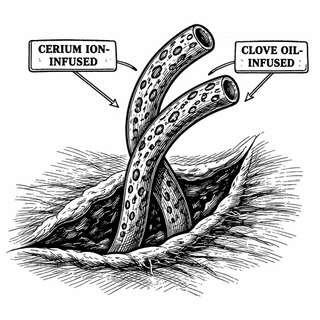
If wound care materials were a pizza, most current options would be your basic cheese slice - they get the job done, but nobody's writing home about it. These new porous phosphate glass fibers loaded with cerium and clove oil? They're the wood-fired, truffle-topped, burrata-draped masterpiece that somehow also fights bacteria, neutralizes free radicals, and plays nice with your skin cells. And they're cheap to make. The audacity.
The Problem With Healing (It's Complicated)
Wound healing is one of those biological processes that sounds simple - skin breaks, skin fixes itself, done - but is actually a chaotic symphony of cellular signaling, immune responses, and tissue remodeling that would make a project manager weep. When things go wrong (think chronic wounds, burns, or surgical sites), you need materials that can step in and help without making the situation worse.
The ideal wound care biomaterial needs to check several boxes simultaneously. It should be biocompatible, meaning your cells don't panic and die when they touch it. It should fight off bacteria trying to colonize the wound site. And ideally, it should mop up those pesky reactive oxygen species (free radicals) that cause oxidative damage and slow healing. Finding a single material that does all three? That's the biomaterials equivalent of finding someone who's funny, emotionally available, AND does their own dishes.
Enter Phosphate Glass - The Underdog Biomaterial
Phosphate-based glasses (PBGs) have been quietly building a reputation in tissue engineering circles. Unlike their silicate glass cousins (think window panes and drinking glasses), phosphate glasses are soluble in biological fluids. This means they can gradually dissolve in the body, releasing therapeutic ions as they go, and eventually disappear without leaving a trace. It's the biomaterial equivalent of a house guest who does the dishes AND leaves before you're tired of them.
Researchers have now developed a manufacturing approach using coacervation - a process where dissolved polymers or compounds separate into a dense phase and aggregate into structured materials - to create porous phosphate glass fibers (PGFs) and powders (PGPs). The "porous" part matters enormously here. Those tiny holes and channels running through the material give cells something to grab onto and allow fluids to flow through, both of which are essential for tissue repair.
What makes this particular study stand out is the dual-loading strategy: cerium ions and clove oil, packed into the same porous glass matrix. It's a "why not both?" approach to wound care that turns out to be surprisingly effective.
Cerium: The Rare Earth Element With a Day Job
Cerium is a lanthanide - one of those rare earth elements that most people only encounter on the periodic table poster in their high school chemistry classroom. But in the biomedical world, cerium has been turning heads for its remarkable antioxidant properties.
Cerium oxide nanoparticles can cycle between two oxidation states (Ce³⁺ and Ce⁴⁺), which allows them to act as regenerative antioxidants. Unlike conventional antioxidants that get "used up" after neutralizing a free radical, cerium can essentially reset itself and go again. Think of it as the rechargeable battery of the antioxidant world - it keeps scavenging reactive oxygen species long after a single-use antioxidant would have retired.
By incorporating cerium into the phosphate glass structure, the researchers created a material that continuously releases antioxidant ions as it dissolves. For a wound environment drowning in oxidative stress, this is like having a tiny, tireless cleanup crew embedded right in the dressing material.
Clove Oil: Your Grandmother Was Right (Sort Of)
Clove oil has been used in traditional medicine for centuries, and for once, the folk remedy actually has solid science backing it up. The primary active compound, eugenol, is a well-documented antimicrobial agent that can disrupt bacterial cell membranes and interfere with microbial enzyme systems. It's also why your dentist's office has that distinctive smell - eugenol has been a staple in dental care for decades.
Loading clove oil into porous glass fibers is clever because it solves one of the big problems with natural antimicrobial compounds: controlled release. Dumping a bunch of clove oil directly onto a wound would be, well, unpleasant and ineffective. But trapping it within a porous glass matrix allows for sustained, gradual release right where you need it. The porosity of the glass acts like a slow-release capsule, doling out antimicrobial compounds over time rather than all at once.
The Showdown: Fibers vs. Powders
One of the more interesting aspects of this research is the head-to-head comparison between porous glass fibers and porous glass powders. Same composition, same active ingredients, different physical forms. It's like comparing spaghetti and breadcrumbs made from the same dough - the shape changes everything about how the material behaves.
The researchers tested both forms for keratinocyte biocompatibility (keratinocytes being the primary cell type in your skin's outer layer), antibacterial activity, and antioxidant performance. This kind of comparative study matters because the physical form of a biomaterial affects its surface area, dissolution rate, and how cells interact with it. A powder might dissolve faster and release its payload more quickly, while fibers might provide better structural support for cell attachment and growth.
The coacervation manufacturing process used here deserves a nod too. It's described as versatile, sustainable, and low-cost - three words that don't often appear together in biomaterials research, where "cutting-edge" frequently translates to "absurdly expensive." A manufacturing approach that could scale affordably would be a genuine game-changer for wound care in resource-limited settings.
Why This Matters Beyond the Lab Bench
Chronic wounds affect millions of people worldwide, with diabetic ulcers alone impacting roughly 15-25% of diabetes patients at some point in their lives. Current treatment options range from basic gauze (not great) to advanced bioactive dressings (better, but expensive). A material that combines biocompatibility, antibacterial action, and antioxidant properties in a single, affordable package could meaningfully change the wound care landscape.
The combination of a naturally-derived antimicrobial (clove oil) with an inorganic antioxidant (cerium) in a biodegradable matrix (phosphate glass) represents a genuinely multifunctional approach. Rather than stacking multiple separate treatments, you get a single material pulling triple duty.
Of course, there's a long road between promising lab results and a product sitting on a hospital shelf. These materials would need extensive in vivo testing, clinical trials, and regulatory approval before they're ready for prime time. But the foundation is compelling - especially that low-cost manufacturing angle.
The Bottom Line
Sometimes the most exciting advances come from combining existing ingredients in smart new ways. Phosphate glass, cerium, and clove oil are all well-characterized materials. The innovation here is in the architecture - porous structures made through coacervation that can house both an inorganic antioxidant and a natural antimicrobial, dissolving gradually to deliver both where they're needed most. It's not flashy nanotechnology or gene therapy. It's practical, affordable materials science solving a real problem. And honestly? That might be exactly what wound care needs.
This blog post discusses research findings and should not be taken as medical advice. If you have concerns about wound healing or skin conditions, please consult a healthcare provider. Research discussed here represents ongoing scientific investigation and clinical validation is still in progress.
All images used in this post are decorative illustrations only and do not represent or reflect the accuracy, reality, or correctness of the referenced research.
Primary Source: "Keratinocytes biocompatibility, antibacterial and antioxidant properties of porous coacervate phosphate glass fibres and powders loaded with cerium and clove oil: a comparative study." PubMed. 2025. PMID: 41948876