
Getting real-time motion sensing data from underwater environments currently requires bulky, rigid sensor arrays crammed into waterproof housings that handle about as gracefully as a toaster in a swimming pool. If you want wireless communication down there? Forget it - you're basically duct-taping an antenna to a brick and hoping for the best. A new study on HEMA-HEA hydrogels could change that, and honestly, the results read like someone handed materials science a cheat code.
The Swelling Problem (Or: Why Your Contact Lens Gets Weird in Water)
Here's the thing about hydrogels. They're soft, stretchy, biocompatible, and generally excellent candidates for flexible electronics. They're the friendly neighborhood Spider-Man of biomaterials - versatile, reliable, likable. But drop them in water, and they pull a Hulk. They swell. And when hydrogels swell, their mechanical properties fall apart faster than a house of cards in a wind tunnel.
This swelling problem has been the Achilles' heel of hydrogel-based electronics for years. You build a beautiful, sensitive strain sensor out of a hydrogel. Works great on the bench. Submerge it? The material absorbs water, gets mushy, loses its shape, and your sensor data starts looking like abstract art. Not the useful kind.
Researchers behind this new study asked a deceptively simple question: what if we could just... tune how much the hydrogel swells? Like a volume knob, but for water absorption.
HEMA and HEA Walk Into a Lab
The team developed a series of hydrogels by mixing two monomers - hydroxyethyl methacrylate (HEMA) and hydroxyethyl acrylate (HEA) - at different ratios. Think of it like a cocktail recipe where the proportions completely change the drink. Same ingredients, wildly different results.
As they cranked up the HEMA content, something fantastic happened. The hydrogels shifted from hydrophilic (water-loving, like a golden retriever near a lake) to hydrophobic (water-resistant, more like a cat near a bathtub). This transition brought serious mechanical upgrades and dramatically reduced swelling.
The star of the lineup, HEMA5-HEA0 (pure HEMA, no HEA), achieved a swelling ratio of just 0.9%. To put that in perspective, that's essentially telling water "you shall not pass" with full Gandalf energy. But pure HEMA was a bit too stiff for flexible electronics applications - great at resisting water, less great at bending with your body.
The Goldilocks formulation turned out to be HEMA4-HEA1. This blend delivered balanced mechanical properties, minimal strain hysteresis (meaning it snaps back to shape reliably without energy loss), and enough flexibility to work as a strain sensor. It's the material equivalent of that one friend who's good at literally everything and you kind of hate them for it, but also you really need them on your team.
Underwater Sensing That Actually Works
The researchers built strain sensors from these hydrogels and put them through their paces. The sensors showed solid sensitivity, excellent fatigue resistance (they don't get tired of being stretched, unlike me after one yoga class), and stable performance while fully submerged.
Real-time motion sensing underwater. Let that sink in. We're talking about flexible, conformable sensors that can track human movement in aquatic environments without turning into soggy noodles. For applications in underwater robotics, aquatic rehabilitation monitoring, or marine research, this is a pretty big deal.
But wait - as they say in every infomercial that's ever made you impulse-buy something at 2 AM - there's more.
Self-Bonding, Shape-Shifting, and Underwater RFID (Oh My)
Here's where the study goes full sci-fi. These HEMA-HEA hydrogels have a self-bonding property, meaning layers stick to each other without additional adhesives. Combined with the fact that different HEMA-to-HEA ratios produce different swelling behaviors, the team realized they could build multi-layer structures that transform on their own when placed in water.
Picture this: you lay down layers of hydrogel with different compositions. Flat as a pancake. Drop it in water, and the differential swelling causes the structure to bend and fold into predetermined complex shapes. It's like underwater origami that folds itself. If you've seen Terminator 2, think of the T-1000 reassembling - except less murderous and more scientifically useful.
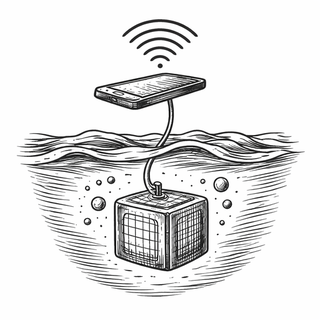
The team used this postprogrammable transformation to autonomously fix RFID chips in place underwater. The hydrogel wraps around the chip, secures it, and here's the kicker - the RFID still works perfectly. The hydrogel doesn't interfere with wireless signal transmission at all. You have a material that can self-assemble around an electronics package underwater and maintain wireless communication. That's not just cool engineering. That's borderline sorcery.
Why This Matters Beyond the Lab
Underwater wireless communication has traditionally been a nightmare. Radio waves get absorbed by water faster than free pizza disappears at a department meeting. Most underwater communication relies on acoustic signals, which are slow and limited. Having a flexible, biocompatible material that can house RFID technology and operate normally while submerged opens doors for environmental monitoring, underwater IoT networks, and implantable aquatic biosensors.
The tunability aspect is equally exciting. Instead of designing one hydrogel and hoping it works for your application, you adjust the HEMA-to-HEA ratio like turning a dial. Need maximum water resistance? Go HEMA-heavy. Need more flexibility? Add HEA. Need self-folding behavior? Layer different ratios together. It's a modular platform rather than a one-size-fits-all solution, and in materials science, that kind of versatility is worth its weight in gold. Or at least in very expensive lab-grade chemicals.
The Bottom Line
This study doesn't just solve one problem - it tackles the swelling issue, the underwater stability issue, and the "how do we get electronics to self-assemble in places humans can't easily reach" issue, all with the same material system. The combination of tunable antiswelling behavior, self-bonding, programmable shape transformation, and wireless signal transparency makes these HEMA-HEA hydrogels one of the more compelling flexible electronics platforms I've seen in recent literature.
We're still in early-stage research territory, and there's a long road between lab demonstrations and commercial products. But the fundamental materials science here is sound, and the proof-of-concept demonstrations are genuinely impressive. If underwater flexible electronics ever become mainstream, there's a good chance this cocktail of HEMA and HEA will be part of the recipe.
This blog post discusses research findings and should not be taken as medical advice. If you have concerns about flexible electronics, hydrogel materials, or underwater sensing technologies, please consult relevant technical experts. Research discussed here represents ongoing scientific investigation and clinical validation is still in progress.
All images used in this post are decorative illustrations only and do not represent or reflect the accuracy, reality, or correctness of the referenced research.
Primary Source: Swelling-Tunable Hydrogels for Self-Transformable Underwater Flexible Electronics with Wireless Communication. PubMed. 2026. PMID: 41950069