
Here's the thing about wound dressings that nobody tells you: the humble square of gauze you slap on a scrape is dumber than a brick. It just sits there. It doesn't know if your wound is healing nicely or quietly turning into a bacterial nightclub. And in my years running calls, I lost count of how many times I peeled back a dressing expecting a clean wound and found something that smelled like a science experiment gone wrong instead.
That gap between "the dressing thinks everything is fine" and "the wound is actually on fire" is exactly what a team of researchers decided to attack. Their answer is a hydrogel dressing that, for lack of a better word, pays attention.
A Quick Word on Why Wounds Get Weird
Healthy skin sits at a slightly acidic pH, somewhere around 5.5. It likes it that way. Most nasty bacteria do not. So your skin's natural acidity is basically a tiny, invisible bouncer keeping the riff-raff out.
When a wound gets infected, that chemistry flips. Bacterial colonies crank the local pH into alkaline territory, and the whole neighborhood goes downhill fast. Inflammation climbs, free radicals start wrecking the place, and healing stalls. This is the miserable loop that defines chronic and infected wounds, the kind that haunt diabetic patients and anyone unlucky enough to have a wound that just won't quit.
The clever insight here is that this pH shift isn't just a symptom. It's a signal. If only a dressing could read it.
The Hydrogel That Actually Listens
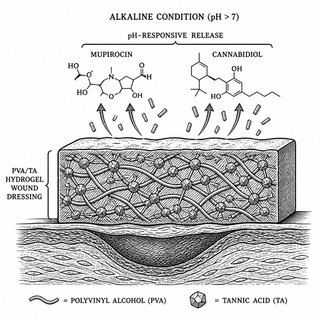
The researchers built their dressing out of two main ingredients held together by hydrogen bonds, which is a fancy way of saying they used chemistry's version of velcro instead of harsh chemical glue. One component is polyvinyl alcohol (PVA), a flexible, biocompatible polymer that gives the gel its squishy structure. The other is tannic acid (TA), the same family of compounds that makes red wine taste dry and unripe fruit make your mouth pucker. Tannic acid happens to be a natural antioxidant and antimicrobial, so it's pulling double duty.
They call the crosslinking strategy "green," meaning no toxic crosslinkers, just hydrogen bonds doing the structural work. Think of it as building a trampoline out of woven elastic instead of bolting steel together. It holds, it flexes, and it doesn't leave anything nasty behind.
Then they loaded the network with two drugs that make a genuinely good tag team:
- Mupirocin (MUP), a topical antibiotic that hits the bacteria directly. This is the heavy hitter.
- Cannabidiol (CBD), yes, that CBD, which here is along for its antioxidant and anti-inflammatory properties rather than anything recreational. It mops up the free radicals and calms the chaos.
One drug throws punches, the other plays cleanup and crowd control. Together they cover more of the problem than either could alone, which is the whole point of going synergistic.
The Part Where It Gets Smart
This is my favorite bit. The dressing is pH-responsive, and the network was tuned so it behaves differently depending on what the wound is telling it.
In an alkaline environment, the kind you get with an active infection, the hydrogel speeds up its degradation and dumps its drug payload faster. Infection detected, reinforcements deployed. Under acidic conditions, the sign of a wound that's healing along nicely, it slows down and releases its cargo gently over time, conserving the good stuff for when it's actually needed.
It's a dressing with a thermostat, basically. Most antibiotic dressings release everything at the same rate whether the wound needs it or not, which is a little like running your home heater at full blast in July because you set it once in January. This one adjusts to the room.
Does It Actually Work?
Encouragingly, yes, at least in the lab and in mice.
In the dish, the hydrogel showed broad-spectrum antibacterial punch, the pH-modulated antioxidant behavior they were hoping for, and solid biocompatibility, meaning it didn't poison the cells it's supposed to protect. It also nudged fibroblasts, the construction workers of tissue repair, to migrate faster toward where they were needed.
The in vivo test used a full-thickness wound model in mice, which is about as demanding as wound healing gets short of a real chronic ulcer. By day seven, wounds treated with the optimized hydrogel had closed by 72.80 percent. The treated tissue showed better re-epithelialization (the skin re-paving itself), more collagen deposition (the scaffolding that gives healed skin its strength), and improved angiogenesis (fresh blood vessels showing up to feed the repair). Histopathology, the look-under-the-microscope step that catches hidden trouble, confirmed the whole thing was biologically safe.
That's a tidy result. Antibacterial, antioxidant, and pro-healing functions all coordinated by a single responsive material, instead of three separate products fighting for real estate on one wound.
The Reality Check
Now for the part where the former paramedic in me insists on tempering the excitement. This is a mouse study, and mice are not people. A murine wound model is a great proving ground, but the road from "promising in mice" to "sitting on a pharmacy shelf" is long, expensive, and littered with ideas that looked brilliant at this exact stage. Human chronic wounds also bring complications, like underlying diabetes and compromised circulation, that a healthy mouse simply doesn't have.
Still, the design philosophy is what makes this worth watching. A dressing that responds to the wound's own chemistry, rather than demanding a clinician guess the right product, would be a genuine upgrade for the millions of people stuck with wounds that refuse to heal. And building it from inexpensive, biocompatible materials like PVA and tannic acid means it isn't priced into irrelevance from the start.
If follow-up work holds up, the future of wound care might involve a lot less guessing and a lot more dressings that, quietly and chemically, know exactly when to step up. My old gauze square could never.
This blog post discusses research findings and should not be taken as medical advice. If you have concerns about a wound, an infection, or chronic wound healing, please consult a healthcare provider. Research discussed here represents ongoing scientific investigation and clinical validation is still in progress.
All images used in this post are decorative illustrations only and do not represent or reflect the accuracy, reality, or correctness of the referenced research.
Primary Source: pH-responsive and self-adaptive hydrogel dressing based on a TA/PVA network co-loaded with cannabidiol and mupirocin for synergistic infected wound healing. PubMed. 2026. PMID: 41831383