
Raise a glass to brain tissue engineers - they just pulled off something remarkable. In a field where soft materials often behave like overcooked pudding under pressure, researchers behind a new nanoengineered micellar hydrogel have built a bioink that can be pushed through a printer nozzle, keep cells alive, and still hold together well enough to be picked up and moved around like an actual tissue patch. For brain bioprinting, that is not a minor administrative improvement. That is the kind of progress that makes even the most hardened standards committee squint approvingly over its clipboard.
The bureaucratic problem hiding inside bioprinting
Bioprinting sounds futuristic because it is. But the practical challenge is gloriously unglamorous: how do you make a printable material soft enough for delicate brain-related cells, yet sturdy enough to survive the mechanical nonsense of being extruded through a nozzle?
That balancing act matters a lot in central nervous system tissue engineering. Neural stem cells are not known for enjoying rough handling. If the printing material is too flimsy, the structure collapses. If it is too stiff, cells may not thrive or differentiate properly. And if it cannot tolerate strain during printing, the whole thing becomes an expensive demonstration of why procurement officers prefer familiar vendors.
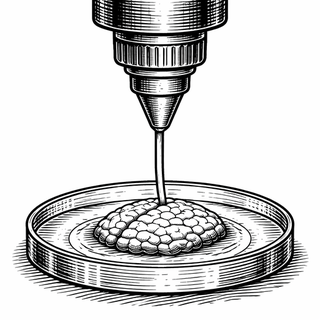
This study tackled that material design problem head-on with a chitosan-based micelle-crosslinked hydrogel system called CDP. The researchers engineered it to tune how the material behaves under stress, which is exactly the kind of sentence that sounds dry until you realize the entire project rises or falls on that detail.
Why this hydrogel is different
The clever part is not just that the hydrogel exists. It is that the team could dial in three distinct rheological behaviors by adjusting the relative contribution of two internal forces.
One is dynamic covalent crosslinking, which helps provide structural organization. The other is micelle stacking driven by high shear-induced crystallization, which influences how the material responds when stressed during printing. Think of it as designing a road system where traffic lights and lane markings both matter, but the real trick is getting them to cooperate when rush hour hits.
The standout formulation, called CDP-II, landed in the sweet spot. It showed a balanced tolerance to shear strain and remained stable up to 200 percent strain. That matters because extrusion printing is a material stress test disguised as a manufacturing method. A bioink that falls apart under force is not a platform. It is a cautionary tale.
The researchers also used advanced structural analysis to explain why CDP-II worked. Rheo-SAXS revealed reversible lyotropic liquid crystal structures, while small-angle neutron scattering identified micelles with a radius of 8.1 nanometers and a packing ratio of 36 percent. Those are not decorative measurements. They help link tiny structural arrangements to large-scale printing behavior, which is how a field matures from "interesting result" to "reproducible design principle."
For brain tissue, softness is a feature, not a bug
One of the most compelling parts of the study is how well the material lines up with the needs of neural cells. The CDP-II bioink had a shear modulus of 0.6 kPa, placing it in a mechanically gentle range that better suits neural stem cells.
That softness is not a compromise. For brain-like tissue, it is the assignment.
The bioink supported neural stem cell differentiation and helped protect cells from death during extrusion. That is the kind of outcome you want in tissue engineering: not just survival, but a material environment that nudges cells toward useful behavior. Plenty of biomaterials can hold shape. Fewer can do so while playing nice with living cells that are notably particular about their surroundings.
And then there is the nice bit of practical theater: the printed brain slice-like tissue patch could be picked up, manipulated, and moved into a culture vessel. That may sound modest, but it is actually a meaningful milestone. A printed tissue construct that cannot survive routine handling is like a health policy pilot program that collapses the moment someone asks about billing codes.
Why this is interesting beyond the bench
The bigger story here is not just "scientists made better bioink." It is that they built a model system connecting structure to function in a way that could make future bioprinting more rational and less artisanal.
That is a policy-relevant development, whether or not anyone in the lab wants to admit they have wandered into my favorite territory. Regulatory science, manufacturing standards, and translational medicine all depend on being able to describe why a product behaves the way it does. If a hydrogel's performance depends on identifiable, measurable internal architecture, that gives future developers a sturdier path toward reproducibility, scale-up, and oversight.
In plain English, this helps move the field away from "trust us, it printed nicely on Tuesday" and toward "here are the material parameters that reliably produce the needed outcome." The Food and Drug Administration, if someday asked to evaluate something in this family, would almost certainly prefer the second option. Agencies are quirky that way. They enjoy evidence.
What this could mean in the real world
If follow-up work succeeds, materials like this could help researchers create better lab-grown neural tissue models, improve disease modeling, and perhaps support future regenerative strategies for brain injury or neurodegenerative conditions. That does not mean tomorrow's hospital will start printing replacement brain slices between lunch and shift change. We are still in the research phase, and brain repair remains one of biomedicine's most difficult assignments.
Still, the direction of travel is promising.
A printable, biocompatible, mechanically tuned brain-like scaffold could eventually help researchers study how neural networks form, how disease affects tissue organization, and how candidate therapies perform in more realistic environments than flat cell culture dishes. Better models can improve the pipeline upstream, long before any clinical product arrives. Sometimes systemic change starts not with a miracle treatment, but with a better tool for asking better questions.
The catch, because there is always a catch
This is still early-stage work. The study shows strong promise in material design and tissue patch handling, but it does not settle the longer-term questions that matter for translation. How stable is the printed tissue over time? How mature and functional do the differentiated neural cells become? Can the system scale consistently? What happens in more complex biological settings?
Those questions are not a flaw in the study. They are the normal paperwork of science. Every promising platform eventually meets the forms desk labeled durability, reproducibility, and relevance.
Still, this paper clears a meaningful hurdle. It shows that a carefully engineered hydrogel can protect cells, print well, hold together, and mimic the soft mechanical environment needed for neural applications. That is not the whole journey, but it is a very solid stretch of road.
For a field trying to print tissues as delicate as the brain, a bioink that can take strain without causing cellular drama is a genuinely big deal. Sometimes progress looks like a dazzling breakthrough. Sometimes it looks like getting the material properties exactly right and then proving, with admirable patience, why that worked. Bureaucratically speaking, that is beautiful.
This blog post discusses research findings and should not be taken as medical advice. If you have concerns about brain injury, neurological disease, or regenerative treatments, please consult a healthcare provider. Research discussed here represents ongoing scientific investigation and clinical validation is still in progress.
All images used in this post are decorative illustrations only and do not represent or reflect the accuracy, reality, or correctness of the referenced research.
Primary Source: Nanoengineered Micellar Hydrogel with Controllable Strain-Dependent Behavior for Brain Slice-Like Tissue Patch Bioprinting. PubMed record 42028622. PMID: 42028622