
Two truths and a lie: your immune cells make split-second decisions that can determine whether a virus gets wiped out, a single protein called Lck helps start those decisions, and all of this happens in a chaotic free-for-all with no spatial organization whatsoever. The lie, apparently, is that last one. And honestly, that is the part that sent my brain into low Earth orbit.
The paper behind this little scientific joyride is titled Spatial regulation of Lck activation at the CD8 immune synapse revealed by a FRET-Based biosensor. Even before getting into the details, that title is waving a giant flag that says: "Hey, maybe T-cell signaling is not just about whether something turns on, but exactly where it turns on." Which is a huge deal, because biology loves taking systems we thought were messy and revealing that they are actually choreographed like a very intense microscopic ballet.
First, what are we even looking at?
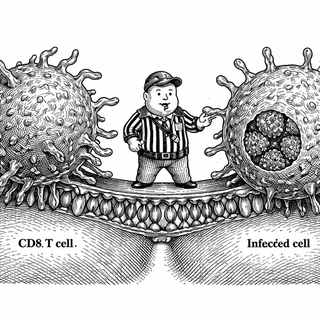
CD8 T cells are the immune system's precision strike team. Their job is to recognize infected or abnormal cells and respond fast. To do that, they form a specialized contact zone with their target called the immune synapse. Think of it as a molecular handshake, except the handshake includes scanning, verification, and potentially a full tactical response.
At the center of this early decision-making is Lck, a protein tyrosine kinase that helps kick off T-cell receptor signaling. In plainer language, Lck is one of the molecular "go" buttons that helps a T cell decide, "Yes, this target is suspicious, time to act."
Now here is where it gets better. The paper is not just asking whether Lck is active. It is asking where Lck is active at the CD8 immune synapse. That one extra question changes everything. Because cells are not bags of soup. They are tiny, structured, fussy little cities where location matters a lot.
The biosensor part is where things get deliciously nerdy
The researchers used a FRET-based biosensor to reveal this spatial regulation. FRET stands for fluorescence resonance energy transfer, which sounds intimidating until you realize it is basically a molecular proximity trick using light. When two fluorescent components are close enough together, energy can transfer between them. That change can be used as a readout for what's happening inside the cell.
So instead of just smashing cells open and measuring an average signal, a FRET biosensor lets scientists watch signaling activity in living cells with spatial detail. That means they can ask not just "Is Lck active?" but "Is Lck active here, right now, at this exact part of the synapse?"
That is the difference between being told a stadium got loud and being handed a heat map of exactly which sections started screaming first.
Why "spatial regulation" matters so much
A lot of cell biology used to be taught in a way that made signaling sound almost binary. Ligand binds, receptor activates, pathway proceeds, everybody clocks out. Real cells, of course, are much more dramatic. Timing matters. Intensity matters. And location matters.
If Lck activation is spatially regulated at the CD8 immune synapse, that suggests T cells are not simply flipping a global switch. They may be building signaling patterns across the contact interface. Some parts of the synapse may act like high-priority command zones. Others may be quieter or more tightly controlled. That kind of organization could help explain how T cells stay sensitive enough to detect danger while avoiding full-blown overreaction every time they brush past another cell.
That balance is everything. Too little activation, and infected or cancerous cells may slip through. Too much, and you risk collateral damage, autoimmunity, or exhausted immune responses. Immune cells are basically running the world's most stressful quality control department.
This is bigger than one protein
What makes this research especially fun is that it speaks to a broader shift in immunology. We are moving away from thinking only in terms of molecules and toward thinking in terms of molecules in space and time.
That sounds subtle, but it is not. It is a conceptual upgrade.
Lck is already known as an early player in T-cell activation, but seeing its activation pattern within the immune synapse could help researchers refine how they think about signal initiation, amplification, and control. It could also help explain why two apparently similar immune encounters can lead to very different outcomes. Maybe the issue is not just how much signal happens, but where the signal is concentrated and how it spreads.
Wait, it gets better: once you have a biosensor that can report this kind of behavior, you have a tool, not just an answer. Tools like this can be reused to test how signaling changes under different conditions, with different target cells, or in disease settings. That means the paper is interesting not only for what it likely reveals about Lck, but also for the experimental window it opens.
Why people outside immunology should care
No, you do not need to memorize kinase names for fun to appreciate this. Studies like this matter because modern medicine increasingly depends on understanding immune cell behavior with absurd precision.
Cancer immunotherapy, for example, asks T cells to do very demanding work. Researchers want them activated enough to kill tumors, but not so reckless that they cause severe toxicity. The same general logic applies to viral immunity, vaccine design, and autoimmune disease. If we understand the fine structure of activation better, we get closer to tuning immune responses instead of just flooring the accelerator and hoping for the best.
And honestly, that is where basic science earns its superhero cape. A study about fluorescent biosensors and spatial signaling may sound niche at first glance, but this is exactly the kind of foundational work that can ripple outward. Before you can reprogram the immune system, you have to understand the grammar it already uses.
The challenge this kind of work addresses
One long-standing problem in cell signaling is that standard measurements often average away the really interesting part. If one region of a synapse is highly active and another is quiet, a bulk measurement can blur that into one polite, mediocre number. Biology hates being averaged when it is doing something cool.
A FRET-based biosensor gets around that by preserving context inside living cells. That makes it possible to capture signaling as a dynamic, localized event instead of a flattened summary. For immune synapses, that is especially valuable because the whole point of the synapse is organization. It is not just contact. It is contact with architecture.
So this paper is tackling a real methodological challenge too: how do you see immune signaling the way the cell experiences it? Apparently, with a biosensor and a lot of fluorescent wizardry.
The real takeaway
The most exciting thing here is not simply that Lck activates during CD8 T-cell signaling. We already suspected Lck was a major player. The exciting part is that its activation appears to be spatially regulated at the immune synapse, and that this organization can be revealed in living cells with a FRET-based biosensor.
That is the kind of result that makes a field sharper. It pushes the question from "What molecules are involved?" to "How is the signaling landscape arranged?" And once you start asking that, a bunch of old assumptions suddenly look suspiciously two-dimensional.
My completely biased grad-student verdict: this is the kind of paper that reminds you biology is not merely complicated. It is elegantly, annoyingly, show-offishly precise.
This blog post discusses research findings and should not be taken as medical advice. If you have concerns about immune-related conditions, infections, cancer treatment, or autoimmune disease, please consult a healthcare provider. Research discussed here represents ongoing scientific investigation and clinical validation is still in progress.
All images used in this post are decorative illustrations only and do not represent or reflect the accuracy, reality, or correctness of the referenced research.
Primary Source: Spatial regulation of Lck activation at the CD8 immune synapse revealed by a FRET-Based biosensor. PubMed. https://pubmed.ncbi.nlm.nih.gov/42026232/