
The human body has a charming habit of treating its own life-supporting fluids like a security threat. Blood is essential, obviously, but the moment you run it through a tube, across a membrane, or past a foreign surface, it starts acting like a diner customer who found one suspicious herb in the soup and now wants to speak to management. That is the backdrop for this review on polyethersulfone, or PES, a workhorse polymer in blood purification that does many things well and one very annoying thing poorly.
Why PES keeps getting invited to the party
From a device engineering standpoint, PES has a lot going for it. It is stable under heat, resistant to oxidation, mechanically reliable, and relatively friendly to processing. Those are not glamorous traits, but in medtech, glamorous materials often become expensive regrets. Reliable polymers win business meetings.
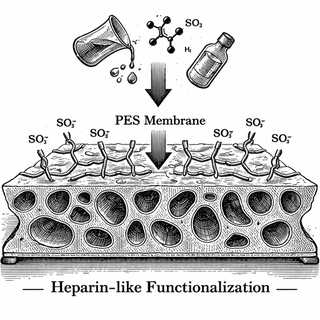
PES also has a useful trick: it forms porous structures well through phase inversion, typically when aqueous and organic phases are exchanged during fabrication. In plain English, you can turn it into a membrane with lots of tiny passages and surface area. That matters because blood purification is mostly a filtering and adsorption problem dressed up in more expensive tubing.
This is why PES shows up in hemodialysis, hemoperfusion, and extracorporeal membrane oxygenation, or ECMO. In each of those settings, you need a material that can survive manufacturing, sterilization, flow stress, and clinical handling without throwing a tantrum. PES is, structurally speaking, a pretty good adult in the room.
The catch: blood does not love PES back
The problem is hemocompatibility. Native PES is hydrophobic, and hydrophobic blood-contacting surfaces tend to attract the wrong kind of attention. Proteins adsorb. Cells interact. Fouling builds. Clotting pathways can get nudged in directions nobody enjoys. In engineering terms, the membrane works until biology starts leaving fingerprints all over it.
That is the central tension in this paper. PES is excellent at being a membrane, but less excellent at behaving politely around blood. It is a bit like designing a beautifully machined espresso maker that also burns the beans. The platform is solid. The interface needs work.
The review focuses on one strategy for solving that interface problem: heparin-like functionalization. The basic idea is to modify PES-based materials so their surfaces behave more like anticoagulant-friendly biological environments, without depending entirely on systemic fixes downstream. Instead of asking clinicians to constantly manage the consequences of material-blood friction, the material itself gets upgraded.
What “heparin-like” is trying to accomplish
Heparin is familiar to anyone who works around extracorporeal circuits. It is effective, widely used, and never comes alone. Bleeding risk, dosing decisions, patient variability, and workflow complexity tend to follow close behind. So the appeal of heparin-like surface chemistry is obvious: keep the antithrombotic spirit, reduce the operational drama.
This review outlines how functional PES materials can be fabricated to improve hemocompatibility while preserving the properties that made PES useful in the first place. That balancing act matters. A surface treatment that improves blood interaction but wrecks permeability, mechanical performance, manufacturability, or sterilization stability is not really a breakthrough. It is just a more sophisticated problem.
That is where the paper is most interesting. It is not arguing that one magic coating solves blood purification forever. It is laying out a materials strategy for tuning PES so it keeps its industrial virtues while becoming less of a biofouling magnet.
Why this matters beyond the lab bench
In blood purification, modest materials improvements can have oversized operational consequences. A membrane that fouls less may maintain performance longer. A surface that is more hemocompatible may reduce clotting tendency in the circuit. A device that performs more consistently may lower interruptions, replacement frequency, or anticoagulation burden. None of that is flashy, but hospitals do not run on flashy. They run on whether the system behaves during the third shift.
For companies building dialysis or hemoperfusion products, this kind of work lands right at the intersection of technical differentiation and commercial reality. Better membrane performance is not just a scientific headline. It can affect shelf positioning, clinical preference, manufacturing strategy, and reimbursement conversations down the line. In this sector, a polymer tweak can eventually become a line item.
ECMO adds another layer of relevance. These systems push blood through complex extracorporeal circuits under conditions where every surface interaction matters. Anything that improves biocompatibility without compromising durability gets immediate attention, even if that attention is followed by the usual industry response: cautious optimism and a long checklist.
The hard part is not making it work once
This is where the skeptical hat stays on.
Material functionalization papers often look excellent in the laboratory because the laboratory is a controlled environment full of short timelines and cooperative variables. Clinical products live somewhere else entirely. They need reproducible fabrication, scalable chemistry, long-term storage stability, sterilization compatibility, regulatory defensibility, and performance that survives contact with real-world blood, real-world patients, and real-world procurement departments.
A heparin-like PES surface has to clear several hurdles at once. It needs to stay functional during use. It needs not to leach, degrade, or complicate safety evaluation. It needs to preserve membrane architecture and transport behavior. It needs to be manufacturable at cost. And it needs to justify itself against incumbents that are already deeply embedded in dialysis and extracorporeal care pathways. The medtech graveyard is full of elegant surfaces that never made it past the spreadsheet.
Still, the direction makes sense. If PES remains valuable because of its processing and structural advantages, then improving its blood-facing behavior is a rational way to extend the platform rather than replacing it entirely. That is usually how this business moves. Not with cinematic reinvention, but with a series of smarter coatings, better interfaces, and fewer unpleasant surprises in the circuit.
What to watch next
The review positions functional PES as a practical next step for blood purification materials, especially where adsorption and separation efficiency must coexist with acceptable hemocompatibility. If follow-up development succeeds, the real impact could be more reliable extracorporeal therapies with fewer performance losses caused by fouling and blood-material conflict.
The key future questions are straightforward. Can these modifications hold up under clinically relevant conditions? Can they be manufactured consistently? Can they improve device performance in ways that matter to clinicians, operators, and health systems, not just microscopy images? And can they do it without introducing a second problem while solving the first? Medical devices, like sauces, have a way of separating when pushed too hard.
This paper does not claim that the case is closed. It argues that PES is still a very strong foundation, and that heparin-like functionalization may be one of the more sensible routes for making that foundation better suited to blood purification’s very particular demands. That is a respectable thesis. In this field, respectable is not faint praise. It usually means someone has finally stopped seasoning the membrane with wishful thinking.
This blog post discusses research findings and should not be taken as medical advice. If you have concerns about kidney failure, extracorporeal blood purification, or related treatment decisions, please consult a healthcare provider. Research discussed here represents ongoing scientific investigation and clinical validation is still in progress.
All images used in this post are decorative illustrations only and do not represent or reflect the accuracy, reality, or correctness of the referenced research.
Primary Source: Fabrication of functional polyethersulfone (PES)-based materials for blood purification. PubMed record 42046985. https://pubmed.ncbi.nlm.nih.gov/42046985/