
I'll be honest, when I first read this title, I thought we had finally reached the inevitable point where leftover banana peels were applying for faculty positions in materials science. “Green synthesis of biomass carbon nanodots” sounds like something whispered by a compost bin with tenure. But beneath the jargon is a genuinely elegant idea: take renewable biological leftovers, turn them into tiny fluorescent carbon particles, and use those particles for sensing, imaging, electronics, and anti-counterfeiting.
That is not a bad career move for agricultural residue.
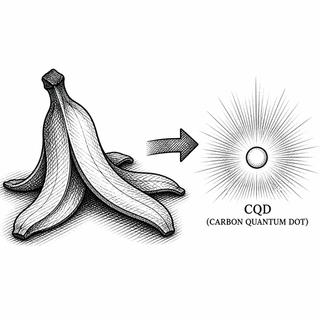
The paper, indexed in PubMed as “Green synthesis of biomass carbon nanodots and their multifunctional applications,” reviews how carbon quantum dots, often shortened to CQDs, can be made from biomass sources such as food waste, agricultural byproducts, and forestry residues. These particles are very small, fluorescent, and potentially biocompatible. In other words, they glow, they can be made from things we usually throw away, and they may play nicely with biological systems. For a physician used to seeing innovation arrive wrapped in expensive packaging and a billing code, this is almost suspiciously wholesome.
What Are Carbon Quantum Dots?
Carbon quantum dots are nanoscale carbon-based particles with unusual optical properties. “Nanoscale” means they are measured in billionths of a meter, which is less “tiny speck” and more “the speck is wearing an invisibility cloak.” Their appeal comes from the fact that they can fluoresce: shine light on them, and they emit light back.
That behavior makes them useful as probes, sensors, and functional materials. Depending on how they are made, CQDs may emit different colors, interact with metal ions, respond to biological molecules, or help move charge in optoelectronic devices.
Traditional nanomaterials can be powerful, but some raise concerns about toxicity, complicated manufacturing, cost, and environmental impact. CQDs offer a more approachable alternative, especially when made from renewable sources. The review focuses on biomass-derived CQDs, which sit at the intersection of nanotechnology, green chemistry, and the satisfying human desire to make yesterday’s scraps useful before they begin judging us from the back of the refrigerator.
The Green Chemistry Appeal
The “green synthesis” part matters. In chemistry, greener production usually means reducing toxic reagents, lowering energy demands when possible, using renewable materials, and generating less waste. Biomass is attractive because it is abundant, cheap, and chemically rich. Agricultural residues, food waste, and forestry byproducts contain carbon, oxygen, nitrogen, and other elements that can help form CQDs.
This is the irony at the heart of the field: the same waste stream that might otherwise rot, burn, or be discarded can become a platform for advanced fluorescent materials. That does not mean every orange peel is destined to become a biosensor, but it does mean the raw material problem looks less grim than it does for many high-tech substances.
The review highlights several major synthesis approaches.
Hydrothermal treatment uses heat and pressure in water to carbonize biomass into nanodots. It is popular because it is relatively simple and can work with many starting materials.
High-temperature pyrolysis uses intense heat in limited oxygen to break down biomass and restructure it into carbon-rich particles. It is effective, though the energy demands and process control can be less cuddly.
Microwave-assisted synthesis uses microwave energy to heat the material quickly and efficiently. Think of it as the lab version of reheating soup, except the soup becomes fluorescent nanomaterial and nobody asks whether you covered the bowl.
Each method affects the size, surface chemistry, structure, and optical behavior of the final CQDs. That is the technical core of the review: the recipe changes the particle, and the particle’s properties determine what it can do.
Why Physicians Should Care
At first glance, this may sound more like materials science than medicine. Fair enough. Nobody is prescribing carbon nanodots at discharge. But the biomedical implications are real.
One major application is fluorescent sensing. Biomass-derived CQDs can be engineered to detect metal ions and vitamins. In clinical and environmental contexts, sensitive detection tools matter. Metal ions can be relevant in toxicology, water safety, industrial exposure, and biological monitoring. Vitamins are central to nutrition and metabolism. A cheap, fluorescent sensor made from renewable materials could be useful in low-resource settings, point-of-care testing, or environmental health surveillance.
Another application is bioimaging. Because CQDs can fluoresce and may have good biocompatibility, researchers are studying them as probes for visualizing cells or tissues. Imaging is one of those fields where the medical system constantly wants sharper, safer, cheaper, and more specific tools, preferably all at once, because apparently radiology was not given enough impossible assignments already.
The review also discusses optoelectronic devices. CQDs may serve as functional layers that improve device performance, including in light-emitting or photovoltaic systems. This is not directly bedside medicine, but better sensors, displays, energy devices, and diagnostic platforms can eventually influence healthcare technology.
Then there is information encryption and anti-counterfeiting. Fluorescent inks made from CQDs could help protect documents, products, or packaging. In medicine, counterfeit drugs and devices are not theoretical annoyances. They are a real global safety problem. A sustainable fluorescent security ink is not going to solve counterfeit therapeutics by itself, but it could become one more tool in a broader authentication system.
The Catch, Because Science Has Rent To Pay
As promising as biomass-derived CQDs sound, the review is clear that the field still has unresolved problems.
One challenge is emission color. Many CQDs tend to emit in a limited range, often toward blue or green wavelengths. For imaging, sensing, and device applications, broader and more tunable emission colors would be useful. Red and near-infrared emission, for example, can be especially attractive in biological imaging because those wavelengths may penetrate tissue better and generate less background interference.
Another challenge is mechanism. Researchers still do not fully understand how CQDs form during synthesis or exactly why they luminesce the way they do. Surface states, particle size, molecular fluorophores, dopants, and structural defects may all contribute. That is a long way of saying the dots glow, but the dots are not yet returning our calls with a full explanation.
This matters because reproducibility depends on understanding. If two labs use slightly different biomass sources, temperatures, times, or purification steps, they may get CQDs with different properties. Biomass is chemically variable by nature. An apple peel, a corn stalk, and a sawdust sample are not interchangeable just because they all had a previous life outside a laboratory.
Scaling up also brings practical questions. Can these methods produce uniform CQDs in large batches? Can purification be standardized? Can toxicity be assessed rigorously? Can manufacturing remain genuinely green once production leaves the bench and enters industry? These are not glamorous questions, but they are the questions that decide whether a technology becomes useful or merely well-lit in a journal figure.
The Real-World Potential
The most interesting part of this research area is not simply that CQDs glow. Plenty of things glow, including my pager at 3 a.m., though with less scientific charm. The exciting part is the combination: low-cost raw materials, tunable optical behavior, possible biocompatibility, and wide application range.
If the field matures, biomass-derived CQDs could contribute to affordable diagnostic sensors, safer imaging probes, sustainable electronic materials, and anti-counterfeit technologies. They could also help shift nanomaterial production away from more resource-intensive or toxic pathways.
For medicine, the timeline is not immediate. A fluorescent probe made from biomass still needs careful characterization, toxicity testing, validation, regulatory review, and proof that it performs better than existing options. The road from “interesting nanomaterial” to “clinically useful tool” is long, paved, repaved, and occasionally blocked by a committee.
Still, the direction is appealing. Medicine increasingly needs technologies that are not only effective but also scalable, affordable, and environmentally sane. Biomass-derived CQDs are not a cure, not a device, and not a diagnostic test yet. They are a materials platform. But platforms matter. They are where future tools begin.
A Small Glow From a Big Waste Problem
The charm of this review is that it reframes waste as feedstock. Agricultural residues and food waste are usually discussed in the language of burden: disposal, emissions, spoilage, inefficiency. Here, they become raw material for nanoscale systems with real technological promise.
That does not mean we should start hoarding coffee grounds in the name of translational science. Please do not bring a bag of “future nanodots” to clinic. But it does suggest that sustainable materials research is becoming more imaginative, and that the boundary between environmental responsibility and biomedical innovation may be thinner than we assumed.
Biomass carbon nanodots are still an emerging field, with plenty of mechanistic fog and engineering homework ahead. But the basic premise is hard not to admire: take what we throw away, convert it into something that glows, and use that glow to sense, image, protect, or power.
For once, the trash may actually have a point.
This blog post discusses research findings and should not be taken as medical advice. If you have concerns about medical testing, imaging, environmental exposure, or nutritional deficiency, please consult a healthcare provider. Research discussed here represents ongoing scientific investigation and clinical validation is still in progress.
All images used in this post are decorative illustrations only and do not represent or reflect the accuracy, reality, or correctness of the referenced research.
Primary Source: Green synthesis of biomass carbon nanodots and their multifunctional applications. PubMed Record ID 41759983. https://pubmed.ncbi.nlm.nih.gov/41759983/