
Picture this: you're trying to quit opioids. Your body, which has spent months or years rewiring itself around these drugs, is now throwing the mother of all tantrums. You're sweating, shaking, nauseated, anxious, and every cell in your body is screaming for the one thing you're trying to avoid. Oh, and you can't sleep. Fun times.
Opioid withdrawal isn't just uncomfortable - it's one of the main reasons people relapse. The symptoms peak in the first few days, and they are brutal enough that many people decide the recovery isn't worth it and go right back to using. It's like trying to climb Everest in flip-flops while someone plays the worst playlist in history directly into your brain.
So what if there was a drug-free way to take the edge off? Enter transcutaneous auricular neurostimulation, or tAN - which is a fancy way of saying "we're going to gently zap your ear with electricity and see if it helps."
The Ear: Your Body's Unexpected Control Panel
Before you dismiss this as woo-woo nonsense, let's talk about why the ear matters.
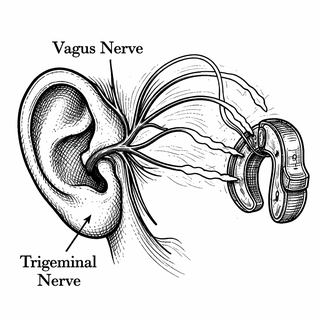
Your external ear - that fleshy thing on the side of your head you probably haven't thought about since your last haircut - is surprisingly well-connected to your nervous system. It's got branches of both the vagus nerve and the trigeminal nerve running through it. These aren't just any nerves; the vagus nerve is the main highway of your parasympathetic nervous system, the "rest and digest" part that calms you down. The trigeminal nerve connects to the brainstem and all sorts of higher brain regions.
When you stimulate these nerves through the skin of the ear, you're essentially sending signals up to the brain that say "hey, maybe chill out a bit." The signals travel to the nucleus tractus solitarius in the brainstem, which then forwards them to regions like the amygdala and hypothalamus - areas involved in stress, emotion, and autonomic function.
Opioid withdrawal is essentially your autonomic nervous system going haywire. It's stuck in fight-or-flight overdrive. By promoting parasympathetic activity through auricular stimulation, you might be able to restore some balance. Plus - and this is the really cool part - there's evidence that this kind of stimulation triggers the release of endogenous opioids (your body's own natural painkillers) and endorphins (Miranda & Taca, 2018, J Neurol Sci; DOI: 10.1016/j.jns.2017.10.004).
Your body is basically running its own internal opioid system. We're just giving it a nudge.
The Sparrow: A Bird That Eases Suffering
Spark Biomedical, a Texas-based company, developed the Sparrow Therapy System - a wearable device that delivers tAN therapy through an earpiece worn on and around the left ear. It looks a bit like a fancy Bluetooth earpiece designed by someone who watched too much Star Trek, but the tech inside is genuinely sophisticated.
The device delivers mild electrical pulses targeting specific auricular regions innervated by the vagus and trigeminal nerves. It's non-invasive, drug-free, and needle-free - which matters a lot when you're dealing with a population that may have complicated relationships with needles.
The Sparrow Therapy System received FDA clearance in January 2021 for use as an adjunctive treatment for opioid withdrawal symptoms in adults. This means it's not meant to replace medications like buprenorphine or methadone - it's meant to work alongside them or help during the acute phase when symptoms are at their worst.
The Clinical Evidence: Not Just Wishful Thinking
The Sparrow has something that many alternative therapies lack: actual clinical trial data.
In a prospective, randomized, controlled trial, 26 participants with opioid use disorder were enrolled and monitored over 12 months. The study used the Clinical Opiate Withdrawal Scale (COWS) - an 11-point assessment that measures symptoms like pupil dilation, sweating, tremor, restlessness, and GI distress.
The results? Participants achieved clinically meaningful reductions in COWS scores (greater than 15%) within the first 60 minutes of therapy. By day three, 100% of participants who continued treatment had sustained meaningful reductions in withdrawal symptoms (Gazi et al., 2022, Drug Alcohol Depend; DOI: 10.1016/j.drugalcdep.2022.109515).
Perhaps more importantly from a treatment perspective, 9 out of 10 participants who completed detox accepted a referral to continue substance use disorder treatment. That's huge. Getting through the acute withdrawal phase is only half the battle - what really matters is whether people stay engaged with treatment afterward.
The Next Generation: Sparrow Ascent
In July 2023, Spark's second-generation device, the Sparrow Ascent, received FDA clearance. This one was designed for more flexibility - not just for inpatient clinical settings but for use in various treatment environments.
The Sparrow Ascent is particularly notable because it's backed by Level 1 clinical evidence - meaning double-blind, randomized controlled trial data. That's the gold standard in clinical research, the stuff that separates "this seems to work" from "we have rigorous evidence this works."
What does the device actually feel like? Users report a mild tingling or buzzing sensation in the ear - nothing painful, just noticeable. The therapy can be applied continuously during the acute withdrawal phase, typically for up to five days.
Why This Matters for the Opioid Crisis
Let's zoom out for a second. The United States is in the middle of an opioid crisis that has killed more than 600,000 people since 1999. More than 81,000 overdose deaths occurred in the 12 months ending in May 2020 alone - the highest number ever recorded in a single year.
We have effective medications for opioid use disorder - methadone, buprenorphine, naltrexone. But not everyone can access them, not everyone tolerates them well, and the gap between "deciding to quit" and "getting stabilized on medication" remains dangerous. People relapse during that gap. People die during that gap.
A device that can reduce withdrawal symptoms during those critical first hours and days - without requiring more drugs - could be a game-changer. It's not going to solve the opioid crisis on its own. Nothing will. But it's another tool in the toolkit, and right now, we need every tool we can get.
The Ongoing Research
Spark isn't resting on its laurels. Current studies include a University of Cincinnati trial (funded by a $2.1 million NIDA grant) testing the device in patients with both opioid use disorder and PTSD. They're also studying neonatal applications - whether this technology can help babies born dependent on opioids.
The Skeptic's Corner
Some limitations deserve mention: the mechanism isn't fully understood, sample sizes have been modest, and this is an adjunctive therapy - not a standalone cure. The device complements, not replaces, evidence-based treatments like medication-assisted therapy.
The Bottom Line
Your ear is weirder and more useful than you probably thought. By stimulating specific nerves in the external ear, we can apparently influence brain regions involved in stress, emotion, and autonomic function - and that influence might help people get through the hellscape of opioid withdrawal.
The Sparrow represents a new category of treatment: drug-free, non-invasive neuromodulation for substance use disorders. It won't work for everyone, and it won't work alone. But for people trying to escape the grip of opioids, having something - anything - that makes those first terrible days more bearable might be the difference between relapsing and reaching the other side.
And that difference? That's life and death.
Disclaimer: This blog post is for informational purposes only and does not constitute medical advice. Opioid use disorder is a serious medical condition that requires professional treatment. If you or someone you know is struggling with opioid addiction, please consult qualified healthcare providers. The views expressed are those of the author. Images and graphics are for illustrative purposes only and do not depict actual medical devices, procedures, mechanisms, or research findings from the referenced studies.