
You do it roughly 600 times a day without thinking about it. Eating a sandwich, sipping coffee, even swallowing your pride when your colleague's terrible hypothesis turns out to be correct - your esophagus handles all of it with the reliability of a Swiss train schedule.
Unless it doesn't.
For the estimated 1 in 100,000 people diagnosed with achalasia each year, that effortless act becomes a nightmare. The lower esophageal sphincter - basically the muscular bouncer at the door between your esophagus and stomach - decides to lock up and refuse entry. Food gets stuck. Liquids back up. Dinner becomes a negotiation rather than a pleasure. And if you've ever tried to reason with a bouncer, you know how well that goes.
What Exactly Goes Wrong?
Achalasia belongs to a family of conditions called esophageal motility disorders. In a healthy esophagus, coordinated waves of muscle contractions (called peristalsis) push food downward like a well-choreographed conga line. In achalasia, the nerve cells controlling those muscles degenerate. The result? The lower esophageal sphincter can't relax properly, and the esophagus loses its ability to squeeze food along.
Patients describe it as feeling like food is "stuck in their chest." Some regurgitate undigested meals hours after eating. Weight loss, chest pain, and aspiration pneumonia can follow. It's not just uncomfortable - it significantly erodes quality of life. Imagine dreading every meal. Now imagine that going on for months before someone figures out what's wrong.
Enter POEM: The Procedure That Changed Everything
Here's where modern medicine gets genuinely cool. Per-oral endoscopic myotomy - or POEM, because gastroenterologists apparently love a good acronym - is a minimally invasive procedure that has transformed how we treat achalasia since Dr. Haruhiro Inoue first described it in 2010 (Inoue et al., 2010, DOI: 10.1055/s-0029-1244080).
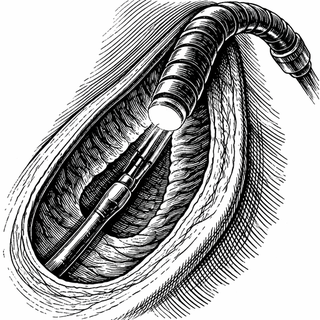
The concept? A flexible endoscope goes in through the mouth (no external incisions), creates a tunnel within the esophageal wall, and then the surgeon cuts the problematic muscle fibers that are causing the obstruction. The tunnel is sealed up, and the patient typically goes home within a day or two. It's like performing plumbing repairs from the inside of the pipe - clever, right?
A landmark 2019 randomized trial published in the New England Journal of Medicine showed that POEM was non-inferior to laparoscopic Heller myotomy - the previous surgical gold standard - for treating achalasia, with comparable symptom relief at two years (Werner et al., 2019, DOI: 10.1056/NEJMoa1811845). Multiple systematic reviews and meta-analyses have since reinforced POEM's strong safety profile and clinical effectiveness, with technical success rates exceeding 95% in experienced hands (Akintoye et al., 2016, DOI: 10.1016/j.gie.2016.03.1474).
But here's the thing about any procedure: the tools matter. A lot.
The Speedboat UltraSlim - A New Instrument Enters the Chat
Which brings us to a new prospective registry trial (NCT07496840) evaluating the Speedboat UltraSlim™ surgical device during POEM procedures. This isn't testing whether POEM works - we already have solid evidence for that. Instead, it's asking a more specific question: how does this particular device perform when used for POEM, and what are the real-world outcomes?
The Speedboat UltraSlim is designed to be a multifunctional endoscopic tool that can cut, coagulate, and dissect - all in one device. Think of it as the Swiss Army knife of endoscopic surgery. For POEM procedures, where the operator needs to create a submucosal tunnel, dissect muscle fibers, and maintain hemostasis (keeping bleeding under control), having a single device that handles multiple tasks could streamline the workflow significantly.
The registry will track patients who are already scheduled for POEM as part of their standard clinical care. No one is being randomized. No one is receiving an experimental treatment. The researchers are simply collecting data on how things go - procedural details, technical success, symptom improvement, and any adverse events - at 30 days, 3 months, 6 months, and up to one year.
Why does that matter? Because real-world data from registries fills a gap that randomized controlled trials sometimes miss. RCTs tell us what happens under ideal conditions with carefully selected patients. Registries tell us what happens on a regular Tuesday afternoon when the patient has three comorbidities and the attending hasn't had lunch yet.
Why Should You Care?
Fair question. Here's why this kind of work matters beyond the walls of an endoscopy suite.
First, achalasia is a lifelong condition. There's no cure - only management. Anything that makes the primary treatment safer, faster, or more reproducible directly benefits patients who will need repeat interventions over their lifetime. A more efficient device could mean shorter procedure times, reduced complication rates, and broader adoption of POEM at centers that currently lack the specialized equipment.
Second, esophageal motility disorders extend well beyond achalasia. Conditions like diffuse esophageal spasm and jackhammer esophagus (yes, that's the real name, and yes, it's as unpleasant as it sounds) are also treated with POEM. Data from this registry could inform device use across the entire spectrum.
Third, and I think most compellingly, this registry represents the kind of evidence-gathering that makes medicine better incrementally. Not every advance comes wrapped in a headline-grabbing breakthrough. Sometimes progress looks like a group of clinicians carefully documenting what happens with a new tool, sharing that data, and letting the field learn from it. Recent meta-analyses of POEM outcomes emphasize that procedure-specific tools and techniques continue to evolve, and that real-world registries are essential for tracking this evolution (Repici et al., 2019, DOI: 10.1053/j.gastro.2019.01.048).
The Bottom Line
For the person sitting in a GI clinic right now, frustrated because their third attempt at eating pasta this week ended in regurgitation, studies like this represent hope that the procedure designed to help them is getting better, one data point at a time. The Speedboat UltraSlim registry won't make headlines the way a miracle drug might. But it's exactly the kind of unglamorous, methodical work that pushes the field forward.
And honestly? The esophagus has had it too easy for too long. It's about time we gave it better tools to work with.
Trial Details:
- ClinicalTrials.gov ID: NCT07496840 (Table View)
- Study Type: Prospective Registry (Observational)
- Population: Patients with achalasia or esophageal motility disorders undergoing POEM
References:
1. Inoue H, et al. Per-oral endoscopic myotomy (POEM) for esophageal achalasia. Endoscopy. 2010;42(4):265-271. DOI: 10.1055/s-0029-1244080
2. Werner YB, et al. Endoscopic or surgical myotomy in patients with idiopathic achalasia. N Engl J Med. 2019;381(23):2219-2229. DOI: 10.1056/NEJMoa1811845
3. Akintoye E, et al. Peroral endoscopic myotomy: a meta-analysis. Gastrointest Endosc. 2016;83(6):1101-1109. DOI: 10.1016/j.gie.2016.03.1474
4. Repici A, et al. POEM and Heller myotomy outcomes for achalasia. Gastroenterology. 2019;156(5):1426-1437. DOI: 10.1053/j.gastro.2019.01.048
Disclaimer: This blog post is for informational and educational purposes only and does not constitute medical advice. The clinical trial discussed is an observational registry and does not involve experimental interventions. Always consult a qualified healthcare provider regarding diagnosis and treatment options. The views expressed here are those of and do not necessarily reflect the positions of the trial sponsors or institutions involved.