
The research team behind this study was chasing one of those maddening medical problems that refuses to behave nicely: how do you repair a big bone defect when bone-building and blood-vessel-building need to happen together, on cue, and in the right place? That is the biological equivalent of trying to coordinate a construction crew and the city utilities department without anyone missing a memo. So they went looking for a molecular middle manager, something that could help osteogenesis, which is bone formation, and angiogenesis, which is blood vessel formation, stay in sync. What they found was SERPINE1, and honestly, this is where the paper starts feeling less like routine lab work and more like a very tidy scientific plot twist.
Why big bone defects are so hard to fix
Bone can heal remarkably well, right up until it really cannot. Small fractures often mend with time and proper care, but critical-sized defects are a different beast. These are large gaps in bone that the body struggles to repair on its own. The problem is not just making new bone. New tissue also needs a blood supply, because cells are not magic and cannot thrive on vibes alone.
That means successful regeneration depends on timing. Bone-forming cells need to show up, specialize, and lay down mineralized matrix. Blood vessels need to grow in and supply oxygen, nutrients, and all the molecular support that turns a repair attempt into an actual rebuild. If those two processes drift out of step, healing can stall.
The unexpectedly exciting starring role of hDPSCs
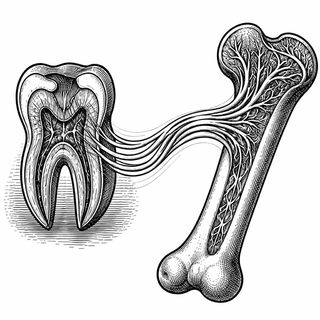
The cells in this study are hDPSCs, or human dental pulp stem cells. Yes, dental pulp. As in the soft tissue inside teeth. Stem cell biology has been quietly pulling off this sort of thing for years, but it still feels a little outrageous that cells associated with teeth may help solve a bone regeneration problem. Biology loves a weird side quest.
These cells are attractive for regenerative medicine because they can differentiate into multiple cell types and seem especially promising for tissue repair. The team wanted to know whether there was a gene that rises to the top during both bone-related and blood-vessel-related differentiation in these cells.
So they used temporal transcriptomic profiling, which is a fancy but useful way of saying they tracked gene expression changes over time while hDPSCs were being pushed toward osteogenic and angiogenic fates. Instead of taking a single snapshot, they watched the molecular movie.
SERPINE1 steps into the spotlight
Among the genes they screened, SERPINE1 stood out because it was consistently upregulated during both differentiation pathways. That alone is interesting. But then the researchers actually tested whether SERPINE1 was doing important work or just hanging around looking impressive.
Wait, it gets better.
When they increased SERPINE1 expression in hDPSCs, the cells showed stronger osteogenic behavior. The study reports increased alkaline phosphatase activity, more mineralized nodule formation, and higher expression of bone-associated markers including RUNX2, COL-1, and OPN. In plain English: the cells looked more ready and more able to build bone.
At the same time, SERPINE1 also boosted angiogenic potential. The researchers saw higher expression of VEGFR2 and CD31, two markers associated with vascular development and endothelial activity. That matters because a bone repair strategy that only makes bone and ignores blood vessels is like building a neighborhood with no roads, pipes, or electricity. Great walls, bad logistics.
The really clever part: the cells may help by sending signals
One of the most interesting findings is that conditioned media from SERPINE1-overexpressing hDPSCs promoted endothelial tube formation. That suggests a paracrine effect, meaning the stem cells may be helping nearby blood-vessel-forming cells by releasing signaling molecules into their environment.
This is the kind of detail that makes regenerative medicine so fascinating. The cells are not just becoming something useful themselves. They may also be acting like tiny biochemical project managers, nudging surrounding cells toward the right job at the right moment. Very polite. Very efficient.
And the reverse experiment strengthened the case. When the team knocked down SERPINE1, those osteogenic and angiogenic effects were suppressed. So this was not just a one-way overexpression stunt. Reducing SERPINE1 made the whole coordination act worse, which supports the idea that this protein is functionally involved in both processes.
A scaffold enters the scene, because cells need a home
The study did not stop at cell culture. The researchers also tested a delivery system made of hydroxyapatite and chitosan microspheres, referred to as HA/CS MS, loaded with SERPINE1 and paired with the stem cell strategy.
That combination matters because tissue engineering usually needs more than a good cell and a good gene target. It also needs a material scaffold that is biocompatible, supports growth, and releases signals in a controlled way. The reported scaffold performed well on those fronts, showing biocompatibility and controlled release properties.
Then came the in vivo test: a rat critical-sized calvarial defect model. In other words, the team created a difficult-to-heal skull bone defect and asked whether their SERPINE1-loaded microsphere approach could improve regeneration.
The SERPINE1-DPSCs/MS group outperformed the comparison groups at 4 weeks. According to the summary, this included better bone volume fraction, thicker trabeculae, and increased CD31-related vascularization. That is exactly the kind of dual outcome you want to see if your whole theory is that bone growth and vessel growth should be coordinated, not treated like unrelated chores assigned on different clipboards.
Why this paper feels bigger than one protein
What makes this study so compelling is that it frames bone regeneration as a choreography problem rather than a single-material problem. For years, plenty of approaches have tried to improve scaffolds, growth factors, or stem cell performance one piece at a time. This paper leans into the idea that successful healing depends on coordination.
SERPINE1 appears to sit at an especially interesting intersection. If future work confirms and extends these findings, it could help researchers design therapies that do not just push harder on bone formation, but instead get the whole repair environment working together more intelligently.
That said, this is still preclinical research. A rat skull defect model is useful, but it is not the final word on human treatment. Questions remain about safety, durability, dosing, manufacturing, and how well this strategy would translate to larger animals or human patients. Science is rude like that. The moment you find something exciting, it hands you a longer to-do list.
Why I cannot stop thinking about it
This study takes a problem that sounds almost impossibly complex, the timing and coordination of vascularized bone repair, and identifies a plausible molecular hub that may help organize the whole process. Then it pairs that finding with a biomaterial delivery system and shows encouraging results in vivo. That is a satisfying amount of mechanistic insight and practical application packed into one paper.
And maybe the most delightful part is that the story runs through human dental pulp stem cells. A molecule in tooth-derived stem cells helping orchestrate bone and blood vessel regeneration is exactly the kind of biological twist that reminds me why this field is so addictive. The body is less like a machine with neat compartments and more like an overachieving group project where everyone is texting in three chats at once.
If SERPINE1 keeps holding up under further testing, this line of work could point toward smarter ways to treat difficult bone defects, not by brute force, but by getting the right regenerative conversations happening at the right time.
This blog post discusses research findings and should not be taken as medical advice. If you have concerns about bone healing or bone defects, please consult a healthcare provider. Research discussed here represents ongoing scientific investigation and clinical validation is still in progress.
All images used in this post are decorative illustrations only and do not represent or reflect the accuracy, reality, or correctness of the referenced research.
Primary Source: The Role of SERPINE1 in Coordinating Osteogenesis and Angiogenesis of hDPSCs for Bone Regeneration. PubMed. https://pubmed.ncbi.nlm.nih.gov/42003429/