
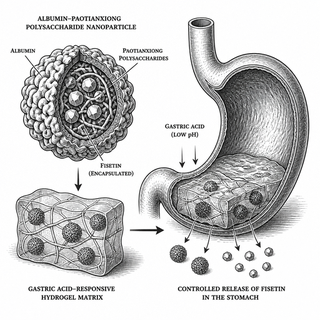
Making a drug delivery system is a bit like trying to bake a soufflé inside a thunderstorm. You need the ingredients to behave, the structure to hold, and the whole thing to arrive at the right place before collapsing into a sad puddle. In this study, researchers tried a rather elaborate recipe: fisetin tucked into albumin-based nanoparticles, stabilized with Paotianxiong polysaccharides, then packed into a gastric acid-responsive hydrogel designed to release its cargo in the stomach.
That is a lot of kitchen equipment for one molecule. But the problem they are tackling is real.
Long-term excessive alcohol intake can damage the stomach lining, contributing to gastritis, ulcers, bleeding, and inflammation. Fisetin, a plant-derived flavonoid, has attracted interest because of its antioxidant and anti-inflammatory properties. The catch is that fisetin is not especially cooperative as a drug candidate. It has poor solubility, limited stability, and low bioavailability, which is scientist-speak for “promising on paper, fussy in the body.”
So the question becomes: can better packaging make fisetin more useful?
The Delivery Problem: Fisetin Needs a Better Ride
Fisetin is found in foods such as strawberries, apples, and onions, but eating a fruit salad is not the same as delivering a controlled therapeutic dose to damaged stomach tissue. The digestive tract is not a gentle spa day for delicate compounds. Acid, enzymes, salts, and constant movement can break down or wash away potential treatments before they do much good.
That is where drug delivery systems come in. Instead of simply sending fisetin into the gastrointestinal chaos and hoping it files the correct paperwork, the researchers built a delivery platform around it.
Their system has two main parts:
- Albumin-Paotianxiong polysaccharide nanoparticles loaded with fisetin
- A sodium alginate and calcium-based hydrogel that responds to gastric acid
Albumin is a protein often used in drug delivery because it can form nanoparticles and carry hydrophobic molecules. But albumin nanoparticles can be unstable under changing pH and ionic conditions, which is inconvenient when the intended destination is the stomach, also known as the body’s acid-themed escape room.
The clever twist here is the use of Paotianxiong polysaccharides, or PP, as a stabilizer.
Why Add Paotianxiong Polysaccharides?
Polysaccharides are long carbohydrate molecules that can influence viscosity, stability, gel formation, and interactions with proteins. In this study, PP was used to help stabilize albumin-based nanoparticles made through a pH-driven “green” method.
That green-method detail is worth appreciating. A pH-driven approach can avoid harsher solvents or processing conditions, which is appealing for food, pharmaceutical, and biomedical applications. This does not automatically make the system clinically practical, but it does suggest the researchers were thinking about manufacturability and biocompatibility rather than building a beautiful lab-only contraption that works only on Tuesdays under moonlight.
According to the abstract, adding PP helped the nanoparticles maintain uniform particle size and good dispersibility. More importantly, PP improved stability under acidic pH conditions and varying ionic concentrations. For an oral delivery system targeting the stomach, that is not a minor perk. That is the difference between “structured delivery vehicle” and “molecular confetti.”
Then Comes the Hydrogel
Nanoparticles alone may improve fisetin’s solubility and stability, but they still need to stay in the stomach long enough to matter. The researchers therefore embedded the fisetin-loaded albumin-PP nanoparticles into an acid-responsive hydrogel made with sodium alginate and calcium.
Alginate-based hydrogels are widely used in controlled release systems because they can form gel networks and respond to environmental conditions. In this case, the goal was gastric retention and sustained drug release. In simpler terms: make the treatment hang around in the stomach and release fisetin gradually rather than dumping it all at once like an overenthusiastic salt shaker.
That sustained-release idea is especially relevant for gastric injury. Damaged stomach tissue may benefit from prolonged local exposure to protective compounds, assuming the compound actually reaches the injury site in useful concentrations.
What Makes This Study Interesting?
The intriguing part is not just “fisetin may help alcohol-related gastric injury.” That idea has been floating around in the broader flavonoid research world for a while. The more interesting piece is the engineering: the study tries to solve several delivery problems at once.
Fisetin is poorly soluble? Put it into albumin-based nanoparticles.
Albumin nanoparticles are not stable enough in stomach-like conditions? Add Paotianxiong polysaccharides.
Nanoparticles may not remain in the stomach long enough? Load them into an acid-responsive hydrogel.
This layered strategy is scientifically sensible. It shows an awareness that biological effectiveness often depends less on whether a compound has a nice mechanism in a dish and more on whether it survives the trip through the body’s obstacle course.
The use of PP as a stabilizer also adds a natural-product angle that could be useful if further work confirms safety, consistency, and scalability. Natural polysaccharides can be versatile, though they also bring their own headaches, including batch variability and complex characterization. Nature is generous, but she is not always GMP-certified.
Let’s Pump the Brakes
This is where the skeptical science communicator in me gently lowers the confetti cannon.
Based on the supplied abstract, this appears to be a preclinical formulation and delivery study. That means we should not treat it as evidence that people with alcohol-related stomach injury should take fisetin, Paotianxiong polysaccharides, albumin nanoparticles, alginate hydrogels, or any DIY combination of the above. Please do not turn your kitchen into a nanoparticle facility. Your blender has been through enough.
Several big questions remain.
First, how well does this system perform in living organisms compared with simpler fisetin formulations? Improved stability and release behavior are useful, but the real test is whether the delivery system meaningfully reduces tissue injury, inflammation, oxidative stress, or bleeding risk in a validated model.
Second, what is the safety profile of the full formulation? Albumin, polysaccharides, alginate, calcium crosslinking, and fisetin may each have plausible safety arguments, but combinations can behave differently. Dose matters. Release kinetics matter. Local irritation matters.
Third, how reproducible is the polysaccharide component? Plant-derived polysaccharides can vary depending on source, extraction method, purification, and storage. If PP is doing important stabilization work, its chemistry needs to be tightly defined.
Fourth, alcohol-related gastric injury in humans is messy. It can involve drinking patterns, nutrition, medications such as NSAIDs, Helicobacter pylori infection, liver disease, and other health factors. A neat delivery system may help address one pathway, but it will not magically simplify the clinical reality.
What Would Make This More Convincing?
The strongest next steps would include detailed animal studies, comparisons against free fisetin and non-PP nanoparticle controls, dose-response testing, and careful histological analysis of gastric tissue. Biomarkers of oxidative stress and inflammation would also help clarify whether the formulation is doing more than simply existing elegantly in a beaker.
Longer-term safety testing would be needed too, especially if the hydrogel is meant for repeated use. A gastric-retentive material should be helpful, not clingy in the way of a houseguest who brought three suitcases.
Eventually, if results remain promising, researchers would need to show that the formulation can be produced consistently and stored reliably. Drug delivery systems often look heroic in early lab studies, then meet the logistical brick wall of scale-up, regulation, and real-world dosing.
The Takeaway
This study presents a thoughtful delivery strategy for a difficult therapeutic target: protecting the stomach from alcohol-induced injury using fisetin, a compound with biological promise but practical limitations. The combination of albumin-PP nanoparticles and an acid-responsive hydrogel is a clever attempt to improve solubility, stability, gastric retention, and sustained release.
That said, this is not a clinical solution yet. It is a formulation platform with promising features, not a proven treatment. The science is interesting because it addresses real delivery barriers rather than just waving at fisetin’s antioxidant properties from across the room.
For now, the most reasonable response is cautious interest. The recipe is clever. The ingredients make sense. But before anyone serves this as medicine, it needs a lot more testing outside the controlled kitchen of the laboratory.
This blog post discusses research findings and should not be taken as medical advice. If you have concerns about alcohol-related gastric injury, gastritis, ulcers, or gastric bleeding, please consult a healthcare provider. Research discussed here represents ongoing scientific investigation and clinical validation is still in progress.
All images used in this post are decorative illustrations only and do not represent or reflect the accuracy, reality, or correctness of the referenced research.
Primary Source: Paotianxiong polysaccharides as a stabilizer for protein nanoparticles and construction of an enhanced gastric acid-responsive hydrogel for delivery of fisetin to alleviate alcoholic gastric injury. PubMed Record 41506097. https://pubmed.ncbi.nlm.nih.gov/41506097/