
If I told you that a flickering light could one day help treat Alzheimer's disease, you'd probably look at me the way Marty McFly looked at Doc Brown when he said he needed 1.21 gigawatts. Sounds ridiculous. Sounds impossible. Sounds like someone watched too many sci-fi movies on a Saturday night.
But here's the thing - researchers at MIT are dead serious about it. And their new pilot study (NCT07496918) is pushing this bizarre-sounding idea closer to reality than you might think.
The 40 Hz Problem (or, Why Your Brain Hums Like a Refrigerator)
Let's back up. Your brain produces electrical oscillations - rhythmic patterns of neural activity that hum along at different frequencies depending on what you're doing. One particularly interesting frequency is 40 Hz, which falls in the "gamma" range. Gamma oscillations are associated with higher cognitive functions like attention, memory, and perception. Think of them as the orchestra conductor keeping all the sections of your brain playing in sync.
In people with Alzheimer's disease, these gamma oscillations are disrupted. The conductor has basically left the building, and the violins are playing a completely different piece than the percussion section. Research over the past decade has shown that this isn't just a symptom of the disease - it might actually be part of what makes things worse. Reduced gamma activity has been linked to the buildup of amyloid-beta plaques and tau tangles, the hallmark villains of Alzheimer's pathology. If Alzheimer's were a Marvel movie, gamma disruption would be the henchman nobody paid attention to while the audience was watching the big bad amyloid boss.
Enter GENUS: The Brain's DJ
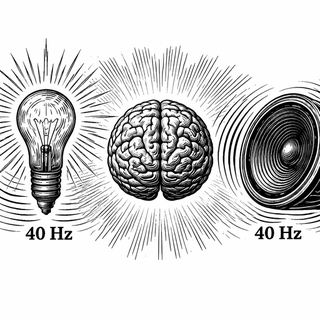
GENUS stands for Gamma ENtrainment Using Sensory stimulation. Developed at MIT's Tsai and Bhatt Labs, the concept is beautifully simple: expose the brain to sensory stimuli - light, sound, or both - flickering and pulsing at exactly 40 Hz. The brain, being the pattern-matching machine it is, "entrains" to that frequency. It starts generating its own gamma oscillations in sync with the external stimulus, like how you can't help but tap your foot when a good beat drops.
The original work, pioneered by Dr. Li-Huei Tsai and colleagues, made a huge splash when mouse studies showed that 40 Hz light exposure could actually reduce amyloid plaques and tau pathology in the brains of Alzheimer's model mice (Iaccarino et al., Nature, 2016; DOI: 10.1038/nature20587). The neuroscience world collectively did a double-take. Light? Reducing plaques? That's like saying listening to the right podcast could clean your apartment.
Since then, the evidence has been building. A 2019 study showed that combining 40 Hz auditory and visual stimulation amplified the effects, reducing amyloid load across broader brain regions, including the prefrontal cortex (Martorell et al., Cell, 2019; DOI: 10.1016/j.cell.2019.02.014). Further work demonstrated that chronic gamma entrainment could preserve neurons, reduce brain inflammation, and even improve performance on memory tasks in mouse models. The mechanism appears to involve activation of microglia - the brain's cleanup crew - essentially giving them a caffeine boost to start clearing out the molecular garbage.
More recent human studies have added fuel to the fire. A 2023 pilot trial showed that Alzheimer's patients who received daily 40 Hz light and sound stimulation for several months showed reduced brain atrophy and maintained better functional connectivity compared to controls (Chan et al., PNAS Nexus, 2022; DOI: 10.1093/pnasnexus/pgac089). And a 2024 systematic review confirmed the growing evidence base for non-invasive brain stimulation approaches in neurodegenerative disease (Manippa et al., Ageing Research Reviews, 2024; DOI: 10.1016/j.arr.2023.102128).
What This New Trial Is Actually Doing
The current pilot study (NCT07496918) is a feasibility evaluation. Participants - cognitively normal, healthy adults - come to MIT for a single-day visit. No overnight stays. No experimental drugs. Just lights, sounds, and a whole lot of brain imaging.
Here's the impressive toolkit the investigators are bringing:
- EEG (Electroencephalogram): Measures electrical activity from the scalp. The bread and butter of brain wave research.
- MEG (Magnetoencephalography): Detects the tiny magnetic fields produced by neural currents. Think of it as EEG's fancier, more spatially precise cousin.
- MRI (Magnetic Resonance Imaging): Provides structural and functional brain images.
- Neuropsychological testing: Standardized cognitive assessments.
- Blood sampling: Looking for biological markers that might change in response to stimulation.
The goal here isn't to cure anyone - it's to answer some fundamental questions. Does GENUS produce measurable biological effects in healthy brains? Is the stimulation safe and well-tolerated? Can they reliably detect entrainment using these imaging tools? It's the "does this thing actually do what we think it does in humans" phase, and honestly, that's exactly the kind of rigorous, unsexy-but-necessary science that separates real breakthroughs from hype.
Why This Matters More Than You Think
Here's the elephant in the room: despite decades of research and billions of dollars spent, we still don't have a treatment that meaningfully stops Alzheimer's disease progression. The recently approved anti-amyloid antibodies (lecanemab, donanemab) offer modest slowing of cognitive decline but come with significant side effects and eye-watering price tags - we're talking tens of thousands of dollars per year, plus regular brain MRI monitoring for potential brain swelling and bleeding. They're a step forward, sure, but it's like upgrading from a horse to a slightly faster horse when what you really need is a car.
GENUS is a completely different beast. It's non-invasive. It's non-pharmacological. A medical device that uses light and sound could potentially be manufactured and distributed at a fraction of the cost of biologic drugs. Imagine a device you use at home daily - like a really boring Netflix show, except it's 40 Hz flickering and it might protect your brain. Okay, maybe that's a terrible pitch for a product, but from a healthcare economics perspective, it's a potential game-changer.
Alzheimer's affects over 55 million people worldwide, and that number is projected to nearly triple by 2050 as populations age. The current global cost of dementia care exceeds $1.3 trillion annually. If a non-invasive, scalable intervention could even modestly slow progression, the impact on patients, families, and healthcare systems would be staggering.
The Healthy Skepticism Section
I should be honest - we're still early in this story. Mouse brains are not human brains (something my graduate advisor reminded me approximately once per hour). The translation from dramatic mouse results to meaningful human outcomes is a graveyard of promising therapies. The mechanism needs more validation. Long-term safety data is limited. And we don't yet know the optimal "dose" - how long, how often, and at what intensity the stimulation needs to be delivered.
But that's exactly why this pilot study matters. It's the next careful step in a process that, if it works, could represent one of the most creative left turns in neurodegenerative disease treatment in a generation. No needles. No infusions. No copay that makes you weep.
Just light, sound, and the brain doing what it does best - syncing up to a rhythm.
I'll be watching this one like it's the season finale of my favorite show. Stay tuned.
The information presented here is for educational purposes and does not constitute medical advice. Clinical trials are experimental by nature, and outcomes are not guaranteed. Always consult a qualified healthcare provider regarding medical conditions and treatments.
Trial Reference: Pilot Study to Evaluate Feasibility of Sensory Stimulation With Gamma Frequency Entrainment. ClinicalTrials.gov Identifier: NCT07496918
Selected References:
1. Iaccarino HF, Singer AC, Martorell AJ, et al. Gamma frequency entrainment attenuates amyloid load and modifies microglia. Nature. 2016;540(7632):230-235. DOI: 10.1038/nature20587
2. Martorell AJ, Paulson AL, Suk HJ, et al. Multi-sensory gamma stimulation ameliorates Alzheimer's-associated pathology and improves cognition. Cell. 2019;177(2):256-271. DOI: 10.1016/j.cell.2019.02.014
3. Chan D, Suk HJ, Jackson BL, et al. Gamma frequency sensory stimulation in mild probable Alzheimer's dementia patients. PNAS Nexus. 2022;1(3):pgac089. DOI: 10.1093/pnasnexus/pgac089
4. Manippa V, Palmisano A, Filardi M, et al. An update on the use of gamma (multi)sensory stimulation for neurological disorders. Ageing Research Reviews. 2024;93:102128. DOI: 10.1016/j.arr.2023.102128