
Scientists set out to find the next big pharmaceutical breakthrough for acute liver injury, a condition with terrifyingly high mortality and basically zero specific treatments. What they found instead was... yams. Yes, the humble root vegetable your grandmother insists on bringing to Thanksgiving just became the unlikely hero of nanomedicine. If this were a Marvel movie, yams would be the character nobody expected to lift Thor's hammer.
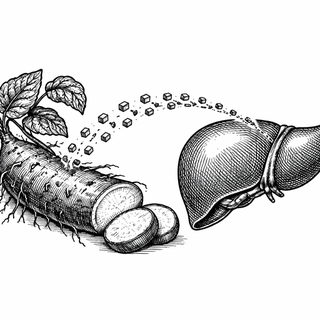
A team of researchers recently published work showing that tiny nanoparticles naturally produced by yam plants can protect the liver from acute chemical damage when taken orally. Not a synthetic drug. Not a billion-dollar biologic. Nanoparticles that a plant just makes on its own, like it's been preparing for this moment its entire evolutionary life.
Wait, Plants Make Nanoparticles?
Here's where things get properly nerdy. Plants, like animal cells, release extracellular vesicles - tiny membrane-bound packages stuffed with bioactive cargo. In the plant world, these are called exosome-like nanoparticles (ELNs), and they're basically biological care packages wrapped in a lipid bilayer membrane. Think of them as the DoorDash of the cellular world, except the delivery is molecular and the tip is free.
The yam ELNs characterized in this study (Li et al., 2025) clock in at an average size of 214.7 nanometers - roughly 400 times smaller than a red blood cell. They have a uniform bilayer membrane structure, and here's the kicker: they're remarkably stable in simulated gastrointestinal fluids. That means you can eat them and they survive the acid bath of your stomach. Your digestive system, which destroys most biological molecules with the enthusiasm of a Sarlacc pit, apparently gives these little guys a pass.
What's Inside the Tiny Package?
The cargo manifest of these yam nanoparticles reads like a biochemistry greatest hits album. They're loaded with:
- Phosphatidylcholine (PC) - the dominant lipid, which plays a major role in cell membrane integrity and liver health
- Antioxidant proteins like GPX1 and GSTP1 - basically the cellular equivalent of firefighters
- microRNAs from the miR159 family - small RNA molecules that can regulate gene expression in recipient cells
This is where it starts feeling like science fiction. A plant is packaging up antioxidant enzymes and gene-regulating RNA into tiny, stomach-proof delivery vehicles. If someone pitched this as a movie script, you'd say it was too ridiculous. Yet here we are.
The Liver Protection Test
To test whether yam ELNs could actually protect a liver, the researchers used a well-established model of acute liver injury: carbon tetrachloride (CCl4) poisoning in mice. CCl4 is nasty stuff - it generates free radicals that overwhelm the liver's antioxidant defenses, triggering a cascade of oxidative damage, inflammation, and cell death. It's essentially the chemical equivalent of setting the liver on fire from the inside.
Mice that received oral yam ELNs before the CCl4 challenge showed significantly lower levels of ALT and AST - the classic blood markers that spike when liver cells are dying. Their MDA levels (a marker of lipid damage from oxidative stress) dropped, while GSH levels (the liver's primary antioxidant) stayed elevated. Histological examination - basically looking at liver tissue under a microscope - confirmed less structural damage.
In plain English: the yam nanoparticles were acting like a biological shield, prepping the liver's defenses before the attack even started. It's the biomedical equivalent of Gandalf showing up and shouting "you shall not pass" at incoming free radicals.
How They Actually Work
The mechanism is genuinely elegant. The researchers used in vivo imaging to track where the nanoparticles go after oral administration, and they home in on the liver like tiny GPS-guided missiles. HepG2 liver cells in culture also gobbled them up efficiently, confirming the uptake isn't just a whole-body phenomenon.
Once inside liver cells, the yam ELNs appear to work through at least two major pathways:
The RNA route: Those miR159 family microRNAs modulate cellular oxidative stress responses. The researchers confirmed this with in vitro experiments showing that the functional RNA cargo is responsible for a significant chunk of the protective effect.
The lipid remodeling route: Using a technique called desorption electrospray ionization mass spectrometry imaging (DESI-MSI) - which is essentially creating a chemical map of the liver tissue - they showed that yam ELNs reshape how glycerophospholipids are distributed throughout the liver. They suppress lipid peroxidation, which is the chain reaction where oxidized lipids damage neighboring lipids like dominoes falling.
Targeted lipidomics analysis sealed the deal, showing that yam ELNs corrected disturbances in glycerophospholipid metabolism and linoleic acid metabolism - two pathways that go haywire during acute liver injury.
Why This Matters Beyond Cool Science
Acute liver injury is a genuine clinical emergency. Drug-induced liver injury, viral hepatitis flares, toxic exposures - these can escalate fast, and treatment options are limited. N-acetylcysteine works for acetaminophen overdose specifically, but for many other causes of ALI, clinicians are largely managing symptoms and hoping the liver regenerates.
The idea that a plant-derived, orally bioavailable, naturally stable nanoparticle could offer prophylactic liver protection is genuinely exciting. The biocompatibility profile is favorable (plants aren't exactly known for producing immunogenic biologics), and the oral route of administration is about as patient-friendly as drug delivery gets.
Plant-derived ELNs from other sources - ginger, grapes, grapefruit - have been explored in recent years for various therapeutic applications, from inflammatory bowel disease to cancer. Yam ELNs now join this growing roster, with the added bonus that yams have a long history in traditional medicine, particularly in East Asian pharmacopeias.
The Reality Check
Before anyone starts blending yams into smoothies as a liver protection protocol (and I know some of you are already reaching for the blender), some important caveats. This is preclinical research in a mouse model. The CCl4 model, while well-validated, is one specific type of liver insult. Whether yam ELNs protect against drug-induced injury, viral hepatitis, or alcohol-related damage remains untested. Dosing, timing, and long-term safety in humans are completely unknown at this stage.
Also, eating a yam is not the same as taking purified yam ELNs. The isolation process concentrates these nanoparticles far beyond what you'd get from dietary consumption. So no, your sweet potato casserole is not a hepatoprotective intervention, no matter how much marshmallow you put on top.
Still, the fundamental concept - that plants naturally produce stable, bioactive nanoparticles that can survive digestion and deliver functional cargo to specific organs - is the kind of finding that opens doors. It suggests that nature has been running a nanomedicine program for millions of years, and we're just now reading the documentation.
This blog post discusses research findings and should not be taken as medical advice. If you have concerns about liver health or acute liver injury, please consult a healthcare provider. Research discussed here represents ongoing scientific investigation and clinical validation is still in progress.
All images used in this post are decorative illustrations only and do not represent or reflect the accuracy, reality, or correctness of the referenced research.
Primary Source: Li et al. Preventive effects and mechanisms of yam exosome-like nanoparticles on acute liver injury. PubMed. 2025. DOI: PMID 41937194