
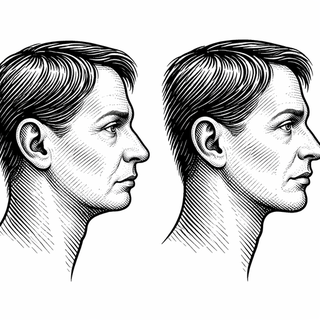
Have you ever looked at an old photograph and thought, "Something about my face just looks... different"? Not the wrinkles. Not the gray hair. Something structural. Something around your jaw, your lips, the whole lower third of your face. You weren't imagining it. Your teeth have been quietly remodeling your face this whole time, and a new clinical trial wants to figure out exactly how.
Wait, My Teeth Change My Face Shape?
Here's a fun party fact that will make you the most popular person at exactly zero parties: the height at which your upper and lower teeth meet - known in the dental world as the occlusal vertical dimension, or OVD - plays a starring role in determining what the bottom half of your face looks like. Think of it as the scaffolding that holds up your lower facial architecture. Change the scaffolding, and the whole building shifts.
When teeth wear down over years of enthusiastic chewing (looking at you, ice-crunchers), or when teeth go missing entirely, the OVD decreases. The chin drifts closer to the nose. The lips fold inward. The corners of the mouth droop. It's the facial equivalent of a building slowly settling into its foundation - except this building is your face, and you kind of live there.
Conversely, when a prosthodontist builds up the bite - say, with crowns, dentures, or implant-supported restorations - the OVD increases. The lower face lengthens. Lips reposition. Patients frequently report looking "younger," which is basically the dental equivalent of a non-surgical facelift, minus the questionable celebrity endorsements.
The Trial: Measuring What Dentists Have Long Suspected
A new clinical trial (NCT07491640) is setting out to do what surprisingly few studies have done rigorously: quantify the dynamic relationship between OVD changes and their effects on lower facial form and lip position. And here's the clever bit - the researchers aren't just looking at one-size-fits-all measurements. They're analyzing how these changes play out differently across gender groups and age groups.
Why does that matter? Because a 25-year-old woman's soft tissue response to a 3mm bite raise is not the same as a 65-year-old man's. Lip thickness, skin elasticity, muscle tone, subcutaneous fat distribution - these all vary with age and sex. Any prosthodontist who's restored a full mouth knows this intuitively. But intuition and evidence-based guidelines are two very different beasts, and dentistry deserves the latter.
You can review the full study details on ClinicalTrials.gov.
Why Should You Care About Millimeters?
Here's where it gets real. If you or someone you love has ever gotten dentures, a full-mouth rehabilitation, or even a set of crowns on back teeth, the clinician made a decision about your OVD. Sometimes they nailed it. Sometimes... less so.
Get the OVD too low, and the patient looks prematurely aged - lips thin and collapsed, deepened nasolabial folds, a chin that looks like it's trying to shake hands with the nose. Get it too high, and the patient looks perpetually startled, with strained lips, visible tension around the mouth, and a jaw that never quite relaxes. Either way, the patient knows something feels "off," even if they can't articulate why.
Previous research has established the biomechanical basics. A systematic review by Abduo and Lyons explored the clinical considerations for increasing OVD, noting that moderate increases (up to 5mm) are generally well-tolerated but that long-term soft tissue adaptation data remain scarce (doi:10.1111/joor.12061). Meanwhile, Rivera-Morales and Mohl's earlier foundational work highlighted that clinicians have historically relied more on clinical judgment than on validated metrics when setting vertical dimension (doi:10.1016/s0022-3913(05)80125-6).
More recently, Gatto et al. (2021) examined how digital facial analysis could improve OVD assessment, suggesting that technology-driven approaches might reduce the subjectivity that has long plagued this area of practice (doi:10.3390/app11083357). And a 2022 study by Yao et al. explored three-dimensional facial soft tissue changes following OVD alterations, finding measurable changes in lip vermilion display and mentolabial fold depth - basically confirming that even small OVD shifts ripple outward across the entire lower face (doi:10.3390/jcm11154568).
The Bigger Picture: Dentistry Meets Facial Aesthetics
We're living in an era where people pay thousands for lip fillers, jawline contouring, and chin augmentation. Meanwhile, dentists are over here adjusting OVD by a few millimeters and achieving comparable (and more durable) aesthetic outcomes - and most patients don't even realize it's happening.
This trial sits at a fascinating intersection of prosthodontics, facial aesthetics, and personalized medicine. If the researchers can establish reliable, age- and gender-specific guidelines for how OVD changes map onto facial soft tissue changes, the implications are significant:
- Better prosthetic outcomes: Dentists could predict, rather than guess, how a given bite adjustment will alter a patient's appearance.
- Improved patient communication: Imagine showing a patient a simulation of how a 2mm versus 4mm bite raise would change their lip position. That's informed consent on a whole new level.
- Cross-disciplinary collaboration: Plastic surgeons, orthodontists, and prosthodontists could share a common framework for understanding facial proportions.
- Reduced remakes: Fewer "something doesn't look right" denture do-overs means less chair time, less cost, and fewer frustrated patients (and dentists).
The Human Side
I think about the patients I've seen over the years who came in after getting new dentures and said, "I don't look like me anymore." That's not vanity talking. That's a person whose sense of self is tied to their face - as it should be. Getting the vertical dimension right isn't just a technical exercise. It's an act of restoring someone's identity.
So will this trial change the world? Probably not. Will it change how we think about the relationship between your bite and your face? I'm betting it will. And honestly, any research that helps a 70-year-old patient look in the mirror after getting new teeth and say, "There I am" - that's research worth paying attention to.
Even if it all comes down to a few humble millimeters.
Disclaimer: This blog post is for informational and educational purposes only. It does not constitute medical or dental advice. Clinical trial information was sourced from ClinicalTrials.gov and may be updated as the study progresses. Always consult a qualified healthcare provider for questions about your individual care.
Citation: ClinicalTrials.gov Identifier: NCT07491640 - Dynamic Effect of Occlusal Vertical Dimension on Lower Facial Form and Lip Positions.