
Somewhere in a lab, a researcher drew blood from a liver cancer patient whose tumors had stopped responding to treatment and found something unexpected: the patient's blood was swimming in copper. Not a little extra copper. Significantly elevated copper, along with a surge in the proteins that shuttle it around the body. That observation - that treatment-resistant liver cancer and copper metabolism are tangled up together - became the foundation for a genuinely clever (if still very early-stage) strategy to fight back.
The Problem: When the Standard Playbook Stops Working
Hepatocellular carcinoma (HCC) is the most common form of primary liver cancer, and for patients diagnosed at an intermediate stage, the go-to treatment is transarterial chemoembolization, or TACE. The procedure works by threading a catheter into the arteries feeding the tumor and delivering a one-two punch: chemotherapy drugs directly into the tumor bed, followed by tiny particles that block blood flow. Starve the tumor of oxygen and poison it at the same time. Elegant, effective, and practiced worldwide for decades.
But here's the catch. A frustrating number of patients develop what clinicians call "TACE refractoriness," meaning the tumors essentially shrug off repeated treatments. The cancer adapts. And one of the key ways it adapts is through hypoxia-driven metabolic reprogramming. When you cut off a tumor's blood supply, the surviving cancer cells don't just sit there politely waiting to die. They rewire their metabolism, flipping on survival pathways that make them tougher and more aggressive. It's like trying to starve out a raccoon that just learns to open your refrigerator.
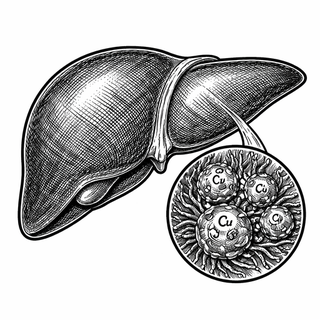
Copper: The Unlikely Villain
This is where copper enters the story in an interesting way. Copper is an essential trace element - your cells need it for dozens of enzymatic reactions. But copper homeostasis (the body's careful balancing act of absorbing, transporting, and excreting copper) appears to go haywire in TACE-refractory HCC.
The research team found that patients whose tumors resisted TACE had notably higher serum copper levels compared to patients who responded well. They also found elevated expression of ATOX1 (a copper chaperone protein that ferries copper ions inside cells) and ATP7B (a copper-transporting ATPase). Together, these findings paint a picture of cancer cells that have learned to hoard and redistribute copper to fuel their survival under the oxygen-starved conditions that TACE creates.
This connects to a relatively new concept in cell biology called "cuproptosis" - copper-dependent cell death. First formally described in 2022 (Tsvetkov et al., Science, 2022; DOI: 10.1126/science.abf0529), cuproptosis occurs when excess copper binds to lipoylated proteins in the mitochondria, triggering proteotoxic stress and ultimately killing the cell. Think of it as copper becoming toxic when it accumulates in the wrong places at the wrong concentrations. The researchers here saw an opportunity: what if you could weaponize copper against the very cancer cells that are stockpiling it?
The Nanogel: A Trojan Horse with a Chemistry Degree
The team engineered a thermosensitive nanogel with the catchy name Cu²⁺/DC_AC50@PNA. Let's unpack that alphabet soup. It's a polymer-based nanogel loaded with two payloads: copper ions (Cu²⁺) and DC_AC50, a small-molecule inhibitor of ATOX1. The nanogel is designed to be injected via catheter just like conventional TACE materials, but with a twist.
Here's the clever bit. DC_AC50 blocks ATOX1, the copper chaperone. Normally, ATOX1 grabs copper and hands it off to ATP7B for export out of the cell. Block that handoff, and copper accumulates inside the cell with nowhere to go. Meanwhile, the nanogel is also delivering extra copper ions into the mix. It's essentially locking the doors and then flooding the room.
The nanogel itself has some nice engineering touches. It's thermosensitive, meaning it transitions from a liquid to a gel at body temperature, which gives it embolic properties - it physically blocks blood vessels feeding the tumor, just like conventional TACE particles. So you get embolization plus targeted copper overload in one package.
The Results: Promising, with Caveats
In rabbit models (both renal artery embolization and VX2 orthotopic liver tumors), the nanogel performed impressively. Compared to conventional TACE, the Cu²⁺/DC_AC50@PNA system showed markedly better tumor suppression, more extensive tumor necrosis, reduced metastasis, and - the big one - prolonged survival. The biosafety profile looked favorable, and the embolic capability held up well.
Mechanistically, the team demonstrated that the nanogel disrupted intracellular copper transport, triggered cuproptosis, inhibited the HIF-1α/VEGF signaling axis (a major driver of new blood vessel formation that helps tumors survive embolization), and even remodeled the tumor immune microenvironment by increasing CD8⁺ T-cell infiltration. That last point is particularly interesting because it suggests the approach might synergize with immunotherapy down the line.
In vitro work with Huh-7 and LM3 liver cancer cell lines confirmed potent anti-tumor and anti-metastatic effects, especially under hypoxic conditions - exactly the environment you'd find in a post-TACE tumor.
Let's Pump the Brakes
Now, before anyone starts planning clinical trials over lunch, let's note what this study is and isn't. This is preclinical work. Rabbit models are valuable, but they are not humans. VX2 tumors are a workhorse model for interventional radiology research, but they don't perfectly recapitulate the complexity of human HCC, which often develops in the context of cirrhosis, viral hepatitis, or metabolic liver disease.
The leap from "works in rabbits" to "works in people" is littered with promising therapies that didn't survive the jump. We also don't yet know much about long-term copper toxicity risks, optimal dosing, or how this would interact with the increasingly complex systemic therapies (checkpoint inhibitors, anti-VEGF agents) that are now standard of care alongside TACE.
That said, the mechanistic logic here is genuinely compelling. The researchers didn't just throw nanoparticles at a problem - they identified a specific metabolic vulnerability in treatment-resistant cancer, designed a targeted strategy to exploit it, and demonstrated multiple complementary mechanisms of action. That's good science, even if it's early science.
Why This Matters Going Forward
TACE refractoriness is a real and growing clinical problem. The interventional radiology community has been searching for ways to make embolization smarter, not just more aggressive. Approaches that combine physical embolization with biologically targeted payloads represent a promising direction, and the cuproptosis angle adds a genuinely novel dimension to the field.
If the concept holds up in larger animal studies and eventually human trials, it could offer a new option for a patient population that currently has limited choices when standard TACE stops working. For now, it's a well-designed proof of concept that deserves further investigation - with appropriately tempered expectations.
This blog post discusses research findings and should not be taken as medical advice. If you have concerns about liver cancer or treatment resistance, please consult a healthcare provider. Research discussed here represents ongoing scientific investigation and clinical validation is still in progress.
All images used in this post are decorative illustrations only and do not represent or reflect the accuracy, reality, or correctness of the referenced research.
Primary Source: Construction of ATOX1 targeted nano gel based on cuproptosis mechanism and its role in reversing TACE refractoriness of hepatocellular carcinoma. PubMed. 2025. PMID: 42035173