
When Apple finally rolled out its self-repair program, the radical promise was this: keep the chassis, swap the broken bits, and your phone lives again instead of going in a drawer. Tissue engineers have been quietly chasing the same idea for human organs, except the chassis is a decellularized ovary and the broken bits are, well, most of it. A new review in the literature on artificial ovaries makes the case that we are getting unsettlingly good at this, and that the ovary - long treated as biological clockwork you cannot rewind - may turn out to be one of the more repairable parts we own.
The organ that quits early
The ovary has two jobs, and it tends to abandon both at the same inconvenient moment. It releases eggs (the reproductive function everyone thinks of) and it pumps out hormones like estrogen and progesterone (the endocrine function everyone forgets until it stops). When the ovary fails ahead of schedule, a condition broadly called ovarian insufficiency, the consequences are not limited to fertility. We are talking about bone density, cardiovascular health, mood, and the general business of feeling like yourself.
The causes are an unfriendly grab bag: genetic conditions, autoimmune attacks, hormonal misfires, and - the one that comes up constantly in oncology - chemotherapy. Cancer treatment is spectacularly good at killing fast-dividing cells, which is wonderful for tumors and terrible for ovarian follicles, which are also fast-dividing and entirely innocent. A young woman can survive her cancer and then discover the cure quietly retired her ovaries in the process. That is the irony at the center of this whole field: we got so good at saving lives that we created a new problem worth solving afterward.
Why freezing eggs isn't the whole answer
The current standard backup plan is oocyte preservation - freeze the eggs before treatment, thaw them later. It is genuinely useful, and I do not want to undersell it. But it solves exactly one of the ovary's two jobs. Frozen eggs sit in a tank waiting for IVF; they do not wake up every morning and make hormones for you. You can bank your fertility and still spend decades in premature menopause, which feels a bit like saving the photos off your phone while throwing away the phone.
Transplanting whole ovarian tissue back into the body does restore hormones, and it has produced real babies. The catch is plumbing. Transplanted tissue needs blood vessels, and revascularization - the slow process of hooking the graft back into the circulatory system - is sluggish enough that a meaningful chunk of follicles starve before the supply lines arrive. You reconnect the organ, but you lose part of it in the waiting.
Keep the scaffold, replace the cells
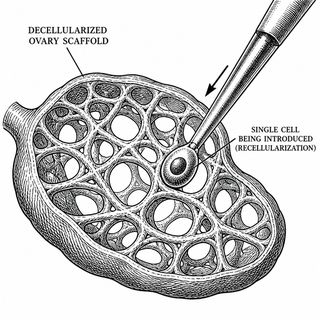
This is where the review gets clever, and where the iPhone-repair analogy earns its keep. The headline technique is decellularization followed by recellularization, which is a mouthful that means roughly: strip an ovary of its cells but keep its frame, then move new cells in.
Every organ is built on an extracellular matrix - a three-dimensional scaffold of proteins, growth factors, and signaling molecules that tells cells where to sit, when to divide, and what to become. Decellularization gently washes away the original cells while preserving that matrix, leaving behind a ghostly architectural blueprint of the ovary. Recellularization then repopulates the scaffold with fresh cells. Because the matrix still carries its native instructions and growth factors, the new cells get a furnished apartment rather than an empty lot, which makes them far more likely to behave like a functioning ovary instead of a confused cellular blob.
The appeal is biological honesty. Rather than guessing at how to mimic the ovarian microenvironment from scratch, you borrow one that already works and just change the tenants. Done right, it could restore both reproductive and endocrine function - both of the ovary's jobs - while sidestepping some of the immune-rejection headaches that haunt transplant medicine, since the scaffold can be stripped of the cells that trigger rejection.
The supporting cast: 3D printing and CRISPR
Decellularization is the star, but the review nods to two technologies waiting in the wings.
3D printing (bioprinting, if we are being precise) offers the possibility of fabricating ovarian scaffolds layer by layer, with engineered porosity and channels - the kind of built-in plumbing that might finally address the revascularization bottleneck. Think of it as designing the chassis with the wiring harness already installed, rather than hoping the wiring grows in later.
CRISPR/Cas9, the gene-editing tool that launched a thousand headlines, gets a more modest role here: tuning the cells you place into the scaffold, correcting genetic defects, or coaxing cells toward the right ovarian identities. Both technologies, the authors are careful to note, carry their own limitations and unsolved problems. This is a review describing a promising construction site, not a ribbon-cutting ceremony.
Why this matters beyond the headlines
What I appreciate about this line of research is that it refuses to treat women's health as a single-issue problem. Fertility tends to dominate the conversation because it photographs well, but a bioengineered ovary that produces hormones could matter just as much for the much larger group of people facing the long, quiet costs of early ovarian failure - the ones who are done having children, or never wanted them, and would simply like their endocrine system to keep showing up to work.
We are not there yet. Building an organ that simultaneously nurtures eggs and runs a hormonal clock is genuinely hard, and the gap between an elegant scaffold in a lab and a transplantable ovary in a clinic is wide and littered with the bones of overpromised therapies. But the strategy - keep the frame, replace the parts, restore both functions - is sound enough that it is worth watching closely. The ovary, it turns out, may not be a sealed appliance after all. It might just be repairable.
This blog post discusses research findings and should not be taken as medical advice. If you have concerns about ovarian insufficiency, fertility, or premature menopause, please consult a healthcare provider. Research discussed here represents ongoing scientific investigation and clinical validation is still in progress.
All images used in this post are decorative illustrations only and do not represent or reflect the accuracy, reality, or correctness of the referenced research.
Primary Source: Artificial ovaries and the future of women's health: Shaping novel functions. PubMed. PMID: 41825642