
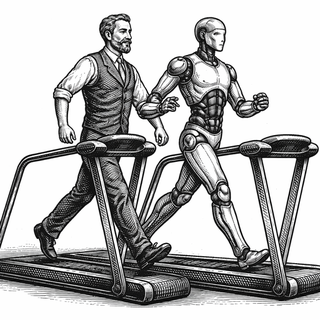
Getting gait therapy to patients currently requires a very human kind of circus: a therapist, a treadmill, a lot of hands-on cueing, and enough repetition to make your calves file a formal complaint. This could change that. The clinical trial NCT07547683 is testing a robot-assisted gait therapy device called Regen, and the basic idea is pretty fascinating. Instead of replacing the therapist, Regen is designed to replicate the therapist's movement pattern and give the patient help when needed during treadmill walking.
That may sound like a niche engineering trick, but in rehab, this is a big deal. Walking recovery is one of those things that looks simple until you try to rebuild it after injury or illness. Then it becomes clear that gait is less like flipping a switch and more like coaching a team sport where every player forgot the playbook.
What This Trial Is Actually Testing
According to the ClinicalTrials.gov record, this study is called "Usability of the Regen Gait Therapy Robot in Healthy Adults." The stated aim is to assess:
- Safety
- Feasibility
- Usability
- How well Regen can replicate a therapist's movement pattern
The participants are young healthy adults walking on a treadmill. That matters. When people hear "healthy adults" in a rehab robot trial, they sometimes wonder why researchers are not jumping straight to patients. Fair question. The answer is that early-stage device testing usually starts where the risk and complexity are lower. If the machine cannot safely and reliably mirror therapist-guided movement in healthy walkers, tossing it into a more medically complicated setting would be like road-testing a new ambulance siren by first entering the Indy 500.
So this trial is not claiming to restore walking in stroke, spinal cord injury, or Parkinson's disease patients yet. It is doing the groundwork. Boring groundwork, maybe, but the kind that decides whether the flashy future headline ever gets written.
Why Gait Therapy Needs Help
As a former paramedic, I spent plenty of time seeing what happens after the dramatic part is over. The stroke is treated. The surgery is done. The patient survives the accident. Then comes rehab, where progress depends on repetition, endurance, staffing, time, and patience. Lots of patience.
Gait therapy is physically demanding for both patient and therapist. Therapists often have to guide leg motion, correct posture, watch balance, adjust pace, and repeat the same movement pattern again and again. It is skilled work, and it can be exhausting work. If a robot can reliably reproduce some of that mechanical assistance while the therapist supervises and fine-tunes the session, it could take some strain off the human side of the equation.
That is the intriguing part of Regen. It is not just a treadmill with bonus hardware. The concept, based on the trial summary, is to capture or mirror the therapist's movement approach and deliver that assistance consistently. In theory, that means more repeatable training, less therapist fatigue, and perhaps a better shot at high-volume walking practice.
And rehab loves repetition. Repetition is the vegetables of neurorecovery. Nobody throws a parade for it, but it keeps showing up because it works.
Why Healthy Volunteers Matter More Than They Sound
There is a reason "usability" is in the study title. A rehab device can have brilliant mechanics and still flop if it is awkward to set up, hard to adjust, uncomfortable to wear, or weirdly unpredictable once someone starts moving.
Testing in healthy adults helps answer practical questions like:
- Does the device move in a way that feels natural?
- Can it sync with treadmill walking without creating new problems?
- Does it assist appropriately rather than overcorrecting?
- Can researchers measure whether it truly matches therapist-guided motion?
That last point is especially interesting. If Regen is meant to replicate the therapist's movement pattern, then the trial is not just asking, "Does the robot move?" It is asking, "Does the robot move in a clinically meaningful way?" Those are very different questions. A robot can be technically impressive and still have the bedside charm of a shopping cart with one bad wheel.
What Could Change if This Works
If Regen does well on safety and usability, the real payoff comes later. A successful early trial could support testing in people with gait impairment, where the need is much larger and much more urgent.
Here is the real-world impact if this line of research pans out:
Therapists could scale their effort more effectively. Instead of spending every second doing the heavy mechanical part of gait guidance, they may be able to focus more on assessment, strategy, and patient-specific coaching.
Patients could get more consistent repetitions. In motor recovery, consistency matters. Human therapists are excellent, but humans also get tired, especially during repetitive physical tasks. Robots do not get tired. They just keep showing up like a gym buddy who has never once suggested skipping leg day.
Clinics might deliver intensive gait training more efficiently. Staffing shortages are real. Rehab demand is real. Anything that helps therapists extend high-quality care without cloning themselves deserves attention.
Future patients with neurologic or orthopedic conditions might benefit. This study is in healthy adults, but the downstream targets are easy to imagine: stroke rehab, spinal cord injury recovery, traumatic brain injury, post-surgical mobility work, and other conditions where walking needs to be relearned or retrained.
The Hard Part Nobody Should Ignore
Now for the reality check. A robot that works in a controlled treadmill study is not automatically ready for prime time. Clinical rehab is messy. Patients have pain, fear, weakness, fatigue, spasticity, asymmetry, and about twelve other things that refuse to behave nicely for a demonstration video.
There are also important questions that this kind of early study does not answer yet:
- Will patients tolerate the device over repeated sessions?
- Does it improve outcomes compared with standard therapy?
- Which patient groups benefit most?
- Does it save time, or just add setup time with a shinier invoice?
Those are not deal-breakers. They are simply the next set of hurdles. Every good rehab technology has to prove not only that it can work, but that it is worth folding into the daily grind of real care.
Why This Trial Is Worth Following
I like this study because it is aiming at a very practical problem. Not "Can we build a robot?" but "Can we build one that behaves enough like a therapist to be useful?" That is a much smarter question.
In healthcare, the best tech is usually not the stuff that looks futuristic in a brochure. It is the stuff that quietly removes friction. It saves a clinician's back. It makes a therapy session more repeatable. It helps a patient get one more block down the hallway, one more minute on the treadmill, one more shot at feeling normal again.
Regen is still in the early innings. This trial is about usability in healthy adults, not guaranteed clinical transformation. But early innings matter. You do not get the home run swing without someone first checking whether the bat is cracked.
For now, this study is a reminder that rehabilitation technology does not have to be flashy to be promising. Sometimes progress looks like a machine learning how to walk like a therapist, one careful treadmill step at a time.
Primary trial record: ClinicalTrials.gov NCT07547683
Table view: ClinicalTrials.gov NCT07547683 Table View
Disclaimer: This article is for educational purposes only and is based on the publicly available clinical trial record summary for NCT07547683. It is not medical advice and should not be used to diagnose, treat, or replace guidance from a licensed clinician.