
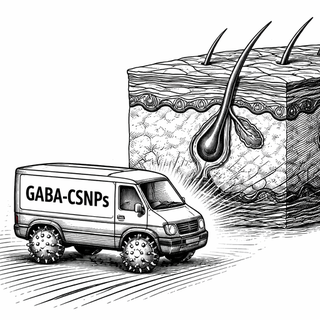
Forget everything you think you know about psoriasis treatment. This new research is not just about putting another cream on irritated skin and hoping for the best. It is about using nanomedicine, specifically gamma-aminobutyric acid packaged inside chitosan nanoparticles, to sneak a helpful therapy through the skin barrier with far better focus. Think less “slather and pray,” more “tiny delivery van with a very specific address.” For a condition as stubborn and inflammatory as psoriasis, that is a pretty interesting shift.
Why psoriasis is such a difficult opponent
Psoriasis is more than a cosmetic nuisance. It is a chronic inflammatory skin disease driven by an overactive immune response, tangled together with oxidative stress, which is essentially a buildup of harmful molecular wear and tear. Patients live with redness, thick plaques, scaling, itching, and sometimes pain. And because skin has the manners of a nightclub bouncer, getting medicine through it in a controlled, effective way is not easy.
From the bedside perspective, this is where frustration lives. Many treatments help, but some lose effectiveness, some irritate the skin, some require injections or systemic therapy, and some simply do not feel sustainable for long-term use. So when researchers try to improve how a therapy reaches the skin, not just what the therapy is, that matters.
The surprising star of the study: GABA
Most people hear “GABA” and think about the nervous system. Fair enough. Gamma-aminobutyric acid is best known as an inhibitory neurotransmitter, the chemical equivalent of a calm hand on a noisy shoulder. But GABA also has immunomodulatory and antioxidant effects, which makes it scientifically appealing for inflammatory diseases like psoriasis.
There is a catch, because there is always a catch. Free GABA does not penetrate skin especially well, and its bioavailability is limited. So even if it has useful biology, getting enough of it to the right place is a challenge. In medicine, many good ideas stall at the delivery step. The molecule has talent, but no decent ride.
Enter chitosan nanoparticles
This is where the study gets clever. The researchers encapsulated GABA in chitosan nanoparticles, creating what they call GABA-CSNPs. Chitosan is a biocompatible material derived from chitin, and in drug delivery research it has a reputation for being friendly to tissues and helpful for carrying cargo.
Under the microscope, these nanoparticles were spherical and uniform. Dynamic light scattering showed they were about 57.63 nanometers in size, with a strongly positive surface charge of +35.93 mV, a sign of good colloidal stability. That sounds technical, because it is, but the practical point is simple: these particles were built in a size range and form that could support consistent delivery.
Why should anyone outside a formulation lab care? Because a better vehicle can turn a promising but underperforming compound into something that actually behaves like a therapy.
What happened in the lab
Before moving into the animal model, the team tested the formulation in vitro. The GABA-loaded nanoparticles outperformed free GABA and unloaded chitosan nanoparticles in antioxidant activity and anti-inflammatory activity. They also showed enhanced biocompatibility in cell testing.
That combination is appealing. You want a treatment that calms inflammatory signaling, reduces oxidative stress, and does not create a fresh problem while solving the old one. Medicine has enough of those trade-offs already.
The antioxidant improvement was shown using the DPPH assay, while anti-inflammatory effects were assessed with a membrane stabilization test. These are not the final word on human efficacy, of course, but they are reasonable early indicators that the formulation is doing more than merely existing in a very small package.
The rat psoriasis model and why it matters
The researchers then used an imiquimod-induced psoriasis-like model in rats. Imiquimod is commonly used in preclinical psoriasis research because it can trigger skin changes that resemble psoriatic inflammation. The animals were divided into several groups, including untreated psoriatic controls, free GABA treatment, unloaded nanoparticles, and GABA-loaded nanoparticles.
The standout result was that the GABA-CSNP group showed the strongest clinical improvement, especially in reducing erythema and scaling. In plain English, the treated skin looked better.
But appearance was only part of the story. Tissue analysis showed restoration of epidermal architecture, suggesting the skin was recovering structurally, not just cosmetically. The nanoparticle treatment also lowered malondialdehyde, a marker of oxidative stress, while increasing superoxide dismutase and catalase, which are part of the skin’s natural antioxidant defenses.
Then there is the inflammatory side. The treatment suppressed key pro-inflammatory cytokines including IL-1β, IL-6, and TNF-α. If you spend enough time around inflammatory disease research, these names start showing up like the usual suspects in a procedural drama.
Why this is genuinely interesting
What I find most compelling here is the layered logic of the therapy. The researchers did not simply pick a drug and test it. They identified a biologically interesting molecule, recognized its delivery limitations, and used nanotechnology to address those limitations directly.
That is often how meaningful translational progress happens. Not with a giant cinematic breakthrough, but with a smarter design choice that solves a real bottleneck.
For patients, the dream scenario is obvious: a locally acting, effective anti-psoriatic treatment that reduces inflammation and oxidative damage while avoiding some of the burdens that come with broader systemic therapy. A transdermal system with sustained local action is an attractive idea, especially for a chronic condition that tends to overstay its welcome.
The reality check we still need
Now for the sentence every clinical researcher eventually says at the party, usually while someone slowly backs away toward the cheese plate: this was a preclinical study in rats. Promising? Yes. Practice-changing? Not yet.
Animal models are useful, but they are not people. Human psoriasis is more complex, more variable, and less cooperative than any laboratory model would like. We still need follow-up work on dosing, formulation stability, long-term safety, skin penetration in human tissue, and ultimately clinical trials.
There are also practical questions. Can this be manufactured reliably? Will it remain stable in a real-world topical product? Will human skin respond as well as rat skin did? Science is full of therapies that looked excellent in an early model and then met the harsh glare of reality.
Still, this study addresses a real unmet need with a thoughtful strategy. That alone makes it worth watching.
The bigger picture
Psoriasis research is increasingly moving toward precision, not just potency. The goal is not only to hit inflammation harder, but to hit it more intelligently. GABA-chitosan nanoparticles fit that trend nicely. They combine a biologically active compound with a delivery system designed to put it where it is needed and keep it there.
If future studies support these findings, this could represent a fresh kind of topical therapy, one that treats psoriatic skin with a little more finesse and a little less brute force. And honestly, in dermatology as in life, finesse tends to age better.
This blog post discusses research findings and should not be taken as medical advice. If you have concerns about psoriasis, please consult a healthcare provider. Research discussed here represents ongoing scientific investigation and clinical validation is still in progress.
All images used in this post are decorative illustrations only and do not represent or reflect the accuracy, reality, or correctness of the referenced research.
Primary Source: Combatting psoriasis with nanomedicine: gamma-amino butyric acid-chitosan nanoparticles as a targeted anti-psoriatic therapy. PubMed Record ID: 42053958. Available at: https://pubmed.ncbi.nlm.nih.gov/42053958/