
What shows up everywhere, keeps cells from falling apart, and now might help fat tissue spill its biochemical secrets under a fluorescent spotlight? Answer: glutathione, the body's hardworking molecular custodian. Not the flashiest job title in biology, but somebody has to keep the cellular kitchen from catching fire.
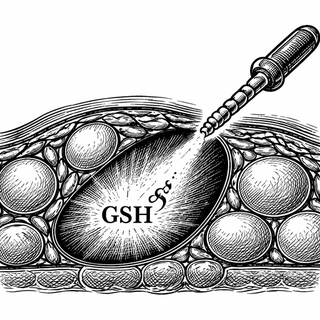
A new PubMed-listed study titled Visualizing glutathione levels in adipose tissue: a CBD aryl ether thiolysis-activated ESIPT probe for obesity research reports a fluorescent probe designed to selectively detect glutathione, also called GSH, in adipose tissue. That may sound niche at first glance. But the minute you ask, "Why would anyone want fat tissue to glow?" the paper gets a lot more interesting.
Why glutathione matters in the first place
Glutathione is one of the cell's main antioxidant molecules. In plain English, it helps cells deal with chemical stress, especially the kind caused by reactive oxygen species. If metabolism is a bustling city, glutathione is part cleanup crew, part repair team, part fire department. Quietly overworked. Rarely thanked.
That matters because adipose tissue is not just passive storage for excess calories. Fat is metabolically active. It sends signals, responds to hormones, changes during inflammation, and plays a major role in obesity-related disease. Researchers want to know what is happening inside fat tissue at the molecular level, not just how much of it is present.
Glutathione can offer one window into that. Changes in GSH levels can reflect shifts in oxidative stress and cellular health. In obesity research, that is a useful clue because obese adipose tissue often behaves differently from lean adipose tissue, especially when inflammation and metabolic dysfunction enter the scene.
The problem with measuring something slippery
Now for the annoying part. Glutathione is biologically important, but it is not exactly standing still waiting to be photographed.
Measuring molecules inside living tissue is hard. Measuring them selectively is harder. Measuring them in a way that is fast, visible, and useful for imaging is harder still. Biology, as usual, refuses to be simple just because we asked nicely.
This study tackles that problem with a fluorescent probe based on cyanobenzoxadiazole, or CBD. The probe is described as "thiolysis-activated" and linked to ESIPT, short for excited-state intramolecular proton transfer. That phrase sounds like it escaped from a chemistry exam, so let us translate.
A fluorescent probe is basically a molecular sensor that lights up under the right conditions. "Thiolysis-activated" suggests the probe is turned on by reacting with thiol-containing molecules. Glutathione contains a thiol group, which makes it a good target. ESIPT refers to a photochemical behavior that can produce distinctive fluorescence signals. Put together, the researchers are using a carefully designed molecule that stays relatively quiet until it interacts in the right way, then gives off a detectable glow.
That is the chemical equivalent of a security badge reader. Not every molecule gets through the gate.
Why adipose tissue is a fascinating target
Adipose tissue might not get the glamorous reputation that the brain or heart enjoys, but it deserves more credit. Fat tissue is an active participant in whole-body metabolism. It helps regulate energy balance, communicates with other organs, and changes dramatically in obesity.
So if scientists can visualize glutathione levels in adipose tissue, they may get a better read on how that tissue is functioning. Is it under oxidative stress? Is it metabolically strained? Are some fat depots behaving differently from others? Those are not small questions. They sit near the center of modern obesity research.
And this is where the paper gets especially appealing. It is not merely about detecting a chemical in a test tube. It is about building a tool that could help researchers study the biology of obesity more directly, with spatial context. Where in the tissue is the signal strongest? Where does it drop? Does it change with disease state, treatment, or time? A glowing map can tell a richer story than a single blended measurement from a homogenized sample.
A chemistry paper with real biological ambition
One of my favorite things about this kind of work is that it lives at the intersection of disciplines. Chemistry makes the probe. Biology gives the question. Imaging provides the readout. Obesity research gets a new set of eyes.
The phrase "selective glutathione detection" is doing a lot of heavy lifting here. Selectivity matters because cells contain many molecules that look annoyingly similar from a reactive chemistry standpoint. If a probe lights up for everything, it is less a scientific instrument and more a biochemical chaos lamp.
A selective probe for GSH in adipose tissue could help researchers separate signal from noise. That could make experiments cleaner and interpretations more trustworthy. It also opens the door to studying redox balance in fat tissue with greater precision. Redox biology is one of those fields that sounds abstract until you realize it is deeply tied to inflammation, aging, metabolism, and disease. Then it starts looking less like a side plot and more like the whole season arc.
What could this lead to?
If follow-up development goes well, tools like this could improve how researchers study obesity at the tissue level. They might help compare healthy and dysfunctional adipose tissue, monitor changes during interventions, or test how therapies alter oxidative stress environments inside fat.
This does not mean a glowing fat scan is about to show up at your local clinic next Tuesday. Early-stage probe development is still early-stage probe development. A lot has to happen between "interesting molecular sensor" and "widely used biomedical tool." Researchers need to validate specificity, test performance in realistic biological settings, confirm reliability, and figure out how broadly the approach can be applied.
Still, the direction is compelling. Better tools often change science faster than louder theories do. Sometimes progress arrives not as a grand headline, but as a smarter flashlight.
The bigger picture
Obesity research needs sharper ways to observe what is happening inside tissues, not just at the level of body weight or blood tests. Adipose tissue biology is more dynamic than it once seemed, and oxidative stress is part of that picture. A probe that can visualize glutathione in fat tissue gives scientists another handle on a complicated system.
That is why this study stands out. It takes a small molecule and asks it to do something very useful: report on a hidden metabolic state in a biologically important tissue. There is something satisfying about that. A tiny chemical design, carefully tuned, could help researchers see patterns that were previously invisible. Science does love a dramatic reveal, even if it usually arrives wearing lab goggles instead of a cape.
This blog post discusses research findings and should not be taken as medical advice. If you have concerns about obesity, metabolic health, or related conditions, please consult a healthcare provider. Research discussed here represents ongoing scientific investigation and clinical validation is still in progress.
All images used in this post are decorative illustrations only and do not represent or reflect the accuracy, reality, or correctness of the referenced research.
Primary Source: Visualizing glutathione levels in adipose tissue: a CBD aryl ether thiolysis-activated ESIPT probe for obesity research. PubMed Record ID 42015845. Available at: https://pubmed.ncbi.nlm.nih.gov/42015845/