
When I saw this study title, I rolled my eyes. Then I read it.
“A luminescent antibacterial compound targeting Gram-negative bacterial membranes” sounds, at first glance, like the sort of phrase assembled by a committee that was paid by the syllable. But buried inside that title is a genuinely interesting idea: what if one compound could both help scientists see dangerous bacteria and help kill them? That is not quite a two-for-one coupon, but in antibiotic research, where progress often arrives with the speed and charm of a licensing review packet, it is close.
Why Gram-negative bacteria keep causing trouble
Gram-negative bacteria are some of the hardest germs to treat. They include notorious hospital and healthcare-associated troublemakers, and they come with a built-in structural advantage: an extra membrane layer that makes it harder for drugs to get in and do their job. Think of them as bacteria that showed up to the fight wearing both armor and an administrative exemption.
That matters because multidrug resistance is no longer some distant science-policy talking point. It is a daily operational problem. Resistant infections mean longer hospital stays, fewer treatment options, more complications, and more pressure on already strained health systems. Every new antibiotic idea has to clear a high bar. It is not enough to work in principle. It has to get to the bacteria, hit a meaningful target, and avoid causing too much collateral damage.
This study takes aim at exactly that bottleneck.
The compound that glows and attacks
The researchers designed a series of compounds based on a type of light-emitting chemical scaffold called an aggregation-induced emission luminogen, or AIEgen. The specific compound that stood out here is called TTCVP.
TTCVP did two things that make people in infectious disease research sit up a little straighter. First, it showed antibacterial activity against Gram-negative bacteria, including multidrug-resistant strains. Second, it acted as a tracking probe, meaning it could help monitor bacteria in real time, both outside cells and inside them.
That second point is more interesting than it may sound. One of the headaches in microbiology and drug development is figuring out where pathogens are, what they are doing, and whether a treatment is actually reaching them. A compound that lights up bacteria while also fighting them is attractive because it blurs the line between diagnosis and therapy. Regulators love categories, so naturally the science is trying to ignore them.
How it appears to work
The study suggests TTCVP selectively binds to the fatty acid chains of phospholipids in the bacterial inner membrane. In plain English, it latches onto a fundamental part of the bacterial membrane, disrupts membrane function, and helps trigger a buildup of reactive oxygen species, or ROS, that contributes to bacterial death.
That is a notable strategy. Bacterial membranes are essential infrastructure. If you can destabilize that infrastructure selectively, you may be able to kill bacteria even when they have evolved resistance to other classes of drugs. It is the microbial equivalent of targeting the plumbing, wiring, and fire alarm all at once.
The researchers also looked at structure-activity relationships, which is the science of figuring out which design features actually matter. Here, broad-spectrum activity seemed to depend on a few specific chemical properties: cationic charge density, a hydrophilic linker, and a higher number of positively charged pyridine groups. Those details matter because they tell future researchers what not to treat as decorative chemistry. Every charge and linker is there on assignment.
Why this is more than a chemistry exercise
A lot of early-stage antimicrobial research lives and dies in the gap between “interesting mechanism” and “usable intervention.” This paper does not close that gap, but it does narrow it in a useful way.
The big challenge in antibiotic discovery is that many promising molecules fail for boring, expensive reasons. They cannot reach the right target. They are too toxic. They work in a dish but not in a living system. They lose steam against the exact pathogens we most need to control. So when a compound shows activity against multidrug-resistant Gram-negative bacteria and also offers real-time tracking capability, that is a meaningful step. It suggests a platform, not just a single clever trick.
There is also a systems angle here. Health policy conversations about antimicrobial resistance often focus on stewardship, surveillance, reimbursement reform, and the thin commercial pipeline for new antibiotics. All of that is necessary. None of it helps if the underlying science stalls. The pipeline problem is not only about incentives. It is also about the fact that Gram-negative bacteria are scientifically difficult customers.
So a study like this is a reminder that policy and chemistry are not separate lanes. One can design all the subscription payment models one wants, but eventually someone still has to produce a molecule worth subscribing to.
The appeal of “see it and treat it”
One of the most compelling parts of this research is the pairing of imaging and therapy. TTCVP is described as photostable and biocompatible, which are useful traits if a compound is going to function as a live-tracking probe. If that holds up in future work, it could help researchers watch how infections behave and how treatment responses unfold in real time.
That has practical implications. Better tracking can sharpen drug development, help refine dosing strategies, and potentially improve how infections are studied in complex tissues. It may also help distinguish whether a therapy is failing because the bacteria are resistant, because the drug never got where it needed to go, or because the infection environment changed the rules halfway through. Microbes are annoyingly adaptive that way.
There is a broader trend here too. Medicine increasingly values tools that do more than one job. Clinicians and health systems are under constant pressure to make decisions faster and with better evidence. A dual-purpose compound that can illuminate pathogens while disrupting them fits that direction of travel nicely.
What to keep in perspective
This is still early-stage research. Promising does not mean proven, and “potential approach” is science’s polite way of saying “please do not make us promise too much yet.” The work highlights a possible path toward new therapies and target discovery, but a long road remains between laboratory findings and anything resembling routine clinical use.
Future studies would need to answer the obvious questions. How well does this approach work in more realistic biological settings? How selective is it for bacteria over human cells in living systems? What happens with dosing, safety, delivery, and durability? Can bacteria adapt around this mechanism too?
Those are not gotcha questions. They are the standard toll booths on the road from elegant experiment to actual medicine.
Why this paper is worth watching
What makes this study interesting is not just that TTCVP kills bacteria. It is that the researchers are using chemistry to attack one of antimicrobial resistance’s hardest design problems while also improving visibility into the infection process itself.
That combination matters. The most useful advances in this field are often the ones that make discovery less blind. If scientists can better see where bacteria are, how compounds interact with membranes, and which molecular features drive activity, the next generation of drug candidates may arrive with fewer expensive dead ends.
For anyone who follows antibiotic policy, that is the quiet appeal here. New antibacterial tools do not emerge from slogans about innovation. They emerge from painstaking work on targets, mechanisms, and molecular design, followed by years of testing and refinement. Glamorous? Not always. Necessary? Absolutely.
And if one of those tools happens to glow while doing its job, I am willing to forgive the title for sounding like it escaped from a chemistry conference tote bag.
This blog post discusses research findings and should not be taken as medical advice. If you have concerns about drug-resistant bacterial infections, please consult a healthcare provider. Research discussed here represents ongoing scientific investigation and clinical validation is still in progress.
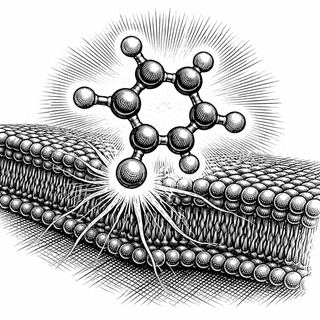
All images used in this post are decorative illustrations only and do not represent or reflect the accuracy, reality, or correctness of the referenced research.
Primary Source: A luminescent antibacterial compound targeting Gram-negative bacterial membranes. PubMed record 41823600. https://pubmed.ncbi.nlm.nih.gov/41823600/