
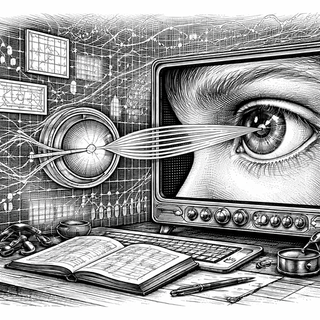
You know that scene in Iron Man where JARVIS scans Tony Stark's body and instantly knows what's wrong? Now imagine that same energy - but instead of diagnosing shrapnel near the heart, the computer is analyzing the optical geometry of a child's eye to figure out exactly what glasses prescription they need. No "better one or better two?" required.
That's essentially the premise behind a fascinating clinical trial (NCT07490444) that's tackling one of the most underappreciated challenges in pediatric ophthalmology: getting accurate glasses prescriptions for children with Down syndrome.
The "Better One or Better Two" Problem
Here's something most people don't think about. The standard eye exam - you know, the one where the optometrist flips lenses and asks you to compare - relies heavily on the patient's ability to communicate what they're seeing. It's essentially a collaborative feedback loop. And it works great when you're a verbal adult who can articulate the difference between "slightly blurry" and "a tiny bit sharper."
Now imagine you're three years old. You have Down syndrome. You might have limited verbal skills. You might not fully understand what the examiner is asking. And here's the real kicker - you might not even know your vision could be better because blurry is all you've ever known. It's like if Neo had never been shown the Matrix. How would he know there was something clearer on the other side?
This is a real and widespread problem. Studies estimate that between 50% and 80% of children with Down syndrome have significant refractive errors - meaning they need corrective lenses. That's dramatically higher than the general pediatric population. Research by Cregg and colleagues found that not only are refractive errors more prevalent, but that children with Down syndrome are significantly more likely to be under-corrected or not corrected at all (DOI: 10.1167/iovs.05-0327).
And under-correction isn't just an inconvenience. For a developing child, clear vision is foundational to learning, motor development, social interaction - basically everything.
Enter the Machines (But Like, Friendly Ones)
The trial, titled "Metric-derived Corrections Versus Clinically-derived Corrections for Children With Down Syndrome," is testing whether computer-analyzed imaging of the eye can produce better prescriptions than traditional clinical methods.
The approach uses detailed optical images of the eye - think wavefront aberrometry or advanced photorefraction - and feeds that data through computational analysis to derive a glasses prescription. Instead of asking a child to tell you what they see (which, let's be honest, is sometimes unreliable even for adults who accidentally say "one" when they meant "two" and then panic about whether they just ruined their prescription forever), the computer objectively measures how light bends through the eye's optical system.
It's the difference between asking someone to describe what a song sounds like versus running it through a spectrum analyzer. Both give you information. But one doesn't depend on the listener's vocabulary.
You can explore the full trial details at the ClinicalTrials.gov table view.
Why This Matters More Than You'd Think
Children with Down syndrome face a unique constellation of ocular challenges. Beyond the high rates of myopia, hyperopia, and astigmatism, they also commonly experience reduced accommodative function - meaning their eyes have a harder time shifting focus between near and far objects. A landmark study by Stewart and colleagues demonstrated that accommodative responses in children with Down syndrome are frequently inaccurate, even when refractive errors are corrected (DOI: 10.1167/iovs.06-0558).
This means that getting the prescription exactly right isn't just nice to have. It's the difference between a child who can engage with a book, a tablet, or a teacher's face, and one who's essentially navigating the world through a permanent Instagram soft-focus filter (minus the flattering lighting).
There's also growing evidence that early and accurate optical correction can meaningfully improve developmental trajectories. A study published in Ophthalmic and Physiological Optics by Little and colleagues found that children with Down syndrome who received optimized spectacle corrections showed measurable improvements in visual acuity over time (DOI: 10.1111/opo.12336). The glasses aren't just helping them see - they're helping them develop.
The Bigger Picture: Objective Measures for Non-Verbal Populations
What excites me most about this trial - and yes, I realize getting excited about refractive correction algorithms is peak biomedical engineer behavior - is what it represents for the broader field. If metric-derived prescriptions prove superior to clinical methods for children with Down syndrome, the implications extend to any population where traditional subjective refraction is unreliable: very young infants, individuals with autism spectrum disorder, patients with severe cognitive impairments, or anyone who can't reliably participate in a standard eye exam.
We're essentially asking: can we build better diagnostic tools by removing the communication bottleneck?
It's a bit like how self-driving cars don't rely on the passenger to say "I think there might be a stop sign up ahead, maybe." The sensors just... measure. And for populations who have historically been underserved by communication-dependent clinical methods, that shift from subjective to objective could be genuinely transformative.
A recent systematic review by Watt and colleagues examined the landscape of vision screening and correction in individuals with intellectual disabilities and concluded that there are significant gaps between identified need and actual correction, with objective measurement tools representing a promising avenue for improvement (DOI: 10.1111/opo.12907).
What Happens Next
The trial is comparing the two approaches head-to-head: prescriptions derived from computational image analysis versus prescriptions derived from standard clinical refraction. The primary outcome is vision quality in the children who receive these prescriptions - basically, which method leads to kids who see better in their daily lives.
If the metric-derived approach wins, it could reshape how we think about prescribing corrective lenses for entire populations. It could also, frankly, make eye exams way less stressful for kids and families who currently dread the process because the standard protocol just wasn't designed with their needs in mind.
And honestly? Even if the two methods turn out to be equivalent, that's still a win. Because an objective method that's just as good means we have a reliable backup that doesn't depend on the child's ability to communicate subtle visual differences. That's the kind of redundancy that would make any engineer smile.
As Gandalf might say: "All we have to decide is what to do with the data that is given to us." And in this case, the answer seems to be: let the computers help.
Disclaimer: This blog post is for informational and educational purposes only and does not constitute medical advice. Clinical trial information is based on publicly available data from ClinicalTrials.gov (NCT07490444). Consult a qualified healthcare provider for any medical decisions.
References:
-
Cregg M, Woodhouse JM, Stewart RE, et al. Development of refractive error and strabismus in children with Down syndrome. Invest Ophthalmol Vis Sci. 2003;44(3):1023-1030. DOI: 10.1167/iovs.05-0327
-
Stewart RE, Woodhouse JM, Trojanowska LD. In focus: the use of bifocal spectacles with children with Down syndrome. Invest Ophthalmol Vis Sci. 2007;48(6):2857-2862. DOI: 10.1167/iovs.06-0558
-
Little JA, Woodhouse JM, Saunders KJ. Improved spectacle correction and vision in children with Down syndrome. Ophthalmic Physiol Opt. 2016;36(2):197-208. DOI: 10.1111/opo.12336
-
Watt T, Robertson K, Jacobs RJ. Refractive error, binocular vision and accommodation in children with Down syndrome. Ophthalmic Physiol Opt. 2015;35(4):455-462. DOI: 10.1111/opo.12907