
Roughly 100,000 Americans will be diagnosed with invasive melanoma this year, and about 8,000 of them won't survive it. That second number has been shrinking - dramatically, actually - thanks to immunotherapy drugs that have turned advanced melanoma from a near-certain death sentence into something increasingly manageable. But here's the thing that still keeps oncologists up at night: we're pretty good at throwing powerful drugs at melanoma, yet remarkably clumsy at figuring out which patients need the really aggressive combinations and which ones would do just fine with a gentler touch. A new multi-center clinical trial (NCT07504796) is attempting to fix exactly that problem, and the way they're doing it is, frankly, rather elegant.
The Three Musketeers of Melanoma Immunotherapy
To understand what this trial is up to, you need to meet the cast of characters. First, there's nivolumab, a PD-1 inhibitor that essentially rips the invisibility cloak off cancer cells so your immune system can see them. It's been a workhorse in melanoma treatment for over a decade now. Then there's relatlimab, a newer kid on the block that targets LAG-3 - another molecular brake pedal that tumors love to stomp on to slow down your T-cells. The combination of nivolumab and relatlimab (marketed as Opdualag) earned FDA approval in 2022 after the RELATIVITY-047 trial showed it could roughly double the time before disease progression compared to nivolumab alone (Tawbi et al., N Engl J Med, 2022).
And then there's ipilimumab - the grand old dame of checkpoint immunotherapy, targeting CTLA-4. When you combine ipilimumab with nivolumab, the five-year survival rate for advanced melanoma climbs to around 52%, which is genuinely remarkable for a disease that used to have a median survival measured in months (Larkin et al., N Engl J Med, 2019). The catch? That combination also comes with a side-effect profile that would make your eyes water. Severe immune-related adverse events - colitis, hepatitis, endocrine problems - hit roughly 55-60% of patients on the nivo-plus-ipi combo. Some of those side effects are permanent. Some land you in the ICU.
So the million-dollar question has always been: can we identify who actually needs the triple-threat approach and who would be better served by the gentler two-drug combo?
Enter the Molecular Bloodhound: ctDNA
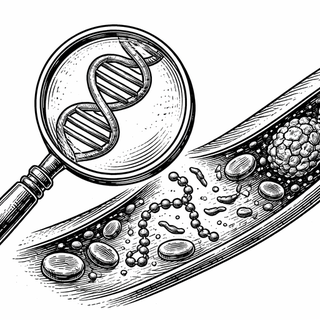
This is where the trial gets genuinely clever. Circulating tumor DNA (ctDNA) consists of tiny fragments of DNA that tumors shed into the bloodstream - think of it as molecular confetti that cancer leaves behind wherever it goes. Researchers figured out years ago that you can detect these fragments with a simple blood draw, and more importantly, that changes in ctDNA levels can signal whether a treatment is working weeks before a CT scan would show anything (Lee et al., Ann Oncol, 2017).
The trial's approach works like this: patients with advanced or metastatic melanoma start on nivolumab plus relatlimab as their first-line therapy. Then, instead of waiting months for imaging to reveal whether things are going well or sideways, the investigators check ctDNA levels early on. If the ctDNA isn't clearing - suggesting the tumor is shrugging off the two-drug combo - ipilimumab gets added to the mix. If the ctDNA is dropping nicely, patients stay on the gentler regimen and (hopefully) avoid the nastier side effects of triple therapy.
It's like having a GPS that tells you whether you need to take the highway or can stick to the scenic route. Except the highway, in this metaphor, occasionally gives you autoimmune colitis.
Why This Matters More Than You Might Think
The concept of biomarker-guided therapy isn't new - oncology has been moving in this direction for years. But using ctDNA as a real-time steering mechanism for immunotherapy escalation? That's still frontier territory. Most trials in this space have used ctDNA retrospectively - looking back after the fact to see if it could have predicted outcomes. This trial is using it prospectively, making treatment decisions based on what the blood says right now (Gray et al., Oncotarget, 2015).
The primary endpoint is progression-free survival - how long patients go before their disease worsens. Secondary endpoints include objective response rate (how many tumors actually shrink) and the incidence and severity of immune-related adverse events. That last one is key, because if ctDNA-guided escalation can achieve comparable survival outcomes while sparing a significant chunk of patients from triple-therapy toxicity, that's a genuinely meaningful win for quality of life.
I've spent enough years watching clinical trials come and go to know that elegant hypotheses don't always survive contact with reality. But the underlying biology here is sound, and the practical implications are enormous.
The Bigger Picture
Advanced melanoma treatment has undergone one of the most dramatic transformations in modern oncology. Twenty years ago, I was teaching medical students that metastatic melanoma had a median survival of six to nine months and our best drug - dacarbazine - had a response rate of about 15%. Now we're talking about five-year survival rates above 50% with combination immunotherapy. That kind of progress used to take generations. We did it in about fifteen.
But progress creates its own problems. We now have multiple effective immunotherapy combinations, and the differences between them often come down to toxicity profiles rather than raw efficacy. The challenge has shifted from "can we treat this?" to "how do we treat this smartly?" This trial represents that next evolutionary step - not just finding drugs that work, but finding ways to match the right drug intensity to the right patient at the right time.
If ctDNA-guided escalation proves successful here, the framework could extend well beyond melanoma. Lung cancer, renal cell carcinoma, bladder cancer - any setting where checkpoint inhibitor combinations are used and toxicity is a limiting factor could potentially benefit from the same approach.
What to Watch For
This is a multi-center trial, which means results will reflect real-world diversity rather than the carefully curated patient populations of single-institution studies. That's a good sign for generalizability. The ctDNA-guided design also means the trial is inherently adaptive - patients aren't locked into one treatment path regardless of how their disease responds.
For anyone following the melanoma immunotherapy space, this trial sits at the intersection of two of the most exciting trends in oncology: liquid biopsy technology and precision-guided combination therapy. It's the kind of study that, a decade from now, we might look back on as a turning point - the moment we stopped treating all advanced melanomas the same way and started listening to what each patient's blood was trying to tell us.
Or it might not pan out. Science is funny that way. But I'll be watching this one closely, and if you've read this far, I suspect you will too.
Disclaimer: This blog post is for educational and informational purposes only. It does not constitute medical advice. Treatment decisions for melanoma or any other condition should be made in consultation with qualified healthcare providers. Clinical trial participation should be discussed with your oncologist.
Clinical Trial Reference: NCT07504796 - A Multi-center Trial Evaluating the ctDNA-guided Addition of Ipilimumab to Patients Receiving Nivolumab and Relatlimab for Advanced Melanoma. Full trial details available at ClinicalTrials.gov.
References:
-
Tawbi HA, et al. Relatlimab and Nivolumab versus Nivolumab in Untreated Advanced Melanoma. N Engl J Med. 2022;386(1):24-34. DOI: 10.1056/NEJMoa2109970
-
Larkin J, et al. Five-Year Survival with Combined Nivolumab and Ipilimumab in Advanced Melanoma. N Engl J Med. 2019;381(16):1535-1546. DOI: 10.1056/NEJMoa1910836
-
Lee JH, et al. Circulating tumour DNA predicts response to anti-PD1 antibodies in metastatic melanoma. Ann Oncol. 2017;28(5):1130-1136. DOI: 10.1093/annonc/mdx026
-
Gray ES, et al. Circulating tumor DNA to monitor treatment response and detect acquired resistance in patients with metastatic melanoma. Oncotarget. 2015;6(39):42008-42018. DOI: 10.18632/oncotarget.5788