
Remodeling a kitchen is a lot like regenerating bone. You strip everything down to the studs, lay in new framework, and pray the whole thing holds together while the contractors (cells, in this case) do their job. Now imagine your kitchen studs are made from pig intestines, coated in nano-sized crystals, and sprinkled with a sticky peptide that makes everything adhere like the world's most biocompatible double-sided tape. Sounds absurd? Welcome to the wild, commercially promising world of bone tissue engineering - where a research team just built what might be the IKEA flat-pack of jawbone repair scaffolds.
The Problem: Your Jaw Is Literally Dissolving
Periodontitis affects roughly half of adults over 30, and in its advanced stages, it doesn't just give you bad breath and bleeding gums. It eats away at the alveolar bone - that's the ridge of bone in your jaw that holds your teeth in place. Once enough bone disappears, teeth start to loosen and fall out. Think of it like soil erosion around fence posts: eventually, the posts just topple over.
Current treatment options for alveolar bone loss exist, but they're expensive, sometimes require harvesting bone from another part of your body (ouch), and often involve commercial products with price tags that would make your dental insurance weep. The global bone graft and substitutes market was valued at over $3 billion in 2023 and continues to grow, so there's plenty of room for a cheaper, more accessible solution. That's the gap this research walks straight into.
The Fix: A Scaffold Made from Pig Intestines (Seriously)
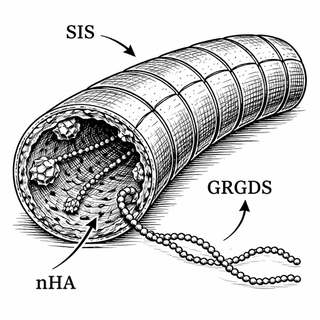
The team behind this study developed a scaffold called G-nHA/SIS, and breaking down that acronym is half the fun. SIS stands for small-intestinal submucosa - a layer of tissue harvested from pig intestines. Before you recoil, know that SIS has been used in surgical repair for decades. It's a proven biomaterial. The key trick is decellularization: you strip out all the pig cells, leaving behind a protein-rich framework that your body recognizes as friendly. It's like gutting a house but keeping the structural beams - the architecture remains, but nothing living (or immunogenic) is left inside.
On top of that scaffold, the researchers layered two ingredients. First, nanohydroxyapatite (nHA) - tiny crystals of the same mineral that makes up about 70% of natural bone. Think of nHA as micro-rebar reinforcing a concrete slab. Second, GRGDS peptide, a short amino acid sequence (Gly-Arg-Gly-Asp-Ser) that acts like a molecular welcome mat. GRGDS mimics a portion of fibronectin, one of the body's own adhesion proteins, so when bone marrow mesenchymal stem cells (BMSCs) encounter the scaffold, they essentially see a big neon sign saying "ATTACH HERE."
Why This Combination Is Commercially Interesting
Plenty of labs have tried individual components before. SIS scaffolds? Done. Hydroxyapatite coatings? Old news. Adhesion peptides? Sure. But the synergy here is what caught my attention from a product standpoint.
The researchers showed that when GRGDS and nHA work together on the SIS scaffold, they don't just add up - they multiply each other's effects. The combo significantly boosted stem cell proliferation, adhesion, and alkaline phosphatase (ALP) activity compared to the scaffold alone. ALP is one of the earliest markers that a cell has committed to becoming bone, so higher ALP means the scaffold is actively pushing cells down the osteogenic (bone-forming) pathway. Gene expression data backed this up, with upregulation of key osteogenic markers like RUNX2 and osteocalcin.
The three-dimensional porous structure of the scaffold also mimics the natural extracellular matrix (ECM), which is the scaffolding that exists around cells in your body. This porous design allows nutrients to flow in and waste to flow out, while giving cells physical surfaces to crawl along and colonize. In engineering terms, it's a well-ventilated building with good foot traffic.
The Animal Data: Rats With Better Jawlines Than Most of Us
In a rat model of periodontitis-induced alveolar bone defects, the G-nHA/SIS scaffold demonstrated excellent biocompatibility (no rejection, no inflammation drama) and solid mechanical properties. The big headline: its bone regeneration performance was comparable to commercially available products already on the market.
And here's the sentence that makes any startup founder's ears perk up: "lower cost and easier availability."
That phrase is startup gold. If you can match the performance of existing products while undercutting them on price and simplifying the supply chain, you've got a business. Pig intestines are cheap and abundant (the pork industry produces them as waste), nanohydroxyapatite synthesis is well-established, and peptide manufacturing scales reasonably well. This isn't some exotic material requiring a rare-earth element mined from one specific cave in Mongolia. It's a scaffold you could realistically manufacture at scale.
Where This Goes Next
The obvious next steps are larger animal models and eventually human clinical trials. Rat jawbones, while useful for proof-of-concept, are a far cry from the mechanical demands of a human mandible. The researchers will need to demonstrate that the scaffold holds up under real chewing forces and integrates properly with human-scale bone architecture.
There are also regulatory considerations. SIS-based products already have FDA clearance for various soft tissue applications (companies like Cook Biotech have been doing this for years), which could accelerate the pathway. Adding nHA and GRGDS peptide introduces new variables, but neither component is exotic or novel enough to send regulators into a tailspin.
From a market perspective, the periodontal regeneration space is ripe for disruption. Dental procedures in general are expensive and often poorly covered by insurance. A lower-cost scaffold that a periodontist could order off the shelf, trim to size, and place during a standard surgical procedure? That's the kind of product that sells itself.
The Bottom Line
This research represents the kind of practical, translatable tissue engineering that actually has a shot at reaching patients. It's not a moonshot. It's not growing organs in a jar. It's taking cheap, available materials - pig intestines, bone minerals, a sticky peptide - and combining them in a smart way that tells stem cells exactly what to do. The fact that it performs on par with existing commercial products at a lower price point is the real story here.
If someone pitched me this at a demo day, I'd want to see the human trial timeline and a plan for GMP manufacturing. Because the science? The science is already there.
This blog post discusses research findings and should not be taken as medical advice. If you have concerns about periodontitis or alveolar bone loss, please consult a healthcare provider. Research discussed here represents ongoing scientific investigation and clinical validation is still in progress.
All images used in this post are decorative illustrations only and do not represent or reflect the accuracy, reality, or correctness of the referenced research.
Primary Source: Decellularized Matrix Scaffold Functionalized with GRGDS Peptide and Nanohydroxyapatite for Alveolar Bone Defect Repair. PubMed. 2026. DOI: PMID 41931675