
The same kind of electromagnetic waves we usually associate with Wi-Fi, cell phones, and reheated pasta can either stimulate neurons or inhibit them, depending on how they interact with specific ion channels. That is a gloriously strange sentence to type, and yet that is exactly what this new research suggests. In cellular terms, microwaves are pulling a very tidy good cop, bad cop routine.
Why this paper stands out
Neuromodulation is already a real medical technology. Doctors and engineers use electrical stimulation to influence nervous system activity in conditions like chronic pain, epilepsy, Parkinson's disease, and more. The catch is that standard electrical neuromodulation often requires implanted hardware, wires, batteries, surgery, and the usual engineering headache of keeping a complex device working in a salty, moving, very opinionated human body.
So the appeal of wireless neuromodulation is obvious. If we could modulate neural activity without threading electrodes into tissue, that would be a major shift. The problem has always been physics being physics. Many noninvasive stimulation methods trade off depth for precision. Getting energy deep enough into the brain or nervous system without spraying it everywhere else is not exactly the biomedical equivalent of threading a needle. It is more like trying to land the Millennium Falcon in a parking spot built for a scooter.
This study tackles that problem from an unusual angle: microwaves in the 0.9 to 3 GHz range.
What the researchers actually found
The team used a miniaturized microwave-powered implantable device, called MINI, to study how neurons respond when exposed to microwaves. The device let them combine microwave exposure with electrophysiological recording, which is a big deal because it means they could watch neurons behave in real time instead of guessing from a distance.
What they found was not a single generic "microwave effect." They saw two different outcomes tied to two different mechanisms.
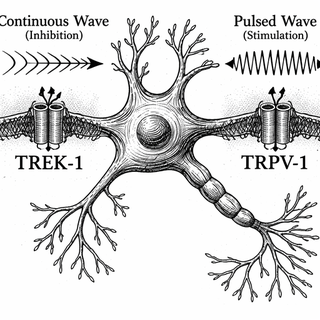
Continuous microwaves inhibited neurons through a nonthermal effect involving increased activity of the TREK-1 channel.
Pulsed microwaves stimulated neurons through a thermal effect involving activation of the TRPV-1 channel.
That distinction matters. A lot.
For years, one of the biggest arguments in this area has been whether microwave bioeffects are simply heating effects wearing a fake mustache, or whether there are meaningful nonthermal mechanisms too. This paper argues for both, but in different contexts. Heating appears to drive stimulation through TRPV-1, while inhibition seems to happen through nonthermal modulation of TREK-1.
That is a much more interesting story than "microwaves heat tissue and stuff happens."
Meet the ion channels
If you have not spent quality time with ion channels lately, here is the short version. They are protein gates in the cell membrane that control the flow of ions like potassium, sodium, and calcium. Open the right gate at the right time, and a neuron becomes more or less likely to fire.
TRPV-1 is the flashy one in this story. It is often associated with heat sensing and painful stimuli. This is the same family of channel that gets talked about in relation to capsaicin, the molecule that makes chili peppers feel like a personal attack. If microwaves warm tissue enough to activate TRPV-1, neurons can become more excitable.
TREK-1 is a different character entirely. It is a potassium channel that generally helps stabilize or quiet neural activity. When TREK-1 activity goes up, neurons tend to become less excitable. In this paper, continuous microwave exposure appeared to enhance TREK-1 activity without relying on heating, which points to a nonthermal inhibitory effect.
So, in one corner, TRPV-1 acts like the red button that ramps things up. In the other, TREK-1 behaves more like the bouncer quietly escorting excess electrical enthusiasm out the door.
Why engineers and clinicians should care
This is where the paper gets especially intriguing. A neuromodulation method that can either stimulate or inhibit neural activity, depending on how the signal is delivered, could be genuinely useful.
In epilepsy, for example, inhibition is often the goal. You want to suppress runaway activity before it spreads. In chronic pain, the answer may depend on the circuit and timing, but modulating excitability without drugs is an attractive idea. Drug-free treatment is not just a nice buzzphrase. It could mean fewer systemic side effects, fewer dosing issues, and fewer situations where a patient is stuck choosing between symptoms and unpleasant medication tradeoffs.
From an engineering standpoint, the ability to tune biological effects by changing waveform characteristics is catnip. Pulsed versus continuous exposure is not just a technical footnote. It may be the control knob that determines whether you press the accelerator or tap the brakes.
That kind of bidirectional control is what turns a neat lab phenomenon into the beginning of a platform technology.
The bigger scientific wrinkle: nonthermal bioeffects
There is another reason this paper matters, and it is a little less flashy but very relevant.
Microwave exposure standards are often discussed mainly in terms of heating. That makes sense because thermal injury is measurable, intuitive, and not subtle. Tissue gets too hot, bad things happen. Straightforward. But if microwaves can also alter cellular behavior through nonthermal mechanisms, then the conversation gets more complicated.
This study does not rewrite exposure policy overnight, and nobody should pretend it does. What it does do is add evidence that nonthermal biological effects deserve serious attention, especially when specific ion channels are involved. That is not a small footnote. It is the sort of mechanistic detail that forces a field to tighten its definitions and ask sharper questions.
In research, "we found the channel" is often the moment a weird observation stops being a rumor and starts becoming biology.
What still needs to be sorted out
As exciting as this is, nobody should mistake a mechanistic study for a ready-to-deploy therapy.
The path from "neurons in an experimental setup respond this way" to "patients safely benefit in the clinic" is long, expensive, and full of opportunities for reality to tackle elegant theories in the hallway. Researchers will need to map dose-response relationships, long-term safety, targeting precision, tissue-specific effects, and reproducibility across different models.
There is also the practical question of control. A wireless neuromodulation system sounds sleek, but medicine does not grade on vibes. It has to be reliable, precise, and predictable under real-world biological variability. Neurons are not identical little circuit elements lined up like stormtroopers. They are closer to an improv cast with ion gradients.
Even so, this paper gives the field something precious: a plausible mechanism with two separable modes of action.
Why I keep coming back to this study
What makes this paper fun, beyond the sheer sci-fi flavor of microwave neuromodulation, is that it respects complexity instead of flattening it. The researchers did not stop at "we saw an effect." They linked different exposure patterns to different channel behaviors and separated thermal stimulation from nonthermal inhibition.
That is the kind of result that invites better device design. If future systems can intentionally recruit TRPV-1 or TREK-1 pathways under controlled conditions, engineers may be able to build more selective and less invasive neuromodulation tools. That would be a real step forward for disorders where current hardware is effective but burdensome.
For now, the headline is simple and weird in the best way: microwaves do not just heat tissue. Under the right conditions, they may also tune neural activity through identifiable molecular gatekeepers. Sometimes biology really does read like a crossover episode nobody expected, but the script turns out to be excellent.
This blog post discusses research findings and should not be taken as medical advice. If you have concerns about seizures, chronic pain, or neurological symptoms, please consult a healthcare provider. Research discussed here represents ongoing scientific investigation and clinical validation is still in progress.
All images used in this post are decorative illustrations only and do not represent or reflect the accuracy, reality, or correctness of the referenced research.
Primary Source: Microwaves stimulate and inhibit neurons via modulation of TRPV and TREK channels. PubMed Record 42013877. https://pubmed.ncbi.nlm.nih.gov/42013877/