
A 58-year-old post-op patient's oxygen saturation nosedives to 82% despite max flow. A young mother with a perforated appendix is suddenly drowning in her own inflammatory fluids. A trauma patient who survived the crash is now losing the war happening inside his lungs. Three beds, three stories, one villain: sepsis-induced acute lung injury, or SI-ALI - the complication that turns a survivable infection into a coin flip with mortality.
I spent years on an ambulance watching sepsis do its worst, and let me tell you, there's a special kind of helplessness in bagging a patient whose lungs have essentially become waterlogged sponges. We've gotten better at supportive care - ventilator strategies, fluid management, the whole bundle - but a targeted therapy that actually shuts down the inflammatory firestorm at the cellular level? That's been the white whale of critical care for decades.
A new study just dropped that might have built a very tiny, very clever harpoon.
What Even Is a Tetrahedral DNA Nanostructure?
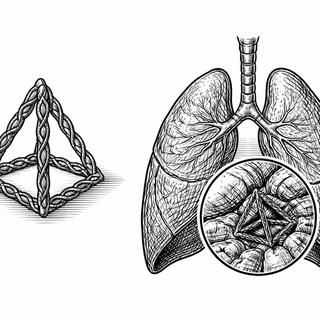
Okay, stay with me here. Imagine you could fold strands of DNA - not the stuff carrying your genetic code, but synthetic DNA - into precise three-dimensional shapes. Like origami, but instead of paper cranes, you're making microscopic pyramids. These are tetrahedral DNA nanostructures, or TDNs, and they're about as small as things get while still being useful.
Researchers have created a nanoplatform called T-D@TDN. Think of it as a tiny delivery truck shaped like a four-sided pyramid, loaded with a drug called dimethyl fumarate (DMF), and wearing a disguise that lets it sneak directly into the immune cells causing all the trouble. It's like a Trojan horse, except the horse is a triangle and the soldiers inside are anti-inflammatory agents. I never said my analogies were perfect.
The Triple Threat Strategy
Here's where it gets genuinely cool. Most drug therapies try to block one pathway - one domino in a chain of bad events. T-D@TDN hits three at once. If sepsis-induced lung injury were a football team's offense, this nanoplatform is playing safety, linebacker, AND cornerback simultaneously.
Play 1: The Framework Itself Scrubs Free Radicals. The TDN structure - the pyramid itself - has an intrinsic ability to scavenge reactive oxygen species (ROS). These are the molecular grenades that damaged cells throw around during sepsis, shredding healthy tissue in the crossfire. The nanostructure soaks them up like a sponge before they can do damage.
Play 2: DMF Activates the NRF2/HO-1 Cleanup Crew. Once the nanoplatform reaches its target macrophages and releases its DMF payload, the drug flips on a cellular defense switch called the NRF2/HO-1 axis. Think of NRF2 as the body's built-in hazmat team - normally it's sitting in the break room, but DMF essentially pulls the fire alarm and gets everyone suited up to neutralize even more ROS from the inside.
Play 3: Direct Blockade of the Self-Destruct Button. Pyroptosis is a particularly nasty form of programmed cell death where immune cells essentially explode, releasing their inflammatory contents like a burst water balloon full of gasoline at a campfire. The protein responsible for punching holes in the cell membrane is called GSDMD. DMF directly inhibits the cleavage of GSDMD, keeping those cells intact and preventing the inflammatory cascade from going nuclear.
Three pathways. One platform. That's not a drug - that's a strategy.
Getting It Where It Needs to Go
One of the most elegant parts of this research is the delivery method. The team designed T-D@TDN to be administered intranasally - a fancy way of saying "up the nose." For a lung disease, this is brilliant. Instead of injecting something into the bloodstream and hoping enough of it wanders into the lungs (like trying to mail a letter to someone by throwing it out a car window on the highway), intranasal administration drops the therapy right at the doorstep.
Better yet, the nanoplatform has surface modifications that make it a homing missile for alveolar macrophages - the immune cells sitting in the lung's air sacs that are major drivers of the inflammatory response in SI-ALI. The study showed prolonged pulmonary retention, meaning these tiny pyramids stick around in the lungs long enough to actually do their job instead of getting cleared out like yesterday's news.
The Results: Not Just Promising - Dramatic
In a mouse model of SI-ALI (induced by cecal ligation and puncture, which is about as rough as sepsis modeling gets), T-D@TDN treatment significantly reduced inflammatory cytokine levels in the lungs. Pulmonary edema decreased. Tissue damage was visibly reduced. And the headline number: the 48-hour survival rate markedly improved.
Now, I've been around long enough to know that mouse models don't always translate to humans. Mice are not tiny people, no matter how much we want them to be. But the multi-mechanistic approach here - attacking the problem from three angles simultaneously - addresses one of the fundamental reasons single-target therapies have failed against sepsis. The inflammatory cascade in sepsis is redundant by design. Block one pathway, and the body just reroutes. Block three? Now you're playing a different game.
Why This Matters Beyond the Lab
Sepsis kills roughly 11 million people worldwide every year DOI: 10.1016/S0140-6736(19)32989-7. Acute lung injury is one of its most lethal complications. Despite decades of research, treatment remains largely supportive - we manage symptoms and hope the patient's body figures it out. The mortality rate for severe ARDS (the worst form of acute lung injury) still hovers around 40%.
What makes this nanoplatform research particularly exciting is the combination of biocompatibility, targeted delivery, and multi-pathway action. DNA nanostructures have been gaining traction in drug delivery research because the body generally tolerates them well - they're made of DNA, after all, not some exotic synthetic polymer. The intranasal route is noninvasive, which matters enormously in patients who are already critically ill and stuck full of more tubes than a pipe organ.
The Road Ahead
Let's pump the brakes just enough to be responsible. This is preclinical work. The jump from mice to humans involves years of safety testing, dosing studies, and clinical trials. We don't yet know how these nanostructures behave in human lungs, whether the targeting is as precise in our much larger airways, or what the manufacturing challenges look like at scale.
But the concept - building a drug delivery vehicle out of DNA that simultaneously serves as part of the therapy while carrying additional therapeutic cargo to specific immune cells - represents a genuinely new approach. It's not just a better drug. It's a better way of thinking about how drugs should work in complex, multi-pathway diseases like sepsis.
And for anyone who's ever stood in a trauma bay watching a septic patient's lungs fail in real time, "new approach" are two of the most beautiful words in medicine.
This blog post discusses research findings and should not be taken as medical advice. If you have concerns about sepsis or acute lung injury, please consult a healthcare provider. Research discussed here represents ongoing scientific investigation and clinical validation is still in progress.
All images used in this post are decorative illustrations only and do not represent or reflect the accuracy, reality, or correctness of the referenced research.
Primary Source: Macrophage-Targeted Nanocarriers Based on Tetrahedral DNA Nanostructure Alleviate Sepsis-Induced Acute Lung Injury by Triple-Pathway Suppression of Pyroptosis. PubMed. 2026. PMID: 41937660