
Translated from paper-speak into normal human language: researchers are trying to build a very tiny anti-cancer multitool that makes harmful oxygen chemicals inside tumors, heats the tumor up, and delivers chemotherapy at the same time. That is a bold pitch. It is also the nanomedicine version of showing up with a Swiss Army knife, a blowtorch, and a chemistry set and claiming you have finally solved dinner.
What this study is trying to do
The paper, titled Potent Polydopamine-Based Cascade Nanozyme as ROS Amplifier for Triple Photothermal-Catalytic-Chemotherapy, sits in a busy and ambitious corner of cancer research. The idea is to use a "nanozyme," which is a nanoparticle designed to act a bit like an enzyme, to generate reactive oxygen species, or ROS, inside a tumor.
ROS are chemically reactive molecules that can damage cells. Cancer researchers like them because, in theory, they can be turned against tumors. The catch is that tumor environments are messy, stingy places. They often do not contain enough of the raw materials these systems need, especially hydrogen peroxide, to produce a strong effect. So the concept here is not just "make ROS," but "amplify ROS production inside a resource-poor environment."
That is where the "cascade" part matters. A cascade nanozyme suggests a stepwise setup where one reaction feeds another, like a biochemical Rube Goldberg machine, except hopefully with fewer points of failure.
Why polydopamine keeps showing up
The platform is based on polydopamine, a material that has become a bit of a celebrity in biomaterials research. Scientists like it because it is relatively versatile, can stick to surfaces, can carry cargo, and often has photothermal properties. "Photothermal" means it can convert light, usually near-infrared light, into heat.
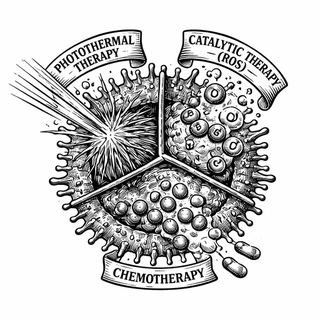
So this paper appears to combine three different treatment ideas:
- Photothermal therapy, where light-triggered heating damages tumor cells.
- Catalytic therapy, where the nanoparticle helps generate ROS.
- Chemotherapy, where a drug is presumably loaded onto or into the system.
On paper, that is appealing. If one mode underperforms, maybe the others help pick up the slack. Cancer therapy has long had a weakness for combinations, and not without reason. Tumors are adaptable, stubborn, and generally uninterested in cooperating with our neat mechanistic diagrams.
Why this is scientifically interesting
The most interesting part is not merely that it combines three therapies. Plenty of papers stack functions onto nanoparticles like someone piling toppings onto frozen yogurt. The more interesting question is whether the combination solves a real bottleneck.
Here, the bottleneck is the lack of enough endogenous hydrogen peroxide in tumors. If a nanozyme depends on hydrogen peroxide to create ROS, then low hydrogen peroxide means weak performance. The paper summary explicitly points to that problem, which is a good sign. It means the authors are aiming at a known limitation rather than pretending the tumor microenvironment is a perfectly stocked lab bench.
That kind of framing deserves credit. Good cancer nanomedicine is not just "small thing attacks tumor." It is "small thing addresses a specific biological obstacle." That is better science and better engineering.
Where I start pumping the brakes
Now for the less glamorous part.
From the information provided here, we do not have the full abstract, experimental design, animal model details, toxicity data, or outcome numbers. That means we should resist the urge to leap from "clever platform" to "future cancer breakthrough." There is a canyon between those two points, and it is filled with failed nanoparticles.
A multi-component system can be powerful, but it can also become fragile. Every extra feature adds another variable: particle size, stability, drug loading, release timing, laser exposure, catalytic efficiency, tumor penetration, immune interactions, and off-target effects. At some point, the elegant tri-therapy platform starts to resemble an overstuffed carry-on bag. Yes, technically it all fits. No, that does not mean airport security will be pleased.
There is also the translational problem. Tumors in mice often cooperate with experimental therapies in ways human tumors absolutely do not. Many nanomedicine studies look impressive in preclinical models and then struggle when confronted with the inconvenient complexity of actual patients.
The real-world promise, if it holds up
If this type of system works beyond early-stage studies, the appeal is obvious. A targeted nanoparticle that can locally heat a tumor, increase oxidative stress, and deliver chemotherapy could, in theory, improve efficacy while reducing some of the collateral damage associated with conventional treatment.
That matters because cancer therapy is often a balancing act between hitting the tumor hard enough and not hitting the patient harder. A smarter local treatment strategy is one of the field's recurring dreams.
There is also a practical elegance to attacking the tumor microenvironment itself. Instead of assuming tumors are passive blobs, this approach treats them as chemically distinct neighborhoods with exploitable weaknesses. That is the right conceptual direction. The tumor microenvironment is not background scenery. It is part of the plot.
The questions that matter next
For a study like this, the next questions are not mysterious.
First, how much better is the combined system than each individual component alone? If the triple approach is only slightly better than simpler alternatives, its complexity may not be worth it.
Second, how selective is it? ROS are not morally discerning. Heat is not, either. A therapy that generates oxidative damage and thermal stress needs a convincing case that it is concentrated in tumor tissue rather than spilling into healthy tissue.
Third, what are the pharmacology and safety profiles? Nanoparticles can accumulate in organs like the liver and spleen. They can behave well in one model and strangely in another. Biology has a talent for finding the least convenient interaction.
Fourth, can this be manufactured reproducibly? That question is rarely the star of the press release, but it often decides whether a promising platform ever leaves the lab.
So, how excited should we be?
Cautiously interested is the right setting.
This paper targets a genuine problem in catalytic cancer nanotherapy: not enough hydrogen peroxide in tumors to fuel strong ROS production. It also appears to use a plausible multifunctional material, polydopamine, to integrate several treatment modes in one platform. That is thoughtful design, not random gadgetry.
But clever design is not the same thing as clinical relevance. Until we see strong evidence on efficacy, specificity, toxicity, and reproducibility, this remains a promising preclinical strategy, not a medical turning point. The field has earned some skepticism here. Cancer nanomedicine has produced many beautiful schematics and far fewer practice-changing therapies.
Still, I would rather read a paper that directly wrestles with a known mechanistic limitation than one that simply announces a shiny new nanoparticle and hopes no one asks difficult questions. This one, at least from the summary provided, seems to understand the assignment.
This blog post discusses research findings and should not be taken as medical advice. If you have concerns about cancer treatment, please consult a healthcare provider. Research discussed here represents ongoing scientific investigation and clinical validation is still in progress.
All images used in this post are decorative illustrations only and do not represent or reflect the accuracy, reality, or correctness of the referenced research.
Primary Source: PubMed Record 42043281. Potent Polydopamine-Based Cascade Nanozyme as ROS Amplifier for Triple Photothermal-Catalytic-Chemotherapy. Available at: https://pubmed.ncbi.nlm.nih.gov/42043281/