
The punchline is refreshingly practical: instead of rebuilding an entire biosensor every time they want a different response curve, researchers say they can tune the sensor by swapping in programmable DNA hairpin reporters. In plain English, they are trying to give cell-free biosensors a volume knob instead of an on-off switch with the emotional stability of a smoke alarm.
That matters because biosensors are often judged not just by whether they detect something, but by how well they behave across different concentrations. Too sensitive, and they saturate early. Not sensitive enough, and they miss the signal until it is practically waving a flag. The new study, titled Tune, Extend, and Narrow the Useful Dynamic Range of Cell-Free Transcription Biosensors Through Programmable DNA-Based Stem-Loop Hairpin Reporters, aims squarely at that problem.1
What problem are they actually solving?
Cell-free transcription biosensors are appealing because they do their work outside living cells. You take the useful molecular machinery, leave the rest of the organism out of it, and build a test platform that can respond to a target signal. That can be handy for diagnostics, environmental sensing, and other settings where simplicity and programmability are valuable.
But these systems have a recurring headache: dynamic range.
Dynamic range is the span of target concentrations over which a sensor gives meaningful information. Too narrow, and the sensor is only useful in a tiny slice of the real world. Too broad, and sometimes you lose precision where you actually care about it. Scientists often want to move that window around depending on the job. A yes-or-no contamination test and a finely calibrated molecular assay are not trying to win the same race.
According to the study summary, the authors built a modular strategy to tune, extend, or narrow that dynamic range by integrating structure-switching DNA stem-loop reporters into in vitro transcription, or IVT, circuits. That is the core idea here.
The basic trick
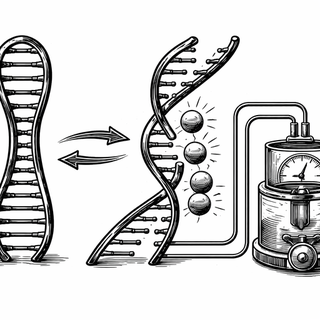
The reporter is a DNA stem-loop hairpin, which sounds exotic but behaves a bit like a spring-loaded clasp. In one state, it is folded up. When the right RNA output appears, the structure switches. That switching event becomes the readout.
The clever part is that the researchers say they can control the reporter's behavior by adjusting its switching equilibrium constant. That is a technical way of saying they can influence how readily the hairpin flips between states. Change that balance, and you can change how the biosensor responds across concentrations.
This is good engineering logic. Instead of treating the readout as a passive afterthought, the study treats it as a programmable layer. That is often where progress happens in synthetic biology and molecular diagnostics: not through one grand miracle, but by realizing a supposedly boring component is actually where all the leverage lives.
Why this is interesting
A lot of biosensor papers promise sensitivity, specificity, portability, affordability, scalability, and possibly inner peace. Real systems usually force tradeoffs. What makes this paper intriguing is that it seems to tackle one of those tradeoffs directly.
If the approach works as advertised, a biosensor designer may not need to redesign the entire sensing architecture to get a different usable range. They could potentially keep the core transcription circuit and adjust the reporter module instead. That is modularity in the actually-useful sense, not modularity in the "there are twelve adapter parts and none fit" sense.
This could matter in real-world deployment. A field test for contaminants may need a broad operating range because samples vary wildly. A diagnostic assay aimed at a narrow clinical threshold may want the opposite: a compressed, more discriminating response over a smaller window. Being able to widen or tighten that range on purpose is more than a neat lab trick. It is a way of tailoring a platform to the question being asked.
The method deserves some credit
Even from the limited summary, there is something methodologically solid here. The study is not just reporting that a biosensor happened to behave differently after some mysterious optimization ritual and several offerings to the gods of buffer chemistry. It frames the tuning in terms of a programmable physical property of the reporter.
That is a stronger position. Rational design beats "we poked it until it improved" every time.
The emphasis on a general strategy also matters. A platform paper can be more valuable than a one-off demo if others can adapt it across targets and contexts. The summary describes the system as modular, which is exactly what you want if the goal is broader usefulness rather than a single polished showcase.
Pump the brakes, though
Now for the part where we resist falling in love after one good seminar slide.
This is still a platform concept in an in vitro transcription biosensing setup. That means the leap from elegant molecular design to rugged real-world assay remains a leap. Plenty of things behave beautifully in controlled test conditions and then become fussy, noisy, or expensive when exposed to actual samples, inconsistent temperatures, storage constraints, or the basic chaos of life outside the bench.
The summary also tells us what the approach is supposed to do, but not much about the full scale of validation. We do not know, from the information provided here, how broadly the method was tested across targets, how stable it is over time, what tradeoffs appear in signal speed or background noise, or whether tuning the dynamic range introduces new headaches elsewhere. Molecular systems are gifted at solving one problem and quietly inventing two more.
There is also the perennial question of usability. A programmable reporter is attractive, but only if the tuning rules are predictable enough that another lab can reproduce them without a month of troubleshooting and a look that says, "I no longer trust tubes."
Where this could go
If follow-up studies hold up, this kind of reporter-level tuning could make cell-free biosensors more adaptable for applications where the relevant concentration window differs from one use case to another. That includes diagnostic testing, environmental monitoring, and perhaps research tools where one assay needs broad detection while another needs a narrower, more decision-focused response.
The larger lesson is appealing too. Biological sensing systems do not have to be locked into one response profile. With enough control over the output layer, they may become more like configurable instruments than fixed gadgets.
That would be a meaningful step forward. Not glamorous, perhaps. No one is making an action movie about equilibrium constants. But the history of useful biotechnology is full of advances like this: a better tuning mechanism, a cleaner interface, a more predictable module. Not fireworks. Better knobs.
The bottom line
This research is interesting because it targets a real bottleneck in biosensor design and does so with a modular, mechanistic idea rather than vague optimization. That is worth taking seriously.
It is also early enough that serious people should keep both eyebrows available. A tunable reporter strategy is promising, not proven destiny. The real test will be whether it remains robust when pushed across diverse sensing problems and less-than-perfect conditions.
For now, the study offers a smart reminder that sometimes the path to better biosensors is not making them louder. It is teaching them when to whisper, when to shout, and when not to overreact like a lab instrument that has had too much coffee.
This blog post discusses research findings and should not be taken as medical advice. If you have concerns about diagnostic testing, environmental exposure monitoring, or related health questions, please consult a healthcare provider or relevant public health professional. Research discussed here represents ongoing scientific investigation and clinical validation is still in progress.
All images used in this post are decorative illustrations only and do not represent or reflect the accuracy, reality, or correctness of the referenced research.
Primary Source: Tune, Extend, and Narrow the Useful Dynamic Range of Cell-Free Transcription Biosensors Through Programmable DNA-Based Stem-Loop Hairpin Reporters. PubMed record 42021126. https://pubmed.ncbi.nlm.nih.gov/42021126/
-
PubMed record for Tune, Extend, and Narrow the Useful Dynamic Range of Cell-Free Transcription Biosensors Through Programmable DNA-Based Stem-Loop Hairpin Reporters: https://pubmed.ncbi.nlm.nih.gov/42021126/ ↩