
Ever wondered how those sci-fi movies manage to show holograms that seem to pop out at you, making you feel like you could reach out and touch them? Well, folks, put down that popcorn because we’re inching closer to making holography an everyday reality! A recent study published in Nano Letters dives into the world of broadband terahertz (THz) holography using some seriously cool technology: nonlinear plasmonic metasurfaces. Sounds like a mouthful, but stick with me - I promise it’ll be more exciting than waiting for your kettle to boil!
What is Terahertz and Why Should You Care?
Let’s break it down. Terahertz waves sit snugly between the microwave and infrared portions of the electromagnetic spectrum. Imagine them as the middle child of the electromagnetic family - often overlooked but packing a ton of potential. These waves have found their way into various applications, from high-speed communication to scanning for hidden weapons. They’re like the Swiss Army knife of the tech world!
So why is this research significant? The ability to manipulate THz waves could unlock a treasure trove of advancements in everything from telecommunications to biomedical engineering. In simpler terms, we’re talking about enhancing how we communicate, sense our environments, and even diagnose medical conditions. You might not know it yet, but this research could touch your life in ways you can’t even imagine!
The Science Behind the Magic
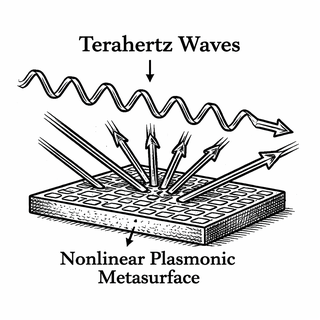
Alright, let’s roll up our sleeves and get into the nitty-gritty. The researchers - Hu Z. and colleagues from Southern University of Science and Technology in China and Tel-Aviv University in Israel - developed what they call Pancharatnam-Berry phase nonlinear metasurface emitters. If that sounds complex, think of it as building a new type of superpower suit for THz waves - this suit allows these waves to not only generate broadband signals but also manipulate them in exciting ways.
The team designed two types of metasurface holograms, which are like the magic glasses through which we can see 3D images. With these holograms, they demonstrated scalar holographic imaging and dual-polarization imaging up to a whopping 2.0 THz! Picture a high-definition TV that can display images in 3D; that’s the level of clarity we’re talking about, but with the added bonus of being able to juggle multiple images at once!
The Real-World Applications: More Than Just a Cool Science Project
Now, here’s where it gets really interesting. The impact of this innovative research could extend far beyond the lab. Imagine a world where hospitals utilize THz holography for non-invasive diagnostics. Doctors could scan patients with a device that uses these advanced metasurfaces, potentially identifying conditions like tumors or other abnormalities far earlier than current methods allow - and with greater accuracy. It’s like having a superhero’s x-ray vision but with medical applications that could save lives!
Furthermore, in the realm of communications, these developments could enhance data transmission speeds and efficiency. You know how frustrating it is when your video call freezes? With better THz holography, we might finally say goodbye to those awkward “Can you hear me now?” moments. Instead, we could have seamless communication that feels like an in-person chat, regardless of where you are in the world.
The Future Looks Bright - And Holographic!
As we stand on the cusp of these advancements, it’s hard not to get excited about the possibilities. This research opens doors to novel applications that could change how we perceive and interact with the world around us. Who knows? Maybe in a few years, we’ll all have personal holographic assistants, helping us navigate our day-to-day lives with ease - a little like a digital butler straight out of a futuristic film!
Of course, there’s still a lot of research to be done, and we may have to temper our excitement with a dose of patience. Science moves at its own pace, after all. But with innovations like broadband THz holography on the horizon, the future is looking a lot more dynamic - and definitely holographic.
So next time you watch a science fiction movie and see those mind-bending holograms, remember that we’re not far off from making that a reality. Grab that popcorn, because the show is just getting started!
Disclaimer: This blog post is intended for informational purposes only and does not constitute medical advice. Always consult a healthcare professional for medical concerns. Images and graphics are for illustrative purposes only and do not depict actual medical devices, procedures, mechanisms, or research findings from the referenced studies.
For further reading, check out the full research paper here: DOI: 10.1021/acs.nanolett.5c05187