
There's a moment every parent dreads - your kid comes home from school, you ask them a question, and they respond with that classic glazed-over "what?" that could mean they're ignoring you OR their ears are full of fluid again. If your child has dealt with otitis media with effusion (OME), you know exactly what I'm talking about. Now there's a clinical trial (NCT06967506) testing whether a high-tech breathing trainer can help kids blow that gunk right out of their ears. Yes, really.
The Problem: Glue Ear Is Way More Common Than You Think
Here's a statistic that'll make you feel slightly better about your own parenting: approximately 90% of children will experience OME before they start school. That's not a typo. Nine out of ten kids will have fluid trapped in their middle ear at some point during early childhood.
OME - sometimes affectionately called "glue ear" because it sounds less clinical and more disgusting - happens when the Eustachian tube decides to take an extended vacation from its job. This tiny tube connects your middle ear to the back of your throat, and its main gig is equalizing pressure and draining fluid. In kids, this tube is shorter, more horizontal, and generally less competent than in adults. It's like having a drainage system designed by someone who didn't really understand gravity.
When the Eustachian tube doesn't work properly, fluid accumulates in the middle ear. There's no infection (that would be acute otitis media), just a pool of goo sitting there, muffling sound like someone stuffed cotton balls in your kid's ears. In the United States alone, about 2.2 million episodes of OME are diagnosed annually, costing the healthcare system around $4 billion.
The Current Treatment Options: Wait or Slice
For most kids with OME, doctors recommend "watchful waiting" - which is medical speak for "let's see if this resolves on its own in three months." Often it does. Kids grow, their Eustachian tubes mature, and the problem sorts itself out.
But when it doesn't? When months of muffled hearing start affecting speech development and school performance? That's when surgery enters the chat. Tympanostomy tubes - tiny cylinders inserted through the eardrum - allow the middle ear to drain and ventilate without relying on the Eustachian tube. The procedure is quick and generally safe, but it's still surgery on a small child's ear. Nobody's first choice if there's an alternative.
Enter the AirOFit PRO: Athletic Training for Your Eustachian Tube
The NCT06967506 clinical trial is testing whether the AirOFit PRO breathing trainer - a device originally designed for athletes who want to improve their respiratory performance - can help kids with OME. It sounds like someone grabbed a random gadget off the shelf and said "let's try this," but the underlying logic is actually sound (pun absolutely intended).
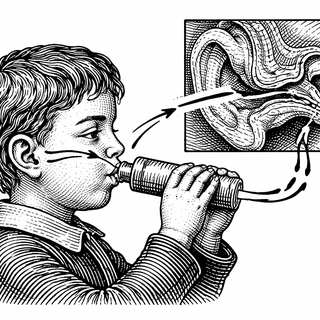
The AirOFit PRO is a handheld breathing device made in Copenhagen, Denmark, that provides adjustable resistance to both inhalation and exhalation. Athletes use it to strengthen respiratory muscles and improve breathing efficiency. But here's the connection: when you blow against resistance, you generate positive pressure in your nasopharynx (the space behind your nose). This pressure can potentially force air up through the Eustachian tube, popping it open and ventilating the middle ear.
It's the same principle behind the Valsalva maneuver - that thing you do when you pinch your nose and blow to equalize pressure during airplane descent. The problem is that young children find it nearly impossible to perform the Valsalva maneuver correctly. Try explaining "blow out through your nose while keeping it pinched" to a four-year-old. I'll wait.
The AirOFit PRO provides a structured way for kids to generate that same pressure through their breath without needing to master complex instructions. Breathe into the device, resistance creates pressure, pressure potentially opens the Eustachian tube. Simple.
The Science Behind Autoinflation
The concept of using breathing exercises to treat OME isn't new. Various autoinflation devices have been tried over the years with promising results.
One study using a different autoinflation system showed that 70% of treated children achieved normal hearing thresholds compared to just 20% of controls who didn't use the device. Another found that regular use of autoinflation devices led to significant improvements in both tympanometry (measuring eardrum movement) and audiometry (measuring hearing) after four weeks.
The beauty of autoinflation is that it addresses the root problem - a dysfunctional Eustachian tube - rather than bypassing it with surgery. If you can repeatedly ventilate the middle ear through natural means, you give the body a chance to clear the fluid and restore normal function.
What Makes This Trial Different?
Currently, there are no published studies specifically evaluating the AirOFit PRO for OME treatment. That's what NCT06967506 aims to change. This trial will be the first to assess whether this particular device - with its adjustable resistance settings and modern design - offers benefits for pediatric OME patients.
The potential advantages are significant. If the trial shows positive results, it could provide:
- A non-surgical option for children who don't respond to watchful waiting
- A bridge therapy that delays or prevents the need for tube insertion
- A home-based treatment that parents can administer without repeated clinic visits
- A kid-friendly approach - breathing into a device is more engaging than trying to explain the Valsalva maneuver
Plus, the device comes with an app that gamifies breathing exercises. If there's one thing modern parents know, it's that turning anything into a screen-based game dramatically increases child compliance.
The Mechanism in Plain English
Here's what we think happens when kids use blowing exercises for OME:
- Child blows into device
- Device creates resistance, building pressure in the airways
- Pressure travels to the nasopharynx
- Eustachian tube, under pressure, opens briefly
- Air enters the middle ear
- Negative pressure in the middle ear normalizes
- Fluid has a better chance of draining
- Hearing improves
Repeat this enough times, and you might train the Eustachian tube to function better overall. It's like physical therapy for an anatomical structure you didn't know could be exercised.
Why This Matters for Parents
The three-month "watchful waiting" period for OME is agonizing for parents who watch their child struggle to hear teachers, miss social cues, or fall behind in speech development. Having an active intervention - something they can do at home, daily, that might actually help - changes the dynamic entirely.
No parent wants their toddler to undergo anesthesia for ear tube surgery if there's a reasonable alternative. If blowing exercises using an adjustable breathing device can reduce the number of kids who need surgical intervention, that's a win worth pursuing.
The trial isn't promising miracle cures. It's asking a straightforward scientific question: does using the AirOFit PRO lead to faster resolution of OME in children compared to standard care? If the answer is yes, even modestly, it opens up a new treatment pathway for millions of affected children.
The Bigger Picture
Medical device innovation often comes from unexpected places. A breathing trainer designed for marathon runners and professional cyclists might turn out to be useful for pediatric otolaryngology. That's how progress happens - someone looks at an existing tool and asks, "what else could this do?"
The AirOFit PRO trial represents exactly this kind of creative thinking. Whether it works or not, we'll learn something valuable. And if it does work, a lot of kids might avoid surgery, a lot of parents might get some peace of mind, and the medical community will have another tool in their arsenal for treating one of the most common childhood conditions.
Sometimes the best solutions are the ones where you literally just blow into a tube. Medicine can be funny like that.
References:
-
ClinicalTrials.gov Identifier: NCT06967506 - Evaluation of Blowing Exercises Utilizing a Breathing Exercise Device in Otitis Media With Effusion
-
Stangerup SE, et al. Treatment of otitis media with effusion based on politzerization with an automated device. Int J Pediatr Otorhinolaryngol. 2000;52(1):23-28.
-
Feasibility of a Novel Autoinflation Device to Treat Pediatric Otitis Media With Effusion At-Home. Laryngoscope. 2025. DOI: 10.1002/lary.32289
-
NCBI Bookshelf - Eustachian Tube Dysfunction. StatPearls Publishing. 2024.
Disclaimer: This blog post is for informational purposes only and does not constitute medical advice. Always consult with a qualified healthcare provider regarding any medical conditions or treatments. Clinical trial results may not reflect individual outcomes. Images and graphics are for illustrative purposes only and do not depict actual medical devices, procedures, mechanisms, or research findings from the referenced studies.