
The motivation behind this paper feels wonderfully familiar: researchers wanted microbes to remember something meaningful about their environment, but the existing memory tool was acting like a smoke alarm that goes off when someone makes toast. The system at the center of the story is Cre recombinase, a molecular machine famous for cutting and rearranging DNA at specific sites. It is powerful, elegant, and, in bacteria, sometimes a bit too eager. That eagerness is exactly the problem this work tackles.
Why microbial memory is such a big deal
One of the most interesting ideas in synthetic biology is giving cells a memory of what they have experienced. Instead of merely reacting in the moment, a microbe could permanently record that it encountered a pollutant, a nutrient shortage, or some other environmental cue. That record could then be read later, even after the original signal is gone.
From a data perspective, this is catnip. A fleeting event becomes a durable bit of biological information. In principle, that means microbes could function as living sensors, tiny ecological reporters, or experimental tools for tracking what happens in messy real-world environments where continuous monitoring is hard.
The catch is that the memory system has to be trustworthy. If it flips on when nothing happened, the result is biological false positives. And in biology, false positives are not just annoying. They can turn a neat experiment into interpretive soup.
The core problem: specificity versus control
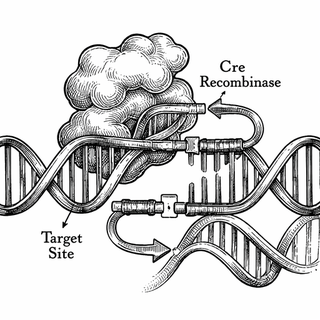
Cre recombinase is already well known for site-specific DNA recombination. In plain English, it can recognize particular DNA sequences and rearrange the DNA between them. That makes it extremely useful for genetic memory because a DNA change can persist and be inherited.
The numbers-style summary from the abstract goes like this: high specificity and high efficiency are nice, but only if you can control when they happen. In prokaryotes, the system has been limited by two recurring issues.
First, there is leaky expression. That means the recombinase gets produced a little even when it is supposed to be off. In a memory circuit, "a little" can be too much. One accidental recombination event is still an event.
Second, there is limited tunability. Biology often works best on a dial, not a light switch. If the only options are "barely on" and "whoops, all recombination," it becomes hard to study subtle effects or engineer low-frequency recording systems.
This paper reports a tightly regulated, titratable Cre recombinase system designed to solve that. Those two words matter. "Tightly regulated" means less unwanted activity. "Titratable" means the researchers can tune the level of activity rather than surrendering to molecular chaos and hoping for the best.
What makes low-rate recombination interesting
At first glance, low-rate recombination might sound like a bug, not a feature. Why would anyone want less of a successful reaction?
Because sometimes rare events are the whole point.
If you are trying to record environmental exposure across a bacterial population, a low and controllable recombination rate can act like a sampling strategy. Instead of every cell flipping at once, you may be able to mark only a fraction, preserving information about timing, intensity, or heterogeneity. In ecology and evolution experiments, that can be especially valuable. Microbial populations are not uniform little armies marching in lockstep. They are more like a city at rush hour: same roads, wildly different trajectories.
A tunable low-rate system also opens the door to asking finer-grained questions. How often should a memory event occur to be informative rather than saturating? How much background activity can be tolerated before the signal becomes unreliable? Those are practical engineering questions, but they are also scientific ones.
What this work appears to add
Based on the abstract, the key contribution is not merely "we used Cre again." It is "we made Cre more governable in bacteria."
That distinction matters. Synthetic biology often advances not through entirely new parts, but through better control architecture around existing ones. Think less "inventing a new engine" and more "finally installing brakes that work." The glamour is lower, but the utility is much higher.
A tightly regulated Cre system could improve several use cases:
- Environmental biosensing, where cells need to log exposure to outside cues
- Experimental microbial ecology, where researchers want to trace rare events or lineage consequences
- Evolution studies, where heritable DNA changes can serve as built-in markers
- Synthetic biology circuits, where stable memory needs to be deliberate, not accidental
The phrase "heritable genomic changes" is doing real work here too. A transient RNA signal is interesting. A DNA change that persists through cell divisions is a different class of record entirely. That is the difference between a disappearing sticky note and a hard save.
Why this is scientifically intriguing
I find this paper interesting because it focuses on calibration, and calibration is where many ambitious biological systems either mature or fall apart.
Anyone can build a dramatic molecular effect. The tougher challenge is building one that behaves proportionally, predictably, and quietly when it is supposed to stay quiet. In statistical terms, you are trying to improve both sensitivity and specificity without letting background noise run the show. Biology, being biology, tends to resist this kind of neatness with the stubbornness of a spreadsheet that keeps reformatting your dates.
If this system truly reduces leakage while preserving tunability, that is not just a technical cleanup. It is a shift in what kinds of experiments become feasible. Researchers may be able to probe low-frequency processes that were previously obscured by tool noise. In other words, the measurement instrument stops arguing with the measurement.
The real-world upside, if development continues
The most immediate impact is likely in research tools rather than medicine. Better microbial memory systems could help scientists map environmental exposures, track population behavior over time, and design more reliable engineered microbes.
Longer term, the concept has broader appeal. Cells that can store information about what they have encountered could become useful in environmental monitoring, industrial bioprocessing, and complex biological diagnostics. That does not mean a clinic is about to hand out "memory bacteria" next week. It means the infrastructure for programmable biological recording keeps getting better, one control problem at a time.
That may sound incremental, but incremental advances often compound. A cleaner switch here, a tighter regulator there, and eventually whole categories of experiments become practical instead of merely clever on paper.
The challenge that still lingers
Even with a better-controlled system, the field still faces a familiar engineering balancing act. Tight regulation, low background, tunable response, stable inheritance, and compatibility with different bacterial contexts do not always coexist peacefully. Improving one dimension can worsen another.
That is why studies like this matter. They do not just show that a molecular tool works. They test whether it works on terms that match real experimental needs. And real needs are usually annoying. They involve edge cases, noise, variability, and cells that decline to read the manual.
For anyone interested in how biology can be turned into a recording medium, this paper points at a useful direction: not maximal activity, but controllable activity. In data science language, the goal is not more signal at any cost. It is a better signal-to-noise ratio with fewer hallucinations from the hardware.
This blog post discusses research findings and should not be taken as medical advice. If you have concerns about environmental exposures, microbial biotechnology, or related health questions, please consult a qualified healthcare provider or relevant scientific expert. Research discussed here represents ongoing scientific investigation and clinical validation is still in progress.
All images used in this post are decorative illustrations only and do not represent or reflect the accuracy, reality, or correctness of the referenced research.
Primary Source: Tunable low-rate genomic recombination with Cre-. PubMed record 41870091. Source link