
Click. A pulse of blue-violet light hits the slide, and suddenly a living cell lights up like somebody strung fairy lights through its plumbing. That, more or less, is the appeal of this new research: scientists built glowing molecules that help them see the endoplasmic reticulum, or ER, inside living cells. As a parent, I read that and immediately translate it into plain English: can this help researchers spot trouble inside cells earlier, understand disease better, and maybe one day lead to something that matters outside the lab? If yes, I am listening. If not, it goes into the mental drawer labeled "science fair, but expensive."
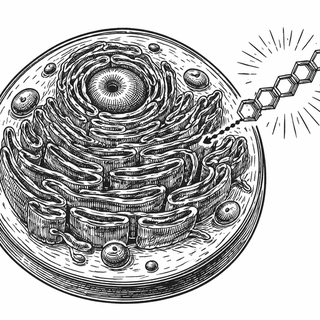
What the ER actually does, minus the jargon fog
The endoplasmic reticulum is one of those cell parts that sounds obscure until you hear its job list. It helps fold proteins, makes lipids, and handles calcium balance. So yes, it is busy. It is less a tiny organelle and more the overworked household utility room of the cell, except if the utility room also managed dinner prep, electrical wiring, and the emotional stability of the whole building.
When the ER is under stress or starts malfunctioning, that is tied to serious conditions, including cancer, neurodegenerative disease, and metabolic disorders. That is why researchers want better ways to watch it in action. If you can track what the ER looks like when cells are healthy, and then see how it changes under stress, you get a better shot at understanding what goes wrong before everything falls apart.
What this study made
This paper reports a new set of fluorescent probes called indole-bipyridyl fluorophores, shortened to IBPs. The team made three versions: IBP-1, IBP-2, and IBP-3. These probes are designed to enter living cells quickly, settle into the ER, and glow in a way that makes the ER stand out clearly under imaging.
That may sound niche, but in cell biology, clearer pictures are not a luxury. They are the whole ballgame. If your probe is weak, messy, toxic, or slow, the data can turn into modern art when what you needed was a map.
According to the summary, these probes absorb light around 420-430 nm, show large Stokes shifts, and have environment-sensitive emission. In normal human terms, that means they can be excited with one wavelength and then emit a distinctly different signal, which helps reduce visual overlap and improves contrast. The "environment-sensitive" part is also useful, because it suggests the probes respond to what is happening around them rather than acting like passive glow sticks.
Why that is interesting
The researchers report that all three probes showed good biocompatibility and rapid cellular uptake in HeLa and COS-7 cells. They also produced a distinct reticular pattern, which is what you want if you are trying to visualize the ER's network-like structure.
Even better, the probes matched closely with commercial ER trackers, with Pearson correlation coefficients of 0.92 to 0.96. That is a strong sign these new molecules are actually going where they are supposed to go. In research, "it ended up approximately nearby" is not the kind of sentence anyone wants to build a future diagnostic or drug platform on.
For me, the practical question is this: does this do something existing tools do not? The answer appears to be yes, at least potentially. These probes are not just locating the ER. They also seem able to report changes linked to ER stress and something described as reticulophagy-like remodeling. That gives them a dual role: map the structure, and hint at the biology unfolding in real time.
What the scientists saw under stress
The study looked at how the ER changed after cells were exposed to DTT or CCCP, two agents commonly used to trigger cellular stress. Under those conditions, the probes revealed ER fragmentation, increased interactions between the ER and lysosomes, and more lipid-droplet formation.
That matters because disease is often less about one thing being simply "on" or "off" and more about systems getting bent out of shape over time. If a probe can show those shape changes clearly in living cells, that gives researchers a better window into early dysfunction.
Think of it like noticing not just that the kitchen light is on, but that the ceiling is sagging, the fridge is humming strangely, and somebody left butter in the silverware drawer. A lot of disease biology works like that. The clues are structural, dynamic, and easy to miss without the right tools.
The zinc angle adds another layer
The summary also notes that the bipyridyl core gives these probes reversible zinc-related sensing ability, although the supplied abstract cuts off before the full details. Even with that limitation, the idea is intriguing. Zinc is involved in plenty of cellular processes, and being able to monitor ER structure while also responding to zinc could make these probes more versatile than standard single-purpose dyes.
That is the kind of feature researchers like because cells do not behave in neat little categories for our convenience. If one probe can help track both organelle localization and a relevant chemical signal, it may save time and reveal relationships that would otherwise be missed. Cells, unfortunately, do not pause for us to take one measurement at a time like polite school photo day children.
Will this help patients anytime soon?
Short answer: not directly, and not soon.
This is cell imaging research. It is foundational lab science, not a treatment. Nobody should read this and think a new scan or medicine is around the corner next month. But foundational science is often where practical progress starts. Before doctors can intervene well, researchers usually need better ways to observe what is happening inside cells with more precision and less disruption.
If these probes continue to perform well, they could become useful tools for studying diseases where ER dysfunction is part of the problem. That could include cancer, neurodegenerative conditions, and metabolic disease. Better tools can improve disease models, help test drug effects, and sharpen our understanding of which cellular changes matter most.
For parents, that may sound indirect, because it is. But indirect does not mean irrelevant. A lot of the medicine we rely on now started with someone figuring out how to see a problem more clearly.
The real value here
What I like about this study is that it aims for something practical inside the lab: strong contrast, low toxicity, quick uptake, and sensitivity to stress-related changes. That is not flashy for the sake of flashy. It is tool-building with a purpose.
And good tools matter. In medicine, bad visibility creates bad guesses. Better visibility creates better questions. Better questions are often what move the field forward.
This does not fix ER-related disease. It does not diagnose a child. It does not replace a therapy. What it may do is help researchers watch one of the cell's most hard-working systems in greater detail while it is still alive and responding. For early-stage science, that is a solid win.
This blog post discusses research findings and should not be taken as medical advice. If you have concerns about cancer, neurodegenerative disease, metabolic disorders, or related health conditions, please consult a healthcare provider. Research discussed here represents ongoing scientific investigation and clinical validation is still in progress.
All images used in this post are decorative illustrations only and do not represent or reflect the accuracy, reality, or correctness of the referenced research.
Primary Source: Indole-bipyridyl fluorophores as dual-functional probes for endoplasmic reticulum imaging and Zn. PubMed record 42046969. https://pubmed.ncbi.nlm.nih.gov/42046969/