
The future of advanced materials isn't silicon, it isn't graphene, and it's definitely not whatever overpriced nanomaterial a startup just raised $40 million to commercialize. It's carbon quantum dots embedded in polymer composites, and frankly, the regulatory world has not even begun to figure out what to do with them.
A sweeping new critical review published in 2025 lays out the case for carbon quantum dot (CQD)-polymer composites as a kind of Swiss Army knife for modern technology - sensing, energy storage, biomedicine, environmental cleanup, anti-corrosion, even flame retardants. If that sounds like a material trying to pad its resume, welcome to the wild world of nanoscale carbon particles that actually deliver on the hype.
Wait, What Even Are Carbon Quantum Dots?
Carbon quantum dots are nanoscale carbon particles - we're talking less than 10 nanometers in diameter. To put that in bureaucratic terms, if a regulation were a football field, a CQD would be somewhere around the size of a period at the end of the fine print nobody reads.
What makes them special is their photoluminescence - they glow under UV light, and you can tune that glow by tweaking their size, surface chemistry, and the precursors used to synthesize them. Think of them as the mood ring of the nanoworld, except they actually work and have peer-reviewed data to back it up.
CQDs belong to the broader family of carbon nanomaterials, sitting alongside their flashier cousins like graphene and carbon nanotubes. But unlike those materials, CQDs bring something refreshingly practical to the table: they're biocompatible, relatively cheap to make, and can be synthesized from sustainable sources. Some researchers have literally made them from orange peels. The circular economy people are beside themselves.
The Polymer Marriage That Actually Works
Here's where things get genuinely exciting. CQDs on their own are interesting. CQDs embedded inside a polymer matrix? That's where the magic happens, and I don't use the word "magic" lightly in a post about materials science.
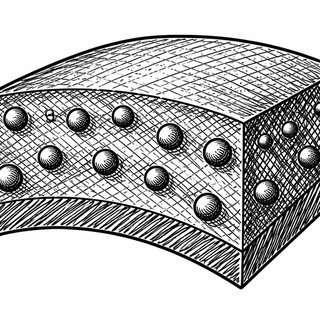
The recent comprehensive review catalogs the various techniques researchers have developed to impregnate CQDs into polymer matrices - everything from in-situ polymerization to electrospinning to simple solution blending. The result is a composite material that combines the structural versatility of polymers with the optical and electronic properties of quantum dots.
The synergistic properties are genuinely remarkable. These composites exhibit tunable photoluminescence (you can dial in the exact color you want), excellent biocompatibility (your body won't reject them), and tailored electrical conductivity. It's the materials science equivalent of finding someone who's attractive, funny, AND has a stable job.
Seven Applications Walking Into a Bar
The review identifies no fewer than seven major application domains for CQD-polymer composites, which is the kind of versatility that makes regulatory agencies break out in hives. Let's run through them:
Sensing: CQD-polymer composites can detect everything from heavy metal ions in drinking water to glucose levels in blood. The tunable fluorescence means you can design sensors that light up - literally - when they encounter specific target molecules. Environmental monitoring agencies should be paying attention.
Energy Conversion and Storage: Solar cells and supercapacitors incorporating CQD-polymer composites have shown promising efficiency gains. In a world where energy policy debates move at the speed of a Congressional subcommittee, the technology is sprinting ahead.
Biomedicine: Drug delivery, bioimaging, tissue engineering - the biocompatibility of CQDs means they play nicely with biological systems. Researchers are exploring CQD-polymer films for wound healing and CQD-tagged polymers for targeted cancer therapy. The FDA's regulatory framework for combination products is about to get a workout.
Environmental Remediation: CQD-polymer membranes that can filter pollutants from water while simultaneously detecting contamination levels. It's like having a water filter that also tells you exactly how disgusting your water was before it cleaned it up.
Anti-Corrosion and Flame Retardants: Less glamorous, perhaps, but enormously practical. CQD-enhanced polymer coatings are showing superior corrosion resistance and flame-retardant properties, which is the kind of unglamorous infrastructure improvement that keeps bridges from falling down and buildings from burning.
The Regulatory Gap Nobody's Talking About
Here's the policy angle that keeps me up at night (well, that and the fact that I voluntarily read CMS coverage determinations for fun). We have a material that crosses biomedicine, environmental science, energy, and industrial manufacturing. It's nano-scale, which means existing regulatory frameworks are already struggling to categorize it. And it's advancing faster than any single agency can keep up with.
The EPA has its Toxic Substances Control Act framework for new chemicals. The FDA has its device and combination product pathways. OSHA has workplace exposure standards. But a material that's simultaneously a medical device component, an environmental sensor, an energy harvester, and an industrial coating? That's a jurisdictional Venn diagram that looks like it was drawn by a caffeinated squirrel.
The review is refreshingly honest about current challenges: scaling up synthesis while maintaining quality, ensuring long-term stability of the composites, understanding degradation pathways, and standardizing characterization methods. These are exactly the kinds of problems that need coordinated research-regulatory dialogue, not the siloed approach we currently have.
What Comes Next
The review points toward several promising future directions: developing greener synthesis routes (more orange peels, fewer toxic solvents), improving quantum yield efficiency, and exploring new polymer matrix combinations. The field is moving from "proof of concept" to "how do we actually manufacture this at scale," which is the transition where good policy can either accelerate progress or strangle it.
For a material that can be made from agricultural waste, functions across half a dozen industries, and might help solve problems from water contamination to energy storage, the biggest risk isn't technical failure. It's that our regulatory infrastructure will treat it like seven separate problems instead of one integrated opportunity.
Carbon quantum dots in polymer composites represent exactly the kind of platform technology that demands systems-level thinking from policymakers. Whether we'll get that thinking before the technology outpaces the policy? Well, I wouldn't bet my orange peels on it.
This blog post discusses research findings and should not be taken as medical advice. If you have concerns about nanomaterial exposure or applications, please consult appropriate scientific and regulatory resources. Research discussed here represents ongoing scientific investigation and clinical validation is still in progress.
All images used in this post are decorative illustrations only and do not represent or reflect the accuracy, reality, or correctness of the referenced research.
Primary Source: Recent advancements in carbon quantum dots and polymer composites: emerging applications and future perspectives. PubMed. 2025. DOI: PubMed Record 41914722