
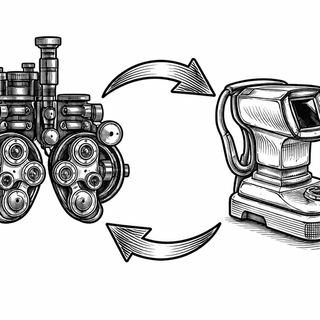
You are sitting in the exam chair, chin parked in the little plastic cup, forehead pressed against the bar, trying not to blink while a machine politely blasts your eyeball with light. A few minutes later, the optometrist swings the phoropter into place and asks the ancient question: “One or two?” Somewhere between the machine’s measurements and your very human squinting, a toric contact lens prescription is born.
That is the oddly fascinating space behind clinical trial NCT07557030, “Optimization for Toric Contact Lenses.” The study’s stated aim is simple: evaluate how well subjective toric lens prescriptions agree with objective toric lens prescriptions. In plain English, it asks whether the prescription you help choose during the eye exam matches what instruments say your eyes need.
That may sound like a tiny technical detail. It is not. For people with astigmatism, tiny details are often where the contact lens drama lives.
Why Toric Lenses Are Fussy Little Divas
A standard soft contact lens corrects simple nearsightedness or farsightedness. A toric contact lens does that too, but it also corrects astigmatism, which happens when the eye’s focusing surfaces are shaped more like a football than a basketball. Light does not focus evenly, so vision can look smeared, doubled, shadowed, or generally “my windshield needs cleaning” even when the windshield is your cornea.
Toric lenses have different powers in different meridians. That means they must sit on the eye at the right rotation. If the lens twists, the correction twists with it. A regular contact lens can spin around like a lazy coin and still do its job. A toric lens needs to behave more like a compass needle after a stern talking-to.
That is why prescribing toric lenses can be part science, part patient feedback, part lens behavior, and part “please stop rotating 10 degrees every time I blink.”
What This Trial Is Asking
According to the ClinicalTrials.gov summary, this trial is evaluating agreement between two ways of determining toric lens prescriptions:
- Subjective prescription: What the patient reports seeing best during refraction, usually through repeated comparisons like “one or two.”
- Objective prescription: Measurements generated by clinical instruments, such as autorefractors, keratometers, corneal topography systems, or similar tools used to estimate focusing error and astigmatism.
The research question is practical: can objective measurements line up closely enough with subjective prescribing to improve, simplify, or optimize toric contact lens fitting?
That is worth studying. The current process can take time. Patients may need trial lenses, follow-up visits, tweaks to axis or cylinder power, and sometimes a small existential crisis in aisle seven while trying to read a shampoo bottle.
Why This Is Intriguing
The most interesting part is not that machines might replace patient input. Let’s pump the brakes on the robot-optometrist parade. Vision is subjective because seeing is subjective. A measurement can be mathematically elegant and still fail the “can I read road signs at dusk?” test.
But better objective tools could help clinicians start closer to the final prescription. That could mean fewer trial lenses, fewer remakes, less chair time, and less patient frustration. For clinics, it could streamline fitting. For patients, it could mean getting clear, stable vision faster.
The study also touches a bigger theme in eye care: how much should clinicians trust instrument-based measurements when the final outcome is lived experience? The best answer is probably not “machine good, patient bad” or “patient always right.” It is more like a duet, ideally one where nobody is singing in the wrong key.
What We Know, And What We Do Not
The provided trial information gives the study title, record ID, source, URL, and overall aim. It does not provide enough detail here to responsibly summarize the full eligibility criteria, sponsor, recruitment status, intervention specifics, or outcome measures.
That matters. A study about toric lens optimization could look very different depending on who is included. Are participants new contact lens wearers or experienced toric lens users? Do they have low, moderate, or high astigmatism? Are the lenses soft torics only? Are patients with dry eye excluded? Are outcomes based on visual acuity, lens rotation, comfort, prescription agreement, or real-world wear experience?
Those details are not academic decoration. They determine whether the findings apply broadly or only to a narrow slice of patients. Clinical trial design is like contact lens fitting itself: the small parameters can change everything.
The Real-World Stakes
If this trial succeeds, the impact would probably be modest but meaningful. We are not talking about curing blindness or inventing bionic eagle vision. We are talking about making a common part of eye care more accurate and less annoying.
Potential benefits could include:
- Faster toric lens fitting
- Better first-try prescription accuracy
- Fewer trial lens changes
- Less dependence on repeated subjective comparisons
- More consistent prescribing across clinicians and clinics
- Improved satisfaction for people with astigmatism
That last one deserves attention. Contact lenses are not just medical devices. They are things people wear while driving, working, reading, exercising, parenting, cooking, doomscrolling, and pretending they did not just walk into a glass door. Small improvements in visual clarity can matter a lot.
The Skeptical Bit, Because Someone Has To Be the Adult
Agreement between objective and subjective prescriptions is useful, but agreement alone does not prove better outcomes. Two methods can agree and still produce lenses patients dislike. The better question is whether objective-guided prescribing improves actual wearer experience: sharper vision, stable rotation, comfort, reduced follow-up visits, and long-term successful wear.
There is also the issue of variability. Astigmatism measurements can shift depending on tear film quality, blinking, corneal surface irregularity, pupil size, instrument type, and patient fatigue. Anyone who has had an eye exam after too much coffee knows the eyes can bring their own chaotic little agenda.
So the ideal version of this research would not just ask, “Do the numbers match?” It would ask, “Do the matching numbers help people see better with less fuss?”
A Sensible Takeaway
This trial is interesting because it focuses on a very practical problem in everyday vision care. Toric contact lenses are widely used, but prescribing them can still involve trial and adjustment. If objective measurements can reliably support subjective prescribing, clinicians may get a better starting point and patients may get to clear vision with fewer detours.
Still, we should be careful. Objective testing is a tool, not an oracle. The patient’s lived visual experience remains the final exam, and unlike a machine, the patient has to wear the lenses through a full day of blinking, screen glare, dry office air, and whatever lighting crimes happen inside big-box stores.
Citation: ClinicalTrials.gov. “Optimization for Toric Contact Lenses.” Record ID: NCT07557030. https://clinicaltrials.gov/study/NCT07557030
Table view: https://clinicaltrials.gov/study/NCT07557030?tab=table
Disclaimer: This article is for educational purposes only and is not medical advice. For questions about contact lenses, astigmatism, or vision correction, consult a qualified eye care professional.