
In The Last of Us, the drama starts when biology goes wildly off-script. Goat mastitis is not quite prestige television, thankfully, but inside an infected udder there is still a microscopic survival thriller: bacteria invade, immune cells rush in, tissue gets inflamed, and the whole system starts looking less like orderly biology and more like a group chat after someone mentions “urgent meeting.”
A new PubMed-indexed study, titled Selenium nanoparticles attenuate Klebsiella pneumoniae-induced mastitis via the suppression of ferroptosis and antioxidant restoration in goats, explores whether tiny selenium particles could help calm that chaos. The work focused on mastitis caused by Klebsiella pneumoniae, a bacterium that can be especially difficult in livestock health because treatment options are limited and infections can damage mammary tissue quickly.
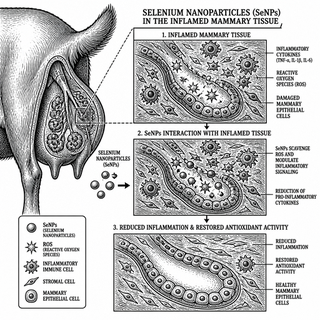
The headline finding: oral selenium nanoparticles, given at 20 micrograms per kilogram of body weight, reduced signs of mastitis in goats and appeared to work through several biological routes at once. In plain language, these nanoparticles did not just tap one biochemical button. They seemed to help restore antioxidant defenses, reduce inflammatory signaling, improve tissue blood-flow patterns, and block a damaging form of cell death called ferroptosis.
That is a lot for a particle small enough to make a dust mote look like a parade float.
Why Mastitis Matters Beyond the Barn
Mastitis is inflammation of the mammary gland, often caused by bacterial infection. In dairy animals, it can mean pain, fever, reduced milk production, altered milk quality, veterinary costs, and sometimes culling. For farmers and veterinarians, it is not an abstract disease label. It is an animal welfare issue, an economic problem, and a food-system headache wearing muddy boots.
Klebsiella pneumoniae is particularly unwelcome. This bacterium can trigger severe inflammation, and infections may not respond neatly to standard approaches. Antibiotic stewardship also matters here. The goal is not simply “more treatment,” but better prevention and smarter interventions that reduce harm without adding avoidable pressure for antimicrobial resistance.
So when researchers test an approach that may support the host’s own antioxidant and anti-inflammatory machinery, ears perk up. Not goat ears exclusively, though they do have an excellent dramatic silhouette.
Selenium, But Make It Nano
Selenium is a trace element the body uses in antioxidant enzymes. Too little can impair health, while too much can be toxic, so biology treats selenium like a spice rack item: useful, powerful, and not something to pour in by the cup.
Nanoparticles change the delivery conversation. Selenium nanoparticles, or SeNPs, are tiny selenium-based particles studied for biocompatibility and antioxidant potential. Their size and surface properties may influence how they interact with cells and biological systems.
In this goat study, oral SeNP supplementation increased selenium concentrations in the serum and boosted mammary glutathione activity. Glutathione is one of the body’s major antioxidant systems, a sort of cellular cleanup crew that helps manage oxidative stress before it turns the tissue environment into biochemical burnt toast.
The researchers also found activation of the PRDX6/SEPHS2 pathway and increased expression of GPX4. These names are not exactly destined for a streaming-service character lineup, but they matter.
PRDX6, or peroxiredoxin 6, helps handle oxidative stress. SEPHS2, or selenophosphate synthetase 2, supports selenium biology. GPX4, or glutathione peroxidase 4, is especially relevant because it protects cell membranes from lipid peroxidation, a damaging process where fats in membranes get oxidized.
Put simply: the selenium nanoparticles appeared to help the mammary gland rebuild some of its antioxidant defenses at the molecular level.
The Ferroptosis Angle
One of the most interesting parts of this study is its focus on ferroptosis. Ferroptosis is a form of regulated cell death driven by iron overload and lipid peroxidation. Unlike apoptosis, which is often described as a tidy cellular shutdown, ferroptosis is more like leaving a cast-iron pan in a thunderstorm and then asking why dinner tastes metallic.
In Klebsiella-induced mastitis, the study suggests that ferroptosis may contribute to mammary tissue injury. The researchers found that SeNP treatment reduced iron overload and lipid peroxidation. It also inhibited NCOA4-mediated ferritinophagy.
That deserves translation. Ferritin is a protein that stores iron. Ferritinophagy is the process of breaking ferritin down, which can release stored iron. NCOA4 helps drive that process. When too much iron becomes available in the wrong cellular context, it can feed oxidative damage and ferroptosis.
The study reported that selenium nanoparticles reduced NCOA4-ferritin heavy chain 1 colocalization, suggesting less ferritin breakdown and less iron-driven damage. That is a fairly elegant mechanism: protect the tissue not only by quieting inflammation, but also by keeping iron from becoming a tiny arsonist in the cell membrane department.
What Happened in the Goats?
The researchers induced mastitis using Klebsiella pneumoniae and then evaluated how SeNP treatment affected the mammary gland. Compared with untreated infected goats, those given SeNPs showed less histopathological damage. In other words, the tissue looked less injured under the microscope.
They also had reduced neutrophil infiltration. Neutrophils are first-responder immune cells, and they are extremely useful when bacteria show up. But when too many pile in, they can worsen inflammation. Imagine sending the fire department, the plumbing department, and three marching bands into one kitchen. The intention is good. The backsplash may not survive.
Inflammatory gene expression shifted in a healthier direction too. SeNP treatment restored anti-inflammatory IL-10 mRNA expression and suppressed pro-inflammatory IL-1β and IL-6 mRNA levels. These are signals that help shape the inflammatory response. Less IL-1β and IL-6 suggests reduced inflammatory drive, while more IL-10 suggests better counter-regulation.
The study also used ultrasonography and Doppler analysis, which makes the work feel closer to the clinical world. Imaging showed improvement in mammary hemodynamics and echotextural abnormalities. Translation: the affected tissue looked and behaved more normally on imaging after treatment.
For a researcher who thinks about both molecular pathways and patient-facing tools, that matters. A mechanism is interesting. A mechanism paired with visible tissue-level improvement is more persuasive.
Why This Research Is Intriguing
What stands out is the multi-pathway effect. Many experimental interventions look promising in one lane. This one appears to act across inflammation, antioxidant restoration, blood-flow patterns, and ferroptosis.
That does not mean SeNPs are ready to become a standard mastitis prevention program tomorrow morning. This is animal research, and the findings need follow-up. Dose, timing, safety margins, long-term effects, milk residues, production outcomes, and real-world farm conditions all need careful evaluation.
Still, the concept is compelling. Mastitis is not a one-problem disease. It is infection plus inflammation plus oxidative stress plus tissue injury. A successful intervention may need to behave less like a single key and more like a very small, very organized maintenance crew.
The fact that this was oral supplementation is also interesting. Practical delivery matters. A therapy that works beautifully in a controlled lab but requires heroic logistics may not survive contact with the milking schedule.
What Could This Mean Long-Term?
If future studies confirm safety and effectiveness, selenium nanoparticles might become part of a prevention or adjunct-treatment strategy for bacterial mastitis in goats and potentially other dairy animals. The word “adjunct” is doing real work here. This research does not replace veterinary diagnosis, infection control, hygiene, or appropriate antimicrobial use when needed.
But it may point toward a future where supporting the host response becomes a bigger part of mastitis management. That would be good news for animals, farmers, veterinarians, and anyone who appreciates a food system with fewer inflammatory plot twists.
There is also a broader scientific lesson. Ferroptosis is being studied in many diseases involving oxidative damage and inflammation. Seeing it show up in livestock mastitis reminds us that biology rarely respects our neat category labels. The mammary gland, the immune system, iron handling, selenium metabolism, and bacterial infection are all in conversation. Some of them are speaking politely. Others are knocking over chairs.
The Takeaway
This goat study suggests that selenium nanoparticles may reduce Klebsiella pneumoniae-induced mastitis by restoring antioxidant defenses, reducing inflammatory signaling, improving mammary imaging findings, and suppressing ferroptosis driven by iron and lipid damage.
That is scientifically rich and clinically relevant. It also feels refreshingly practical: protect the tissue, calm the immune overreaction, and keep cellular iron from causing trouble in the membrane neighborhood.
For now, this is promising preclinical veterinary research. The next steps should be careful, measured, and very much grounded in animal health, food safety, and real farm conditions. Tiny particles can do interesting things, but they still need big, boring validation. And in science, “big and boring” is often where the real progress gets its shoes on.
This blog post discusses research findings and should not be taken as medical or veterinary advice. If you have concerns about mastitis or livestock health, please consult a qualified veterinarian. Research discussed here represents ongoing scientific investigation and clinical validation is still in progress.
All images used in this post are decorative illustrations only and do not represent or reflect the accuracy, reality, or correctness of the referenced research.
Primary Source: Selenium nanoparticles attenuate Klebsiella pneumoniae-induced mastitis via the suppression of ferroptosis and antioxidant restoration in goats. PubMed Record ID 41780848. https://pubmed.ncbi.nlm.nih.gov/41780848/