
Imagine if we could tell cancer cells to pack their bags and leave without burning, freezing, or cutting them out. Sounds like wishful thinking, right? Well, here's the thing: irreversible electroporation (IRE) - marketed under the wonderfully dramatic name "NanoKnife" - is doing something remarkably close to this, and researchers are now investigating whether it could work for early breast cancer.
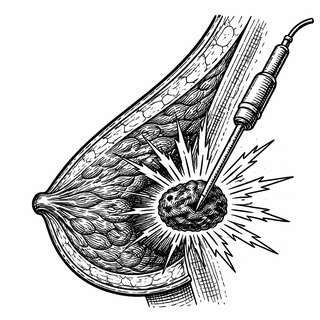
Let me explain, because this technology is genuinely wild.
Death by a Thousand (Nano)Pores
Here's the basic concept: every cell in your body has a membrane that acts like a bouncer at an exclusive club. It decides what gets in and what stays out. IRE delivers extremely short, high-voltage electrical pulses that punch microscopic holes in this membrane - we're talking nanometer-scale pores. The pulses are so brief (microseconds) that the tissue doesn't heat up significantly.
Now, if you punch a few holes, the cell can patch itself up. No big deal. But if you punch enough holes, the membrane becomes Swiss cheese. The cell loses its ability to maintain homeostasis, and it triggers apoptosis - essentially, programmed cell death. The cell commits suicide because its internal machinery has become too compromised to function.
The beautiful part? Unlike thermal ablation techniques (radiofrequency, microwave, cryotherapy), IRE doesn't destroy the underlying tissue architecture. Blood vessels, nerves, and the extracellular matrix - the scaffolding that holds tissues together - remain largely intact. This means faster healing and less scarring.
Why Breast Cancer?
Breast cancer treatment has come a long way from the days of radical mastectomies. We've moved toward breast-conserving surgery, lumpectomies, and minimally invasive approaches whenever possible. The goal isn't just to kill the cancer - it's to do so while preserving as much normal breast tissue and function as possible.
IRE fits neatly into this philosophy. Early studies - including animal models using pigs and rabbits with implanted tumors - have shown that IRE can effectively ablate breast tissue while sparing critical structures. A 2016 study published in the Journal of Translational Medicine (DOI: 10.1186/s12967-016-0993-7) examined percutaneous IRE in breast tissue and found promising safety and feasibility results.
The attraction for early breast cancer is obvious: small, localized tumors could potentially be zapped away in a single outpatient procedure with minimal recovery time. No general anesthesia required. No overnight hospital stays. Just some electrodes, some precisely calculated electrical pulses, and you're done.
The Technology in Your Tumor
The NanoKnife system itself is FDA-cleared for soft tissue ablation and uses specialized electrodes that are inserted into or around the tumor. A computer controls the delivery of electrical pulses, calculating the optimal parameters based on the size and location of the target tissue.
Here's what happens during a procedure:
1. Electrodes are placed under image guidance (ultrasound, CT, or MRI)
2. The patient receives local anesthesia and sometimes sedation
3. The system delivers a series of 70-100 microsecond pulses at high voltage
4. The treated tissue undergoes cell death over the following days and weeks
5. The body's immune system clears away the dead cells
The whole active treatment takes minutes. Not hours. Minutes.
The Immune System Angle
This is where things get really interesting. There's emerging evidence that IRE doesn't just kill cancer cells - it might train your immune system to recognize and fight them.
When cancer cells die from IRE, they release their contents in a relatively intact form. This includes tumor-specific antigens - the molecular "mugshots" that identify cancer cells. Some researchers believe this creates an immune response against any remaining cancer cells in the body.
A review published in the Annual Review of Chemical and Biomedical Engineering explored how IRE can modulate the tumor microenvironment in ways that "dismantle pathways of cancer immunosuppression." In plain English: IRE might help your immune system stop being fooled by the cancer's disguise and start fighting it properly.
Is this proven for breast cancer specifically? Not yet. But it's a tantalizing possibility that adds another potential benefit to the technology.
What the Safety Data Says
Any time you're talking about running electricity through human tissue, safety is obviously a concern. A 2025 analysis published in BMC Surgery examined the FDA's MAUDE (Manufacturer and User Facility Device Experience) database for adverse events related to NanoKnife from 2014 to 2024 (DOI: 10.1186/s12893-025-03136-9).
The findings were generally reassuring. Adverse events peaked around 2020 and have since stabilized with a gradual decline. The majority of issues were manageable, and the technology has a track record of being used safely across thousands of procedures for various tumor types.
That said, most of this experience comes from pancreatic, liver, and more recently prostate cancer. Breast cancer applications are still in earlier stages of investigation.
The Prostate Success Story
If you want to see where breast cancer IRE might be heading, look at prostate cancer. In December 2024, AngioDynamics (the company behind NanoKnife) received FDA 510(k) clearance clearance]) for prostate tissue ablation following the completion of the PRESERVE clinical study.
The trial enrolled 121 patients across 17 clinical sites and demonstrated that IRE was safe and effective for ablating prostate tissue in patients with intermediate-risk prostate cancer. The results were published in European Urology - one of the top journals in the field.
What's particularly compelling is that IRE preserved urinary and sexual function in most patients. For prostate cancer, this is huge because many traditional treatments cause significant quality-of-life issues in these areas.
Could similar benefits apply to breast cancer? Potentially. The preservation of surrounding tissues that IRE offers could translate to better cosmetic outcomes and fewer complications compared to surgery or thermal ablation.
The Current State of Research
Clinical trials specifically investigating IRE for breast cancer are emerging. The approach would likely focus on small, early-stage tumors where the goal is complete ablation without surgery.
Key questions that need answers:
- What tumor sizes are appropriate for IRE ablation?
- How do we verify complete tumor destruction?
- What are the long-term oncological outcomes?
- How do results compare to standard lumpectomy?
These are the kinds of questions that well-designed clinical trials can answer. And that's exactly what's starting to happen.
Who Might Benefit?
If IRE for breast cancer pans out, the ideal candidates might include:
- Women with small, unifocal tumors
- Patients who are poor surgical candidates due to other health conditions
- Women who want to avoid the scarring and recovery time of surgery
- Cases where breast conservation is a high priority
It's not going to replace surgery for everyone. But it could add another option to the treatment toolkit - one that's less invasive, faster to recover from, and potentially gentler on the body.
The Skeptic's Corner
Let me play devil's advocate for a moment. We've seen promising technologies come and go in oncology. IRE needs rigorous, long-term data specifically for breast cancer before we can declare victory.
The concerns include:
- Can we be certain all cancer cells are destroyed?
- What happens at the margins of the treatment zone?
- How does it perform in denser breast tissue?
- Will insurance cover it?
These are legitimate questions that only time and research can answer.
Looking Ahead
The next few years should bring clarity. As more breast cancer-specific trials complete enrollment and publish results, we'll have a much better picture of where IRE fits in the treatment landscape.

For now, it's worth keeping an eye on this technology. The concept of destroying tumors with precisely targeted electrical pulses - leaving surrounding tissues intact while potentially boosting immune recognition of cancer - is too elegant to ignore.
Whether NanoKnife becomes a standard option for early breast cancer or remains a niche technique for specific situations, it represents exactly the kind of innovation that medicine needs: less invasive, more precise, and focused on quality of life alongside cure rates.
Disclaimer: This blog post is for informational purposes only and does not constitute medical advice. Cancer treatment decisions should be made in consultation with qualified oncologists who can evaluate individual circumstances. Clinical trials have specific eligibility criteria, and experimental treatments should only be pursued under proper medical supervision. Images and graphics are for illustrative purposes only and do not depict actual medical devices, procedures, mechanisms, or research findings from the referenced studies.