
Here's the thing about transcription factors that nobody tells you: some of the most biologically important molecules are also the most annoying to measure. They show up in tiny amounts, hide in messy biological samples, and generally behave like the startup prospect who says they're "very interested" and then vanishes for three weeks. That is exactly why this new paper on ultrasensitive detection of NF-kB p50 caught my attention.
The study, titled Cube-track encoded dual-mode ECL/SERS biosensor for ultrasensitive NF-kB p50 detection via transcription-DSN cascade, tackles a real technical bottleneck. Researchers are trying to measure trace amounts of NF-kB p50, a transcription factor involved in regulating genes tied to inflammation, immune signaling, cell survival, and disease processes. The catch is that transcription factors are not easy lab targets. You first have to convert a protein-DNA binding event into a measurable signal, then make sure the result still holds up in the noisy chaos of real biological samples and imperfect instruments.
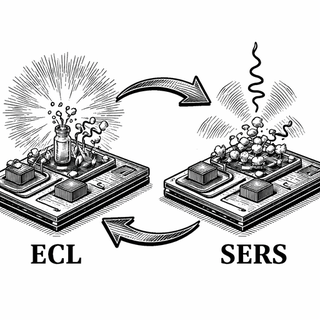
This paper proposes a clever answer: a dual-mode, ratiometric biosensor that combines electrochemiluminescence, or ECL, with surface-enhanced Raman scattering, or SERS, and uses a transcription-DSN cascade to amplify detection. That sounds like a mouthful, because it is, but commercially it reads like something much more interesting: a better way to turn a faint biological whisper into a dependable diagnostic-style readout.
Why NF-kB p50 is worth chasing
NF-kB is one of the better-known signaling families in biology, and p50 is one of its subunits. If that sounds abstract, the business translation is simple: when a molecule sits close to major pathways in inflammation and disease activity, measuring it well can become very valuable. The better we can quantify proteins like this, the better the odds of building tools for research, drug development, and potentially clinical testing down the line.
Right now, measuring trace transcription factors is hard because these proteins are not just floating around waving flags. They operate through specific molecular recognition events, often involving DNA sequences, and they can be present at low concentrations. Biological samples also contain plenty of "background nonsense" that interferes with the clean signal researchers want. Anyone building diagnostics learns this early: biology is a noisy neighbor.
That is why this paper matters. It is not merely about detecting NF-kB p50. It is about building a detection architecture that is more stable, more selective, and less vulnerable to the classic enemies of biosensing, namely matrix interference and instrumental drift.
The core idea: don’t trust one signal when you can have two
I tend to like papers that quietly admit a truth every product team eventually learns: one measurement channel is nice, two are safer. This biosensor uses dual-mode detection, combining ECL and SERS into a ratiometric setup.
ECL is attractive because it can produce sensitive optical signals generated through electrochemical reactions. SERS is attractive because it boosts Raman signals in a way that can make molecular fingerprints much easier to detect. By using both, the system is not betting the entire farm on a single readout. A ratiometric approach compares signals rather than just reporting one raw value, which can help correct for variation caused by sample complexity or instrument instability.
That is a big deal. In research settings, and even more so in commercial ones, drift is where good ideas go to become support tickets. If a platform can self-correct or at least resist false swings, it becomes much easier to imagine it leaving the benchtop and entering a product pipeline.
What the transcription-DSN cascade brings to the table
The paper also uses a transcription-DSN cascade for amplification. The useful high-level idea is that the original protein recognition event does not remain a tiny, lonely event. It gets translated and amplified through a designed molecular cascade, helping the final sensor produce a much stronger and more measurable output.
DSN, or duplex-specific nuclease, is often used in nucleic-acid-based amplification strategies because it can selectively process certain duplex structures and support signal recycling or amplification workflows. In practical terms, that means the biosensor can squeeze more readable information out of very small starting amounts of target.
This is where I start seeing product possibilities instead of just clever chemistry. Signal amplification that preserves specificity is one of the ingredients you need if you want a lab method to become a robust assay. Not every promising biosensor survives contact with real-world deployment, but the ones that do usually have an unfair advantage in sensitivity and reproducibility. This paper is clearly trying to build both.
Why the “cube-track encoded” part is not just decorative jargon
The title also points to cube-track encoding and the integration of a CsPbBr-based component, which suggests the authors engineered the sensing platform itself to contribute to signal quality and distinguishability. Even from the limited summary provided, the direction is clear: this is not a plain sensor with one flashy label attached. It is a layered design where structure, encoding, and signal generation all work together.
That matters because many biosensors look impressive in a graph and fragile everywhere else. A more engineered architecture can make multiplexing, calibration, and signal discrimination more feasible. If future work shows the platform generalizes beyond NF-kB p50, that is where the commercial story really gets interesting. A sensor framework that can be retargeted to other low-abundance biomolecules is not just a paper. It is a platform thesis wearing a lab coat.
Where this could lead if it keeps working
The immediate value is in research use. A highly sensitive method for NF-kB p50 detection could help scientists study inflammatory signaling, disease mechanisms, and cellular responses with greater precision. That alone is useful.
But the broader upside is larger. If dual-mode ratiometric biosensors like this can be made reliable, scalable, and manufacturable, they could support next-generation assays for hard-to-detect biomarkers. That could affect drug screening, translational research, and eventually diagnostics, especially in areas where low-abundance targets carry meaningful biological information.
The commercial challenge, of course, is that beautiful sensing chemistry still has to survive the usual gauntlet: reproducibility, cost, shelf stability, sample prep demands, regulatory expectations, and instrument integration. The market is full of technologies that were undefeated in PowerPoint and considerably less heroic in routine use. So this is not a victory lap. It is a promising early signal.
Still, I would much rather see a paper attack the actual pain points, like interference and drift, than publish yet another "look how sensitive our sensor is in perfect conditions" story. Real progress comes from designs that admit the world is messy and build accordingly.
The bigger takeaway
What I like most here is the mindset embedded in the work. The authors are not just measuring a biomolecule. They are solving a translation problem: how do you turn a subtle biological recognition event into a robust, trustworthy output? That question sits at the heart of a lot of future diagnostics.
NF-kB p50 may be the first target in this setup, but it is probably not the last target anyone would want to test. If this dual-mode strategy proves adaptable, it could become one of those enabling technologies that quietly powers a lot of downstream applications. Those are often the best businesses in biotech, frankly. Not always the loudest, but very often the ones selling picks and shovels while everyone else argues over the gold.
And yes, anytime I see a paper combining amplification logic, dual-mode readouts, and engineered signal encoding, my inner founder starts making spreadsheets it absolutely did not ask permission to make.
This blog post discusses research findings and should not be taken as medical advice. If you have concerns about inflammatory or immune-related conditions, please consult a healthcare provider. Research discussed here represents ongoing scientific investigation and clinical validation is still in progress.
All images used in this post are decorative illustrations only and do not represent or reflect the accuracy, reality, or correctness of the referenced research.
Primary Source: Cube-track encoded dual-mode ECL/SERS biosensor for ultrasensitive NF-kB p50 detection via transcription-DSN cascade. PubMed record 42048747. https://pubmed.ncbi.nlm.nih.gov/42048747/