
Imagine a sponge so light it is mostly air, so delicate that if you tried to clean it the normal way it would shrivel up like a marshmallow left too long over a campfire. Now imagine doctors want to put that sponge inside your body to help your tissue heal. Before they can do that, they have to make absolutely sure it is free of germs. The tricky part is that all the usual germ-zapping tools tend to wreck the sponge. That is the puzzle a team of researchers set out to solve, and their answer involves the same stuff that makes your soda fizzy.
Meet the Aerogel: The Material That Is Basically Solidified Air
Aerogels are some of the strangest solids on the planet. They are up to 99 percent empty space, which makes them feather-light yet riddled with a sprawling internal network of tiny pores. That porous architecture is exactly why biomedical engineers are so smitten with them. Those pores can cradle cells, ferry drugs, soak up fluids, and act as scaffolding for regenerating tissue. Think of them as the architectural equivalent of a Minecraft world built entirely out of microscopic open rooms.
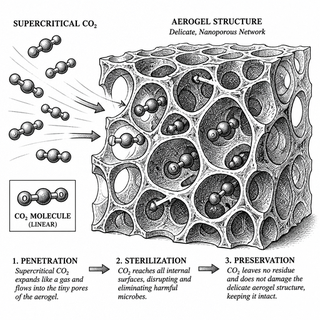
The catch is that all that delicate emptiness makes aerogels the Jenga tower of biomaterials. Push too hard in the wrong place and the whole structure collapses. And nothing pushes harder on a fragile material than the gauntlet of medical sterilization.
The Problem With Our Usual Germ-Busting Gear
Anything destined for the inside of a human body has to be sterile, full stop. The two heavyweight champions of medical sterilization have ruled this arena for decades, and both come with baggage.
First up is ethylene oxide, a gas that is fantastic at killing microbes and also, inconveniently, a known carcinogen. It has a nasty habit of leaving toxic residue behind, which means products need a long airing-out period before anyone can use them safely. It is a bit like fumigating your house and then having to wait days before you are allowed back inside without coughing.
The other contender is gamma radiation, which blasts materials with high-energy rays. Effective? Absolutely. Gentle on delicate polymers? Not even a little. Gamma rays can snap molecular chains and degrade the very structure that makes an aerogel useful, like using a flamethrower to light a birthday candle. On top of that, both methods are running into tightening environmental regulations, because it turns out the world is less enthusiastic about toxic gases and radioactive sources than it used to be.
So engineers found themselves stuck. The materials of the future were being sterilized with the methods of the past.
Enter Supercritical CO2, the Goldilocks of Gases
This is where the research gets genuinely clever. The team turned to supercritical carbon dioxide, and to appreciate why, you need to know about one of chemistry's coolest party tricks.
If you crank up the temperature and pressure on CO2 past a certain threshold, it stops behaving like a normal gas or liquid and enters a "supercritical" state. In this mode it flows and seeps into tight spaces like a gas but dissolves and carries things like a liquid. It is the Swiss Army knife of phases. For a material that is 99 percent pore space, that infiltrating quality is a dream come true, because the CO2 can reach every nook and cranny without having to physically muscle its way in.
Best of all, the conditions are mild. We are talking temperatures and pressures gentle enough that the aerogel's fragile skeleton stays intact. No molecular chains getting snapped, no structure collapsing into a sad little pancake. Once the process is done, you simply drop the pressure and the CO2 evaporates away cleanly, leaving no toxic residue to worry about. It is the houseguest who not only does not trash your place but actually tidies up on the way out.
If ethylene oxide is the chemical sledgehammer and gamma radiation is the flamethrower, supercritical CO2 is the locksmith who quietly slips in, handles business, and leaves without breaking a single window.
Why "Green" Is More Than a Buzzword Here
The "green" label on this technology is not just marketing gloss. Carbon dioxide used in these systems is often captured and recycled, the process avoids hazardous chemicals entirely, and it sidesteps the radioactive infrastructure that gamma sterilization demands. For a medical industry under growing pressure to clean up its environmental act, that combination is a rare win-win: a method that is kinder to both the patient and the planet.
And the patient angle is the part that matters most. A sterilization method that preserves an aerogel's structure means the material actually performs the way it was designed to once it reaches the operating room. The whole point of building an exquisitely porous scaffold is wasted if the cleaning step flattens it first. Biocompatibility, the property that determines whether your body welcomes a material or rebels against it, hinges on keeping that delicate architecture in one piece.
What This Could Mean Down the Road
If this approach scales up the way the researchers hope, the ripple effects are exciting to think about. Aerogels are being explored for wound dressings, tissue engineering scaffolds, drug delivery systems, and implantable devices. A reliable, gentle, non-toxic sterilization method removes one of the big roadblocks standing between these lab marvels and actual clinical use.
It is the unglamorous step that nobody outside the field thinks about, sort of like how the most important character in a heist movie is often the one who disables the alarm system rather than the one cracking the safe. Sterilization is that quiet specialist. Get it wrong and the whole operation fails. Get it right and suddenly a whole category of next-generation biomaterials becomes practical.
There is still work ahead. Proving a method kills every relevant microbe across many material types, scaling it for manufacturing, and clearing regulatory hurdles all take time and rigorous validation. But the direction is promising, and the elegance of using ordinary CO2 to solve such a stubborn problem is the kind of thing that makes engineers grin.
For a material made mostly of nothing, aerogels are turning out to be a surprisingly big deal. And thanks to a clever bit of phase-change chemistry, we may finally have a way to keep them clean without wrecking what makes them special.
This blog post discusses research findings and should not be taken as medical advice. If you have concerns about medical implants, wound care, or biomaterials, please consult a healthcare provider. Research discussed here represents ongoing scientific investigation and clinical validation is still in progress.
All images used in this post are decorative illustrations only and do not represent or reflect the accuracy, reality, or correctness of the referenced research.
Primary Source: Engineering of green sterilization technology to obtain biocompatible aerogels: Supercritical CO2. PubMed. 2026. PMID: 41512466