
The recovery is famously slow, frequently painful, and usually involves an uncomfortably close relationship with your prescription pill bottles. But what if a small electronic device - one you use at home, starting the day of surgery - could change that entire equation?
A new randomized controlled trial (NCT07501949) is putting that question to the test, and honestly, it's one of the more practical clinical trials I've come across in a while.
The Shoulder Problem Nobody Warns You About
The rotator cuff is a group of four muscles and their tendons that hold your shoulder joint together. Think of them as the unsung stagehands of your upper body - you never appreciate them until they're gone. Rotator cuff tears are staggeringly common, affecting an estimated 2 million Americans annually, with surgical repair rates climbing steadily over the past two decades (Colvin et al., 2012).
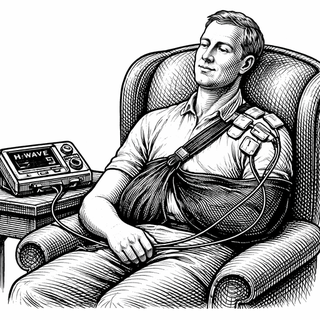
Here's the part that catches people off guard: the surgery itself has gotten quite good. Arthroscopic techniques have made the procedure less invasive and more precise. But the recovery? That's still a beast. We're talking about 3 to 6 months of rehabilitation, weeks of immobilization in a sling, and a pain management challenge that too often defaults to opioids.
And speaking of opioids - that's where this trial gets really interesting.
Enter H-Wave: Not Your Grandmother's TENS Unit
If you've ever seen those little electrode pads people stick on sore muscles, you're probably thinking of a TENS (transcutaneous electrical nerve stimulation) unit. The H-Wave device looks similar on the surface, but it operates on a fundamentally different principle. Where TENS primarily works by flooding your sensory nerves with competing signals (basically telling your brain "listen to this instead of the pain"), H-Wave uses a unique biphasic waveform designed to stimulate deep muscle contractions and promote blood flow at the tissue level.
The distinction matters. Prior research has suggested that H-Wave Device Stimulation (HWDS) may not just mask pain but actually support the physiological processes of healing - improved local circulation, reduced edema, and enhanced lymphatic drainage (Blum et al., 2006). It's the difference between putting a "Do Not Disturb" sign on the pain and actually addressing what's causing the ruckus in the first place.
What This Trial Is Actually Testing
The study, registered at ClinicalTrials.gov, is a prospective, single-center, double-blinded, randomized controlled trial. For those keeping score at home, that's basically the gold standard of clinical trial design - double-blinded means neither the patients nor the evaluators know who's getting the real treatment, which is exactly how you keep wishful thinking from sneaking into your data.
Participants undergoing rotator cuff repair are randomized into two groups:
- Group A: Standard post-surgical care, including access to opioid and non-opioid pain medications
- Group B: Standard post-surgical care PLUS H-Wave Device Stimulation, initiated immediately upon arriving home after surgery
That "immediately" part is worth highlighting. Many post-surgical interventions don't kick in until weeks after the procedure, once initial healing has occurred. This trial is betting that early intervention - right from day one at home - could set the tone for the entire recovery trajectory.
Participants will be followed for three months, with researchers tracking range of motion recovery, pain levels, medication usage (particularly opioids), sleep quality, and overall functional recovery. That's a comprehensive scorecard, and every single metric on it is something patients genuinely care about.
Why This Matters Right Now
Let me put on my "big picture" glasses for a moment. The opioid crisis didn't come out of nowhere. A meaningful portion of opioid dependencies begin with legitimate prescriptions after surgery. Orthopedic procedures are among the highest prescribers, and rotator cuff repair is right in that wheelhouse. Studies have shown that opioid consumption after rotator cuff repair can be significant and prolonged, with some patients still using opioids well beyond expected timelines (Westermann et al., 2017).
If a non-pharmacological device can meaningfully reduce opioid consumption after shoulder surgery - even partially - the downstream effects are enormous. Fewer pills prescribed means fewer pills in medicine cabinets. Fewer opportunities for misuse. Fewer patients accidentally wandering down a path nobody planned on.
And let's not sleep on the sleep data (pun absolutely intended). Anyone who's tried to sleep with a freshly repaired shoulder knows it's roughly as restful as napping on a bed of Legos. Poor sleep impairs healing, worsens pain perception, and generally makes recovery miserable. If HWDS improves sleep quality, that's not a minor footnote - it's a game-changer for quality of life during those brutal first weeks.
The Bigger Rehabilitation Picture
This trial also fits into a broader trend in orthopedic rehabilitation that frankly excites me. We're seeing a shift from passive recovery models ("take your pills, rest, wait") toward active, technology-assisted approaches. Electrical stimulation in various forms has shown promise across multiple post-surgical contexts, from knee arthroplasty to ACL reconstruction (Kittelson et al., 2019).
What makes this particular trial compelling is its pragmatic design. The device is used at home. The intervention starts immediately. The outcomes measured are the ones patients actually ask about in clinic: "When can I move my arm again? Can I sleep tonight? Do I need more painkillers?" That's not ivory tower research - that's research with its feet on the ground.
What Could Go Wrong (Because I'm a Scientist)
No trial preview would be complete without a healthy dose of skepticism. This is a single-center study, which means the results may not generalize to every patient population or surgical approach. Blinding with a device is tricky - sham devices need to look and feel convincing without delivering the therapeutic waveform, and even then, some patients figure out which group they're in. The three-month follow-up captures the most intense recovery period, but longer-term outcomes remain an open question.
Still, even with those caveats, this is a well-designed study asking a question that desperately needs answering: can we make rotator cuff recovery less painful, less drug-dependent, and less miserable?
I'm rooting for a "yes." So are about 2 million shoulders a year.
Stay Tuned
This trial is currently in its early stages, and results won't be available for some time. But it represents exactly the kind of research that could change everyday clinical practice - not through some exotic new drug or surgical robot, but through a device patients can use on their own couch, starting the day they come home. Sometimes the most revolutionary solutions are the ones that fit in a shoebox.
Disclaimer: This blog post is for informational and educational purposes only and does not constitute medical advice. Always consult your healthcare provider regarding treatment decisions. Clinical trial results are pending and the efficacy of the intervention described has not yet been established by this study.
Trial Registration: ClinicalTrials.gov NCT07501949
References:
-
Colvin AC, Egorova N, Harrison AK, Moskowitz A, Flatow EL. National trends in rotator cuff repair. J Bone Joint Surg Am. 2012;94(3):227-233. DOI: 10.2106/JBJS.K.00116
-
Blum K, Chen AL, Chen TJ, et al. The H-Wave device is an effective and safe non-pharmacological analgesic for chronic pain: a meta-analysis. Adv Ther. 2008;25(7):644-657. DOI: 10.1007/s12325-008-0073-3
-
Westermann RW, Anthony CA, Bedard N, et al. Opioid consumption after rotator cuff repair. Arthroscopy. 2017;33(8):1467-1472. DOI: 10.1016/j.arthro.2016.10.013
-
Kittelson AJ, Stackhouse SK, Stevens-Lapsley JE. Neuromuscular electrical stimulation after total joint arthroplasty: a critical review of recent controlled studies. J Orthop Sports Phys Ther. 2019;49(4):255-263. DOI: 10.2519/jospt.2019.8438