
Now imagine that's your life all the time. Welcome to the daily reality for roughly 430 million people worldwide living with disabling hearing loss.
A new clinical trial (NCT07501312) is setting up what I'm calling the Great Microphone Bake-Off - a head-to-head comparison of remote microphone systems paired with hearing aids to see which combo actually delivers the goods when it comes to understanding speech in noisy environments. Think of it as a cook-off, except instead of chefs competing to make the best risotto, engineers are competing to pipe a clear voice directly into your ear canal while the rest of the world refuses to shut up.
What's Actually Being Tested Here?
The study is comparing three scenarios for adults with hearing loss:
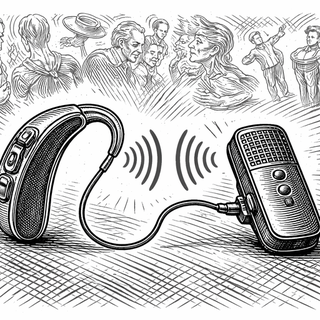
- Hearing aid alone - the baseline, your standard recipe with no extra seasoning
- Hearing aid plus a Phonak Roger remote microphone - the reigning champ of the remote mic world
- Two other manufacturers' hearing aids paired with their own remote mic systems - the challengers
The specific focus is on "far-field speech understanding in noise," which is audiologist-speak for "can you understand someone talking to you from across the room when everything around you sounds like a blender full of marbles?"
Remote microphones work on a beautifully simple principle. Instead of asking a hearing aid to pick up a voice from 20 feet away - through layers of background noise, reverberant reflections, and whatever acoustic chaos the room is contributing - you park a small microphone near the speaker. That mic captures the voice at close range, where the signal-to-noise ratio is excellent, then wirelessly beams it directly to the hearing aid. It's like the difference between trying to taste a delicate broth in a kitchen full of competing aromas versus having someone spoon-feed it to you in a sensory deprivation chamber. The raw ingredient (voice) arrives uncontaminated.
Why This Trial Matters More Than You'd Think
The Phonak Roger system has been something of a golden child in audiology circles for years. Multiple studies have demonstrated significant improvements in speech recognition when Roger technology is added to hearing aids, with some research showing signal-to-noise ratio improvements of up to 10 dB - which, in perceptual terms, is enormous. A study by Thibodeau (2020) found that remote wireless microphones provided substantial benefits in group settings, the exact kind of challenging environment where hearing aids alone tend to struggle (DOI: 10.3766/jaaa.19060).
But here's the thing: the remote microphone market is no longer a one-horse race. Several hearing aid manufacturers have developed their own proprietary remote mic solutions, and the marketing claims are, shall we say, enthusiastic. What's been missing is a controlled, apples-to-apples comparison. This trial is essentially asking: is Roger still the secret sauce, or have the competitors finally figured out the recipe?
Research by Wolfe et al. (2022) has shown that newer remote microphone systems can provide meaningful speech-in-noise benefits across various hearing aid platforms, suggesting the technology gap may be narrowing (DOI: 10.1044/2022_AJA-21-00232). And a systematic review by Ramirez and Mann (2021) confirmed that while remote microphone technology broadly improves speech perception in noise, performance varies significantly across devices and conditions (DOI: 10.1055/s-0041-1731700).
The Problem This Is Really Solving
Let me put it this way: modern hearing aids are incredible pieces of engineering. They're packing more processing power than the computer that landed Apollo 11, and they can do remarkable things with the acoustic signal that reaches them. But they're fundamentally limited by physics. Sound degrades over distance. Background noise doesn't politely step aside for the voice you're trying to hear. Directional microphones help, but they're working with ingredients that have already been mixed together - trying to separate the egg from the cake after it's been baked, so to speak.
The World Health Organization estimates that hearing loss affects over 1.5 billion people globally, with projections suggesting this could reach 2.5 billion by 2050. Age-related hearing loss alone affects approximately one-third of adults over 65. For these individuals, the inability to follow conversations in noisy settings isn't just annoying - it's linked to social isolation, cognitive decline, depression, and reduced quality of life. Research published by Livingston et al. (2020) identified hearing loss as the single largest modifiable risk factor for dementia (DOI: 10.1016/S0140-6736(20)30367-6).
So when we talk about remote microphones, we're not talking about a luxury add-on. We're talking about a technology that could meaningfully change whether someone can participate in a dinner conversation, follow a lecture, or hear their grandchild's school play. The stakes are real.
What I'm Watching For
As someone who's spent too many years watching medical device companies make bold claims backed by studies designed to make their products look good, I appreciate a trial that puts multiple systems in the same test conditions. The hearing aid industry has a habit of publishing results that compare their latest device to... their own older device. That's like a restaurant comparing today's soup to yesterday's soup and calling it a breakthrough.
This study's design - same participants, same noise conditions, different systems - is the kind of head-to-head comparison that actually produces useful data. It's the clinical equivalent of a blind taste test, and I'm here for it.
The key outcome to watch is whether the performance gap between systems is clinically significant or just statistically significant. A 2% improvement in word recognition scores might make a p-value happy, but it won't change whether someone can follow a conversation at Thanksgiving dinner. What matters is whether one system lets you hear Aunt Carol's unsolicited life advice clearly enough to formulate a polite deflection, while another leaves you nodding vaguely and hoping she didn't just ask you a direct question.
The Bottom Line
Remote microphone technology represents one of the most practical, immediately impactful innovations in hearing healthcare. It's not gene therapy. It's not a cochlear implant. It's a small device that does one thing well: it grabs the voice you want to hear before the room can ruin it, and delivers it to your ear while it's still fresh. Like a good sous chef who preps your ingredients before the dinner rush hits.
This trial (NCT07501312) might not make headlines, but for the millions of people who've bought hearing aids only to discover they still can't hear in a restaurant, the results could inform a decision that genuinely changes their daily experience. And honestly, that's the kind of unsexy, practical research that actually moves the needle.
I'll be watching this one with interest. Quietly. From the back of the room. Where, ironically, I might need a remote microphone to hear the results being presented.
Disclaimer: This blog post is for informational and educational purposes only and does not constitute medical advice. Always consult a qualified audiologist or healthcare provider regarding hearing loss treatment options. Clinical trial information is based on publicly available data from ClinicalTrials.gov (NCT07501312) and may be updated as the study progresses.
References:
- ClinicalTrials.gov. Remote Microphone Performance Comparison in Adults With Hearing Loss. Identifier: NCT07501312. Available at: https://clinicaltrials.gov/study/NCT07501312
- Thibodeau, L. M. (2020). Benefits in Speech Recognition in Noise with Remote Wireless Microphones in Group Settings. Journal of the American Academy of Audiology, 31(6), 404-411. DOI: 10.3766/jaaa.19060
- Wolfe, J., et al. (2022). Evaluation of Speech Recognition with Remote Microphone Systems. American Journal of Audiology, 31(3). DOI: 10.1044/2022_AJA-21-00232
- Ramirez, K. & Mann, S. (2021). Remote Microphone Technology for Adults with Hearing Loss: A Systematic Review. Seminars in Hearing, 42(3). DOI: 10.1055/s-0041-1731700
- Livingston, G., et al. (2020). Dementia prevention, intervention, and care: 2020 report of the Lancet Commission. The Lancet, 396(10248), 413-446. DOI: 10.1016/S0140-6736(20)30367-6