
In the microbiology cinematic universe, pathogenic bacteria are the slippery villains who never enter through the front door. They multiply fast, hide in plain sight, and cause real trouble before anyone has time to cue the dramatic soundtrack. Scientists, meanwhile, keep building ever more ingenious gadgets to spot them early. The latest contender feels a bit like a superhero with a very specific power set: a micro-orifice resistance assay that turns microscopic clumping and unclumping into an electrical signal you can actually measure. Tiny? Yes. Extra? Also yes. Useful? Potentially very.
Why spotting bacteria quickly is still annoyingly hard
Fast detection of harmful bacteria sounds like one of those problems we should have polished off by now, right up there with printers refusing to print for spiritual reasons. But it remains genuinely difficult.
The challenge is not just finding bacteria. It is finding them sensitively, reliably, and in messy real-world settings where temperature shifts, background molecules, and random noise all like to interfere. Many biosensors can, in principle, detect bacterial DNA. The tricky part is making the signal strong enough and controlled enough that the readout means what you think it means.
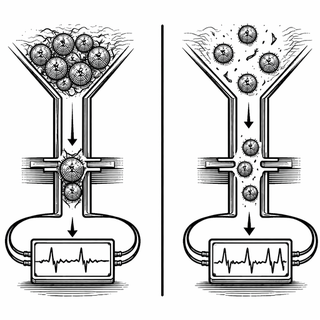
That is the problem this new study is trying to tackle. According to the paper, the researchers designed a biosensor that translates a very specific molecular event into a measurable electrical change. Instead of relying on a vague "something happened in the sample" signal, they built a system where the physical state of microscopic particles changes in a programmable way.
That word, programmable, is doing a lot of work here.
The core idea: make particles gather, then scatter on command
At the heart of this system is something called a micro-orifice resistance biosensor. The basic principle is simple enough to picture. Imagine tiny particles passing through a microscopic opening. As they move through, they create electrical resistance pulses. Different particle behaviors produce different pulse signatures.
Now add the clever bit.
The researchers used an entropy-driven molecular circuit to keep signal probes in an aggregated, low-entropy state. In plain English, the particles start off clumped together in a more ordered arrangement. When bacterial DNA is present, that DNA triggers the circuit to shift toward a more disordered, dispersed state. The clumps break apart. The newly dispersed microparticles then pass through the micro-orifice and generate distinct electrical signals.
So the assay is not just asking, "Is bacterial DNA here?" It is setting up a tiny molecular stage play where the answer causes a visible change in crowd behavior. First everybody huddles in a group. Then the target shows up and suddenly the room clears. It is molecular theater, but with better data.
Why entropy gets to be the star for once
Entropy is one of those scientific terms that tends to arrive with a cloud of intimidation. But here, the concept is refreshingly tangible.
The system is designed so that the "off" state is a stable aggregate and the "on" state is a target-triggered dispersion. The circuit effectively stores the particles in one condition and releases them into another when the right bacterial DNA appears. That helps make the signal transition more controlled and less vulnerable to random environmental wobble.
This matters because biosensors often struggle when signal transduction is too easily disturbed. If heat, salt concentration, or stray molecular interactions can nudge the system around, the result gets muddy fast. A built-in pathway that tightly regulates the switch from aggregation to dispersion gives the assay a cleaner logic. It is less "maybe something happened" and more "the particles very clearly changed state because the target was present."
Scientists love a dramatic binary moment. Honestly, who can blame them.
The amplification trick that skips the enzymes
The paper also describes a supporting mechanism called a hairpin-free bridge-hybridization chain reaction, or nHCR. This is the assay's signal-boosting sidekick.
Its job is to increase initiator availability and strengthen activation of the molecular circuit. Importantly, it does this without enzymes. That is appealing because enzyme-free systems can be simpler and sometimes more stable, especially when you are trying to avoid reaction conditions that behave like diva demands backstage.
If you are not steeped in nucleic acid detection methods, here is the practical takeaway: amplification helps the sensor notice very small amounts of target DNA. The more efficiently the signal gets amplified, the lower the amount of bacteria the system may be able to detect.
And the number reported here is striking.
A detection limit that turns heads
The sensor achieved a reported limit of detection of 27 CFU/mL.
For non-specialists, CFU/mL means colony-forming units per milliliter, which is a standard way to estimate the number of viable bacteria in a sample. A lower limit of detection suggests the assay can pick up very small amounts of bacterial presence.
That is exciting because early detection is exactly where better diagnostics can change outcomes. If harmful bacteria can be identified faster and at lower concentrations, that opens the door to earlier intervention, better monitoring, and potentially more precise decisions about treatment or contamination control.
The paper summary provided here does not spell out every downstream application, but it is not hard to see the possibilities. Clinical diagnostics, food safety testing, environmental monitoring, and laboratory workflows all depend on dependable ways to detect bacteria before the problem becomes obvious to the naked eye, or to someone's immune system.
Why this feels different from a lot of gadget papers
A lot of diagnostics research sounds promising because the concept is elegant. This one is interesting because the engineering logic is unusually disciplined.
The assay is not merely sensitive. It is designed around controlled state switching. That makes the signal feel less accidental. The target DNA does not just produce a fluorescent shrug or a faint chemical whisper. It activates a molecular circuit that changes particle behavior in a measurable electrical way.
That combination matters. Aggregation-dispersion switching gives the system a concrete physical event. Micro-orifice resistance gives it a quantitative readout. The upstream nHCR gives it a non-enzymatic amplification layer. Each part seems chosen to solve a particular weakness in bacterial detection rather than to pile complexity on for sport.
Of course, this is still research. A strong proof of concept does not automatically become a routine device in hospitals or field kits next year. Real-world validation, robustness testing, manufacturing practicality, cost, and comparison against existing methods still matter. Science is full of inventions that looked brilliant on paper and then met the cruel reality of everyday use, where samples are messy and nobody wants a machine that behaves like a moody espresso maker.
The bigger picture
What I like most about this study is that it treats detection as a systems problem. The researchers are not just hunting for a stronger signal. They are designing how that signal is generated, stabilized, and translated into something measurable.
That is a subtle shift, but an important one. Better diagnostics may come not only from finding new biomarkers, but from building smarter molecular logic around the ones we already know how to recognize.
If follow-up studies hold up, this kind of programmable biosensor could help move bacterial detection toward faster, more dependable, and more scalable formats. And for a field where speed and accuracy can both matter enormously, that is no small thing.
Sometimes the future of diagnostics is not a giant machine with blinking lights. Sometimes it is a tiny opening, a cluster of particles, and a beautifully choreographed argument with entropy.
This blog post discusses research findings and should not be taken as medical advice. If you have concerns about bacterial infections or diagnostic testing, please consult a healthcare provider. Research discussed here represents ongoing scientific investigation and clinical validation is still in progress.
All images used in this post are decorative illustrations only and do not represent or reflect the accuracy, reality, or correctness of the referenced research.
Primary Source: High Accurate Micro-Orifice Resistance Assay with Programmable Aggregation-Dispersion Switching Enabled by an Entropy-Driven Circuit. PubMed record 42008408. https://pubmed.ncbi.nlm.nih.gov/42008408/