
Here's the thing about recovering from surgery that nobody tells you: once the operation is over, the real suspense does not necessarily leave the building. A patient can look stable, feel groggy, and be tucked into a regular hospital ward while their oxygen level or breathing rate starts wandering off like a toddler in a supermarket.
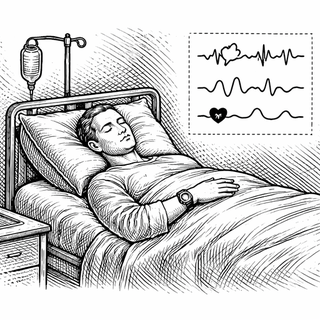
That is what makes this new prospective observational study so interesting. Researchers at University Medical Center Hamburg-Eppendorf in Germany used a wearable device to continuously and secretly monitor vital signs in 190 adults recovering from noncardiac surgery on general wards for up to five postoperative days. "Secretly" here means blinded monitoring, not cloak-and-dagger medicine. The clinical team was not using the device data in real time, so the study could show what abnormalities were happening in the background without changing care.
What were the researchers actually looking for?
The study focused on abnormal vital signs after surgery, specifically:
- Low oxygen saturation, defined as 91% or less
- Breathing that was too slow or too fast
- Very low or very high systolic blood pressure
- Very low or very high pulse rate
The main question was simple and surprisingly underexplored: how often do these abnormalities happen, and how long do they last, in patients who are no longer in the operating room or ICU but are back on standard hospital wards?
That may sound like a niche detail, but it gets to a very practical problem. On general wards, vital signs are often checked intermittently. A nurse measures them, writes them down, and moves on to the next patient, because hospitals are staffed by humans and not by a platoon of caffeinated octopuses. If something abnormal happens between those spot checks, it can be missed.
The short version: abnormalities were common
The headline result is hard to ignore. Patients spent a median of 6% of their monitored time with at least one abnormal vital sign. In plain English, that translated to a median cumulative time of 155 minutes with some kind of abnormality.
That is not a tiny blip. That is more in the category of "long enough to matter, or at least long enough to deserve serious attention."
Even more striking, 39% of patients had an abnormal vital sign that lasted at least 15 continuous minutes. Not seconds. Not a momentary monitor wobble. Fifteen minutes or more.
Which problems showed up most often?
Two abnormalities did most of the heavy lifting here: hypoxaemia and bradypnoea.
Hypoxaemia means low blood oxygen. Patients had a median cumulative hypoxaemia time of 33 minutes, and 31% had episodes lasting at least 15 continuous minutes.
Bradypnoea means breathing that is too slow. That one lasted even longer overall, with a median cumulative time of 62 minutes, and 10% of patients had episodes lasting at least 15 continuous minutes.
The other abnormalities, like extreme blood pressure or pulse changes, were rare by comparison.
That pattern raises an obvious question: why these two? A smart guess is that they fit the postoperative setting all too well. Surgery, pain medication, residual anesthesia effects, disrupted sleep, and lying in bed are not exactly a five-star recipe for perfect breathing. If breathing slows down, oxygen levels can follow.
Why this matters outside the stats section
This is the part where the study becomes more than a collection of thresholds and medians.
Patients recovering on general wards are often in a kind of middle zone. They are not sick enough for intensive care, but they are also not exactly back to normal life. They may be on opioids, sleepy, less mobile, and still physiologically stressed from surgery. It is easy to think of this stage as the calm after the storm. This study suggests it may be more like the part of the movie where the soundtrack goes quiet for suspicious reasons.
Continuous monitoring changes what we can see. Intermittent checks are like taking a few snapshots during a soccer match and trying to reconstruct the score. Continuous data, by contrast, lets clinicians catch the parts where something drifted, dipped, or stayed off-course longer than anyone realized.
But does catching more abnormalities automatically help patients?
Not necessarily, and this study is careful about that.
It shows that abnormal vital signs are common. It does not prove that every detected episode leads to harm. It also does not prove that continuous automated monitoring improves outcomes such as fewer complications, fewer ICU transfers, or lower mortality.
That distinction matters. Medicine has a long history of discovering that seeing more data is useful right up until it becomes overwhelming, noisy, or alarm-heavy. A monitor that beeps for every brief wobble can become the clinical equivalent of a car alarm in a city block. People stop reacting.
So the next step is not simply "put wearables on everyone and declare victory." The real challenge is figuring out which abnormalities are clinically meaningful, which patients benefit most from monitoring, and how hospitals can respond quickly without drowning staff in alerts.
Why this study still feels like a big deal
Even with those caveats, I find the study genuinely compelling because it shines a light on a part of hospital care that can disappear into routine. Postoperative recovery on the general ward is easy to think of as the boring chapter. This paper suggests it is more like a chapter we have not been reading closely enough.
The fact that low oxygen and slow breathing were the main recurring issues is especially useful. It points future research toward targeted questions: should some surgical patients get more respiratory-focused surveillance? Can monitoring identify trouble before a patient looks visibly unwell? Could earlier intervention prevent escalation?
Those are not small questions. If the answers turn out to be yes, the real-world impact could be substantial. Better monitoring might help clinicians intervene earlier, reduce complications, and make the ordinary hospital ward a little less dependent on chance timing.
And from a patient perspective, that matters. Most people assume surgery is the dramatic part and recovery is the administrative sequel. Fill out paperwork, eat gelatin, go home. But the body does not always respect our narrative preferences.
The bigger picture
This study is a reminder that medicine often advances not just by inventing new treatments, but by noticing what has been happening all along. In this case, wearable continuous monitoring acted less like a miracle gadget and more like someone finally turning on the lights.
The research does not answer every question. It does, however, make one thing difficult to ignore: postoperative vital sign abnormalities on general wards are common, they can last a while, and we may be underestimating them when we rely only on occasional checks.
That is a useful finding all by itself. Sometimes the first big breakthrough is not fixing the problem. Sometimes it is realizing how much of the problem has been hiding in plain sight.
This blog post discusses research findings and should not be taken as medical advice. If you have concerns about recovery after surgery, breathing problems, or low oxygen levels, please consult a healthcare provider. Research discussed here represents ongoing scientific investigation and clinical validation is still in progress.
All images used in this post are decorative illustrations only and do not represent or reflect the accuracy, reality, or correctness of the referenced research.
Primary Source: Abnormal vital signs during recovery from noncardiac surgery on general wards: A blinded prospective observational study. PubMed Record 42057579. https://pubmed.ncbi.nlm.nih.gov/42057579/