
The evidence is in, and the nanobody is on trial. Several of them, actually, all accused of the same crime: claiming to bind lysozyme better than their cousins. The prosecution has charts. The defense has charts. And presiding over the whole affair is a machine called Surface Plasmon Resonance, which has the rare judicial virtue of not caring at all what anybody wishes were true.
A new protocol paper in Current Protocols lays out exactly how to run this courtroom, start to finish, on a Biacore T100 instrument. It is not a flashy paper. It is a careful one. And if you have ever tried to rank a handful of protein variants by eyeballing some squiggly curves, careful is exactly the friend you want.

The contestants: small antibodies with big resumes
Let's meet the defendants. Nanobodies are single-domain antibodies derived from camelids, which means llamas and their relatives quietly contributed to molecular biology while mostly being known for spitting. At roughly 12 to 15 kilodaltons, a nanobody is about a tenth the size of a conventional antibody, and yet it binds its target with the kind of specificity that would make a full-size antibody jealous.
The appeal is straightforward when you tally it up. High specificity, excellent thermal stability, cheap and easy production in bacteria, and a structure simple enough that you can engineer variants without the whole thing falling apart. For anyone building a biosensor, that combination is close to a wish list. The receptor sitting on your sensor surface needs to grab the right molecule, hold on appropriately, and not denature the moment someone looks at it sideways. Nanobodies check those boxes.
The catch is that "a nanobody" is rarely one molecule. During biosensor development you typically generate a whole lineup of variants, each a slightly different take on the same binding problem, and only one of them is your star witness. The rest are understudies. The question is which is which, and that question has a number attached to it.
SPR, or measuring love at the speed of light
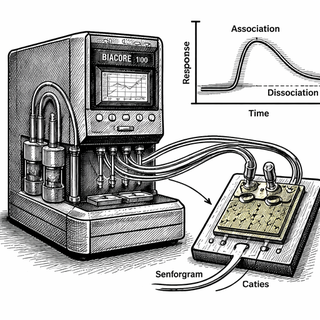
Surface plasmon resonance is the label-free method of choice for watching two molecules decide how they feel about each other. Here is the gist without the optics lecture: you immobilize your target, lysozyme in this case, onto a thin gold sensor surface. You flow your nanobody over it. When molecules bind, the mass at the surface changes, and that change tweaks how light reflects off the gold at a very particular angle. No fluorescent tags, no radioactive labels, no dye that might politely lie to you. Just mass, light, and time.
What you get out is a sensorgram, a curve that tells you two things the verdict actually depends on. The association rate, how quickly the nanobody finds and grabs lysozyme, and the dissociation rate, how reluctantly it lets go. Divide one by the other and you land on the equilibrium dissociation constant, K_D, the single number that ranks affinity. A smaller K_D means a tighter grip. This is the figure that decides which variant gets promoted and which goes back to the freezer to think about what it did.
Lysozyme, for its part, is the perfect stand-in for these trials. It is small, stable, cheap, and has been studied so thoroughly since Alexander Fleming first described it in 1922 that it functions as the lab equivalent of a crash-test dummy. You are not trying to cure anything here. You are calibrating a workflow on a target that won't surprise you, so that the workflow itself can be trusted later on targets that will.

Why a protocol is the actual product
Here is the part that sounds dull and absolutely is not. SPR has a lot of knobs. Buffer composition, immobilization chemistry, ligand density, flow rate, analyte concentration series, regeneration conditions, reference subtraction. Each one is a place where an honest experiment can quietly go sideways. On a high-throughput instrument you can brute-force your way past some of this with sheer replication. On a non-high-throughput machine like the T100, you cannot. You need a plan, and the plan needs to be good before you spend the sample.
That is what this paper delivers, and it does so end to end. Basic Protocol 1 covers expressing and purifying the lysozyme-specific nanobodies, because garbage protein in means garbage kinetics out, and no amount of clever fitting rescues a degraded sample. Support Protocol 1 confirms you actually made what you think you made through protein identification. Basic Protocol 2 is the SPR characterization itself. And Support Protocol 2, tucked at the end like the most important footnote in the building, handles assay planning and development, the unglamorous design work that separates a clean affinity ranking from a pile of curves you'll argue about for a week.
The genuine contribution is reproducibility. A K_D is only as good as the method that produced it, and a method is only useful to the wider field if someone else can run it and get the same answer. A streamlined, documented workflow turns "we got a number" into "anyone can get this number," which is the difference between an anecdote and a measurement.
Why this matters beyond the llama
Biosensors built on nanobody receptors show up in diagnostics, environmental monitoring, and research tools that need to detect a specific molecule in a messy sample. Every one of those applications rests on a receptor that was chosen because somebody, somewhere, ranked the candidates correctly. Get the ranking wrong and you build your detector around the second-best binder, which is the molecular equivalent of hiring the runner-up and never finding out.
By nailing down a clean comparative SPR workflow on an accessible instrument, this work lowers the barrier for smaller labs to do that ranking properly. The trial gets fairer. The verdict gets more trustworthy. And the next nanobody to take the stand, this time bound to something that actually matters clinically, walks into a courtroom that already knows how to weigh the evidence.
The numbers, as always, get the final word. This protocol just makes sure they're telling the truth.
This blog post discusses research findings and should not be taken as medical advice. If you have concerns about biosensor technologies or related diagnostics, please consult a qualified professional. Research discussed here represents ongoing scientific investigation and clinical validation is still in progress.
All images used in this post are decorative illustrations only and do not represent or reflect the accuracy, reality, or correctness of the referenced research.
Primary Source: Surface Plasmon Resonance (SPR) Workflow for Comparative Analysis of Nanobody Variants Binding to Lysozyme as a Model Ligand. Current Protocols. 2026. PubMed: 42053294