
Changing a car tire with the parking brake off is technically possible, but nobody would call it a smart way to spend a Tuesday. That is roughly the vibe of giving a corticosteroid injection without doing everything possible to make it hurt less. The clinical trial NCT07553273 takes a very practical swing at that problem by asking a refreshingly simple question: when someone needs a steroid shot in the upper extremity, what is the least miserable way to get the needle through the front door?
The Study in Plain English
This trial is titled The Effect of Vibratory Anesthesia on Patient Pain Perception in Corticosteroid Injections of the Upper Extremity. In regular-people language, researchers want to know whether adding vibration or a vapo-coolant spray can reduce the pain patients feel when the needle goes in for a corticosteroid injection.
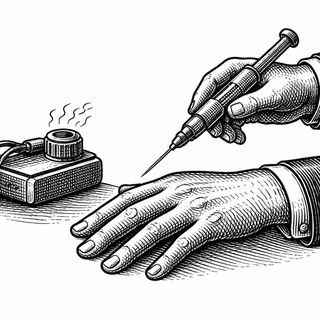
The study compares three anesthesia approaches at the injection site:
- No anesthesia
- Vibrational anesthesia
- Vapo-coolant anesthesia
According to the trial summary, each participant's pain perception will be compared across two of those three options. The main outcome is injection pain at the moment of needle insertion. Clean question, clear comparison, and honestly, a pretty relatable one. Most patients are not lying awake at night pondering study endpoints, but they absolutely remember whether a shot felt like a quick pinch or like their tendon declared war.
The trial focuses on corticosteroid injections of the upper extremity, meaning areas like the hand, wrist, forearm, elbow, or nearby structures. These injections are common in orthopedic and sports medicine settings for painful inflammatory problems. They can help calm down irritated tissue, but the path to relief often involves a needle, and needles still have an undefeated public relations problem.
Why This Is More Interesting Than It Sounds
On paper, this might look like a small comfort issue. In real clinics, it is bigger than that.
I used to work in emergency medicine, and one thing you learn fast is that pain changes behavior. If a patient expects something to hurt, they tense up, pull away, brace early, or avoid the next treatment altogether. Even when the procedure is short, the memory of it can stick around like a bad commercial jingle.
That matters because corticosteroid injections are not rare, exotic procedures. They are everyday tools. If one low-cost trick like vibration can make the experience easier, it could improve how patients tolerate treatment, how calmly procedures go, and maybe even whether people come back when they need follow-up care. That is not glamorous science, but it is useful science. I will take useful over flashy almost every time.
Vibration as pain control also makes physiologic sense. The idea is that competing sensory input can dull the brain's attention to the needle pain. It is a little like trying to notice one person whispering while someone else is drumming on the table next to you. Not a perfect analogy, but close enough for blog work and former paramedic standards.
The Problem This Trial Is Trying to Solve
Corticosteroid injections can be genuinely helpful for inflammation and pain, but the injection itself can be uncomfortable for a few reasons.
First, the skin gets punctured. No mystery there. Second, some injection sites in the hand, wrist, or elbow are packed with sensitive tissue in tight quarters. Third, anticipation makes everything worse. If you have ever watched someone stare down a needle like it owes them money, you know what I mean.
Clinicians already use a variety of tricks to make injections easier. Cooling sprays are one. They numb the surface briefly by rapidly chilling the skin. Vibration is another, often using a handheld device placed near the injection site. Both are fast and simple. The question is whether either one works well enough to beat doing nothing at all, and whether one comes out ahead.
That is exactly the kind of nuts-and-bolts comparison that can change practice if the results are convincing. Not every meaningful medical improvement arrives wearing a cape. Sometimes it shows up as a better spray bottle or a buzzy gadget.
Why Patients Might Care
If this trial finds that vibrational anesthesia reduces pain more than no anesthesia, or even more than vapo-coolant, the real-world payoff could be immediate.
A clinic would not need to rebuild the whole workflow. Staff would not need a six-week retreat in the mountains to learn a new method. They could potentially add a simple step before injection and make a common procedure more tolerable. That is the kind of upgrade healthcare badly needs: not always bigger, but better.
Patients with hand and arm problems are often already frustrated before they ever sit down for the shot. They may be dealing with limited grip strength, trouble working, sports interruptions, sleep loss, or that low-grade daily annoyance of not being able to twist a doorknob without muttering at the universe. If the treatment itself can feel less intimidating, that lowers one more barrier between pain and relief.
There is also a trust factor. When patients see a team making an effort to reduce discomfort, it signals respect. That matters more than some health systems seem to appreciate. People are usually pretty good at spotting the difference between "this is fast" and "this is thoughtful."
What Makes This Trial Worth Watching
I like this study because it deals with a small moment that patients experience in a very big way.
Researchers are not only asking whether corticosteroid injections work. That part has been studied in many contexts already. They are zooming in on the part patients actually dread: the needle entering the skin. That is where memory forms. That is where fear builds. That is where somebody decides whether this was "totally fine" or "absolutely not, never again."
And if vibrational anesthesia does help, it could be one of those rare medical wins that is both low-tech and high-impact. No million-dollar robot. No acronym soup. Just a smarter way to make a routine procedure easier to tolerate. Frankly, medicine could use more of that and fewer gadgets that look like they were designed by a Formula 1 pit crew on no sleep.
The Bottom Line
The clinical trial NCT07553273 is testing whether vibrational anesthesia or vapo-coolant can reduce needle insertion pain during upper extremity corticosteroid injections compared with no anesthesia. It is a focused question, but not a trivial one. If the answer is yes, clinics may have a practical way to make a very common treatment less painful without adding much time, cost, or complexity.
That is the kind of research I never roll my eyes at. When medicine can make something work better and feel better, patients notice. Usually before the billing department does.
ClinicalTrials.gov links:
Primary study page: https://clinicaltrials.gov/study/NCT07553273
Table view: https://clinicaltrials.gov/study/NCT07553273?tab=table
Disclaimer: This article is for educational purposes only and is not medical advice. It is based on the ClinicalTrials.gov study record for NCT07553273 and should not replace guidance from a licensed clinician.
Citation: ClinicalTrials.gov. NCT07553273, "The Effect of Vibratory Anesthesia on Patient Pain Perception in Corticosteroid Injections of the Upper Extremity." Available at: https://clinicaltrials.gov/study/NCT07553273