
The same white powder that makes your toothpaste look clean, your doughnut icing look bright, and your tennis court lines look crisp is also one of the most effective ultraviolet shields humans have ever smeared on their faces. Titanium dioxide, or TiO2 to its friends, is a remarkably boring-looking compound with a surprisingly heroic day job: standing between your skin cells and the part of sunlight that wants to scramble your DNA.
This particular research takes aim at the inorganic nanoparticle side of that story, the version where scientists shrink TiO2 down to specks far smaller than a human cell and ask it to keep doing its sunscreen work without leaving you looking like a mime. Before we get carried away, let's pump the brakes and figure out what this mineral actually does, why making it tiny is both clever and complicated, and what we still don't know.
What titanium dioxide is actually doing up there
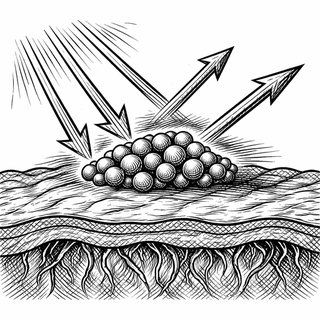
Most chemical sunscreens work like little sponges. They absorb UV photons and dissipate the energy as a trickle of heat. Titanium dioxide takes a more confrontational approach. As a "physical" or "mineral" filter, it largely scatters and reflects ultraviolet light, sending those high-energy photons back where they came from. Think of it less as a sponge and more as a very enthusiastic bouncer who turns troublemakers away at the door.
The catch is that classic TiO2 is also fantastic at scattering visible light, which is exactly why old-school zinc-and-titanium sunscreens left lifeguards looking like they'd lost a fight with a bag of flour. That chalky white cast is the price of the protection, and for decades it was a deal-breaker for anyone hoping to leave the house.
Why "nano" changes the game (and the questions)
Here is the counterintuitive engineering trick. If you grind TiO2 particles down to the nanoscale, they become too small to scatter visible light effectively, so they go more or less transparent on skin. But they remain perfectly capable of interfering with shorter ultraviolet wavelengths. You get the UV-blocking bouncer without the ghost-makeup side effect. It is a genuinely elegant bit of physics, and it explains why nearly every modern mineral sunscreen relies on nanoparticles whether the label brags about it or not.
The phrase in this paper - inorganic nanoparticles with "excellent anti-ultraviolet ability" - is doing a lot of quiet work. Inorganic matters because these mineral filters tend to be photostable, meaning they don't break down quickly under the very sunlight they're meant to fight. Many organic chemical filters degrade after a couple of hours of sun, which is part of why reapplication exists and why your beach day involves so much reapplying and so little relaxing.
But shrinking a material almost always changes how it behaves, and not always in the directions you'd hope. A nanoparticle has enormously more surface area relative to its volume than a chunky particle does, and surface area is where chemistry happens. TiO2 is also a known photocatalyst, which is a fancy way of saying that under UV light it can generate reactive oxygen species - the same unstable molecules your dermatologist keeps warning you about. The irony of a sunscreen ingredient potentially producing the very free radicals associated with sun damage is not lost on the field, which is why most commercial nano-TiO2 is coated with materials like silica or alumina to keep that reactivity in check. Whether a coating stays intact through manufacturing, bottling, a summer in a hot car, and a few hours of sweaty swimming is a fair question, and it is exactly the kind of detail this sort of research exists to scrutinize.
The skin barrier deserves more credit than we give it
The headline worry with any nanoparticle is migration. If these specks are small enough to vanish on skin, can they slip through it? The reassuring news from the broader literature is that healthy, intact skin is a genuinely excellent fence. Repeated studies have found that TiO2 nanoparticles in sunscreen stay parked in the outermost dead layer of the epidermis, the stratum corneum, rather than tunneling into living tissue. Your skin barrier, it turns out, has been keeping the outside world out for a very long time and is not easily impressed by a marketing department's word "nano."
The honest caveat is that "intact" is the operative word. Sunburned skin, eczema-cracked skin, or freshly shaved skin is a different barrier, and inhalation is a separate conversation entirely - which is why most regulators are far twitchier about loose TiO2 powder and spray sunscreens than about a lotion you rub in. Spraying any aerosolized nanoparticle near your own face is a category of risk worth treating with respect.
What this research adds, and what it doesn't settle
Work like this matters because the gap between "blocks UV beautifully in a lab dish" and "is safe and effective on millions of human faces for decades" is wide and littered with good intentions. Characterizing how inorganic nanoparticles achieve their anti-UV performance is the unglamorous foundation that lets formulators optimize particle size, coating, and dispersion rather than guessing. The real-world payoff, if follow-up development holds up, is sun protection that is more transparent, more photostable, and more reliably distributed across the skin than what we've got - which translates to fewer sunburns, and over a lifetime, fewer skin cancers.
I'll resist declaring victory. A single study summarized by a truncated abstract is a data point, not a verdict, and the questions that matter most for nanoparticle sunscreens - long-term coating stability, behavior on compromised skin, environmental fate once it rinses into the ocean - are precisely the ones that need years of patient follow-up rather than one promising result. The physics here is genuinely lovely. The diligence required to turn lovely physics into a product you'd trust on a toddler is where the hard part lives.
In the meantime, the boringly correct advice remains intact: a hat, some shade, and a sunscreen you'll actually reapply beat any miracle ingredient sitting unused in the cabinet.
This blog post discusses research findings and should not be taken as medical advice. If you have concerns about sun protection, skin cancer risk, or sunscreen safety, please consult a healthcare provider or dermatologist. Research discussed here represents ongoing scientific investigation and clinical validation is still in progress.
All images used in this post are decorative illustrations only and do not represent or reflect the accuracy, reality, or correctness of the referenced research.
Primary Source: Titanium dioxide (TiO2) inorganic nanoparticles for ultraviolet protection. PubMed. 2026. PMID: 41962711