
For $1,000 — what medical innovation just changed the game for esophageal mucosal damage? The answer may be: esophageal organoids grown and delivered in an esophagus-derived extracellular matrix. Not exactly a phrase that rolls off the tongue, which is ironic given the organ involved, but the idea is elegant. Instead of growing tiny esophageal tissue structures in a generic lab gel with baggage, this study asks: what if the cells were given something closer to their own kitchen?
The research, indexed in PubMed under record ID 41551765, focuses on a practical problem in organoid science. Esophageal organoids could one day help repair damaged lining in the esophagus, including ulcer-like mucosal injuries. But the standard culture material, Matrigel, is a problem child. It works well in the lab, but it comes from tumor-derived mouse material, which makes clinical translation about as tidy as bringing soup to a cleanroom in a paper bag.
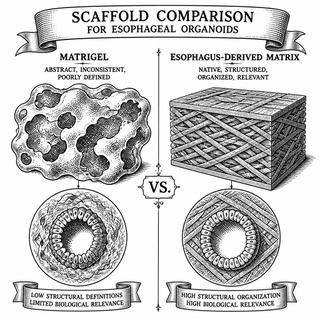
So the team tested a different scaffold: decellularized esophagus-derived extracellular matrix, or EEM. In plain English, they took esophageal tissue, removed the cells, and kept the protein-rich structural environment that cells normally live in. Think of it as stripping a building down to its beams, plumbing, and wiring, then inviting new tenants who already know the neighborhood.
Why Matrigel Is Useful, Awkward, and Hard to Defend
Matrigel has been a workhorse for organoid culture because it gives cells a 3D environment where they can grow, organize, and behave more like tissue than flat cells on plastic. For research, that has been enormously useful.
For a medical product, though, Matrigel raises eyebrows. It is derived from tumor material, can vary from batch to batch, and is not a natural esophageal microenvironment. Regulators tend to ask uncomfortable questions about things like source materials, reproducibility, safety, and manufacturing control. This is their job. They are not being difficult; they are being the adult in the room.
If organoids are ever going to move from “fascinating biology” into “something a clinician might use,” the supporting matrix matters. The scaffold is not just packaging. It can influence cell behavior, survival, differentiation, and healing. In device terms, it is part of the product architecture, not bubble wrap.
What the Study Did
The researchers developed and tested EEM hydrogel for both culture and transplantation of esophageal organoids. The idea was to make the growth environment more biologically relevant by using extracellular matrix from the same organ type.
Their proteomic analysis found that EEM carried a broader, more esophagus-specific protein profile than Matrigel. That matters because cells are not just floating blobs taking orders from DNA. They constantly read their surroundings. Matrix proteins act like local instructions, telling cells when to stick, spread, mature, migrate, or repair damage.
The study reports that esophageal organoids grown in EEM hydrogel could expand through multiple passages. They also showed comparable or higher expression of esophagus-related genes compared with organoids grown in Matrigel. That is a meaningful signal. It suggests EEM did not merely keep the organoids alive, which is the biological equivalent of serving boiled potatoes and calling it dinner. It may have supported a more appropriate esophageal identity.
The Mouse Ulcer Model: Where It Gets More Interesting
The team then moved beyond culture dishes and tested transplantation in a mouse model of esophageal ulcer injury. Organoids delivered with EEM promoted epithelial regeneration and reduced fibrosis at the wound site.
That second part deserves attention. Fibrosis is the body’s repair crew getting overenthusiastic with the caulk gun. Some scarring is part of healing, but excessive fibrosis can stiffen tissue and impair function. In the esophagus, where flexibility and coordinated movement matter, scar-heavy repair is not ideal.
The study also examined protein profiles in regenerating esophageal tissue and found patterns supporting activation of wound healing after organoid transplantation. That helps connect the visual tissue repair findings with underlying biology. It does not prove clinical efficacy in humans, but it strengthens the story.
Why This Matters for Medical Product Development
From an engineering and commercialization standpoint, this paper is interesting because it addresses a translation bottleneck. Organoid therapy is not just a cell therapy problem. It is also a materials problem, a manufacturing problem, a delivery problem, and eventually a reimbursement problem wearing a lab coat.
A matrix that better mimics the native esophagus could improve performance. A matrix that replaces tumor-derived Matrigel could improve the clinical development story. Those are two very different wins, and this study points toward both.
But the road from mouse ulcer model to human therapy is not short. A practical product would need answers to questions such as:
- Can EEM be manufactured consistently at scale?
- What tissue source will be used, and how will it be qualified?
- Can decellularization reliably remove cellular material while preserving useful matrix proteins?
- How will sterility, storage, viscosity, and delivery be controlled?
- What release tests prove each batch is “good enough”?
- Will the organoid-plus-matrix combination be regulated more like a biologic, device, combination product, or something that makes everyone schedule extra meetings?
That last one is not a joke so much as a forecast.
The Business Case, If the Biology Holds
Esophageal mucosal injury can occur in several clinical contexts, including reflux-related damage, ulceration, inflammatory disease, endoscopic procedures, and other insults to the lining. A therapy that helps restore epithelium while limiting fibrosis could have meaningful clinical value.
The most obvious early application might be severe or localized injury where current management is limited and healing quality matters. But a future product would need a clear use case. “Regenerates esophageal tissue” sounds exciting. “Improves healing after defined injury type in a measurable way that changes patient outcomes” is what gets buyers, regulators, and clinicians to lean forward.
For industry, the attractive part is that EEM may function as both culture system and transplant matrix. That could simplify the workflow if the same or related material supports manufacturing and delivery. Fewer handoffs, fewer formulation changes, fewer places for biology to throw a tantrum.
Still, autologous versus allogeneic organoids, off-the-shelf feasibility, logistics, and cost of goods all loom large. Organoid products can become expensive quickly. Tiny tissues are charming until finance asks how many technicians, incubators, assays, and release tests are hiding behind each dose.
What Makes This Study Stand Out
The clever part is not just “use a natural matrix.” Researchers have explored decellularized extracellular matrices in many tissue engineering contexts. The sharper move here is matching the matrix to the target organ and showing that its protein complexity differs from Matrigel in ways that may matter for esophageal organoids.
That is a more disciplined approach than treating all 3D gels as interchangeable pudding. Cells notice the recipe.
The reported reduction in fibrosis also gives the work a therapeutic angle beyond simple epithelial replacement. If follow-up studies confirm that EEM-guided organoid transplantation improves repair quality, this could become a more compelling regenerative strategy.
The Skeptical Take
This is still preclinical research. Mouse esophageal injury models are useful, but they do not capture all the mechanical, immunological, microbial, and clinical realities of human esophageal disease. The esophagus is not just a tube. It is a hostile, moving, acid-adjacent logistics corridor. Any implanted or transplanted material has to survive that environment long enough to matter.
There is also the question of standardization. Proteomic richness is biologically attractive, but product developers hear “complex natural mixture” and immediately start looking for batch records, potency assays, and coffee. A refined matrix that preserves useful biology while meeting manufacturing standards would be the real prize.
Even so, this study moves the field in a practical direction. It does not simply celebrate organoids as magical repair pellets. It tackles one of the less glamorous but more decisive questions: what should these cells live in, and what should they be delivered with?
That is where many regenerative medicine programs either become products or become beautiful posters in conference hallways.
Bottom Line
This research suggests that esophagus-derived extracellular matrix can support esophageal organoid growth and may improve healing when used for transplantation in a mouse esophageal ulcer model. By replacing Matrigel with a tissue-specific matrix, the approach addresses both biological relevance and clinical translation concerns.
There is a lot still to prove before this becomes a therapy. But as a platform concept, EEM looks like a smarter scaffold for esophageal organoids: less generic gel, more native instruction manual. In regenerative medicine, that kind of upgrade can matter.
This blog post discusses research findings and should not be taken as medical advice. If you have concerns about esophageal injury, reflux disease, swallowing problems, or related symptoms, please consult a healthcare provider. Research discussed here represents ongoing scientific investigation and clinical validation is still in progress.
All images used in this post are decorative illustrations only and do not represent or reflect the accuracy, reality, or correctness of the referenced research.
Primary Source: Esophagus extracellular matrix with microenvironmental complexity for esophageal organoids. PubMed Record ID 41551765. PubMed