
Fun fact: humans are remarkably willing to change behavior when a gadget starts quietly keeping score. Give us a wrist wearable, a sleep metric, and a recovery graph, and suddenly that late-night second drink can feel about as subtle as bringing a tuba into a library. That is what makes a new study on alcohol use among WHOOP members so interesting. It suggests that during the first 72 weeks of membership, people reported drinking less over time.
That may sound simple, but from a clinical perspective it is not trivial at all. Alcohol use touches sleep, heart rate, recovery, mood, exercise performance, metabolic health, and long-term disease risk. In real life, behavior change rarely arrives with a trumpet fanfare. More often, it creeps in through repeated small decisions, especially when people get feedback they can actually see.
What the study found
The study, titled Alcohol Use Trajectories During the First 72 Weeks of WHOOP Wearable Platform Membership: Observational Cohort Study, followed 30,000 new wearable users across 11.6 million person-days. That is a very large sample, and large samples are helpful when you are trying to detect meaningful patterns rather than random noise.
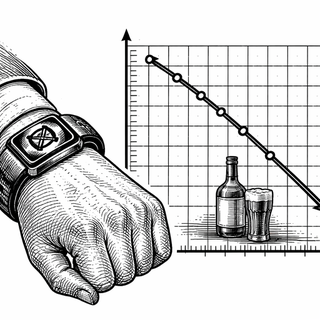
The core finding was straightforward: self-reported alcohol consumption declined significantly over the 72-week study period. More specifically, the daily probability of drinking dropped by 5.8 percentage points, with a statistically significant result of P<.001. The reduction appeared across age groups and across biological sex.
On the surface, 5.8 percentage points may not sound dramatic. But pause for a second. A shift in daily drinking probability across tens of thousands of people, sustained over many months, is not a tiny wobble. It is the sort of population-level change that gets clinicians and public health researchers to sit up a little straighter in their chairs.
Why would a wearable be linked to less drinking?
This is where the bedside part of my brain gets interested. Patients do not usually change habits because someone recited a risk ratio at them in a fluorescent exam room. They change because the consequences become tangible. Wearables can do that.
Alcohol often worsens sleep quality, increases overnight heart rate, and can leave recovery metrics looking less than glamorous the next morning. A person may not feel convinced by abstract health advice, but seeing a rough sleep score after a night of drinking can be a different kind of nudge. It is immediate. It is personal. And, perhaps annoyingly for some of us, the wristband has receipts.
In other words, a wearable may act less like a scolding hall monitor and more like a very persistent mirror. It reflects patterns back to the user in near real time. For some people, that feedback loop may help connect behavior with outcome in a way that sticks.
Why this matters beyond fitness culture
It would be easy to dismiss this as a story about wellness enthusiasts optimizing their Tuesdays. I would resist that temptation.
Alcohol reduction matters clinically even when the change is modest. Lower alcohol intake can improve sleep regularity, reduce cardiovascular strain, support mental health, and in some cases decrease the likelihood of escalating use over time. Not every person who drinks is headed toward alcohol use disorder, of course, but even moderate changes in routine can have meaningful health benefits.
There is also something refreshing here from a research standpoint. Much of medicine depends on people trying to remember what they did last week, last month, or over the holidays, which is a heroic expectation at best. Wearables do not solve every measurement problem, but they can anchor self-awareness in daily life. They capture rhythm, repetition, and trends. Human memory is many wonderful things, but a precision instrument it is not.
The most interesting part may be the timing
The study looked at the first 72 weeks of membership, which is long enough to move beyond the honeymoon phase. That matters. Plenty of healthy behaviors bloom brightly for three weeks and then vanish like a New Year's resolution by February 14.
A longer observation window gives this finding a bit more weight. It suggests the decline in drinking was not just a short burst of enthusiasm from people excited about a new device. Instead, it may reflect a more durable shift in how some users respond to ongoing feedback about sleep, strain, and recovery.
That does not prove the wearable caused the change. But it does raise an important possibility: digital self-monitoring may support healthier choices over time, not just in the first burst of motivation when people are still reading every metric like it is a horoscope.
What this study does not prove
As promising as these results are, this was an observational cohort study. That means we can see an association, but we cannot claim a direct cause-and-effect relationship.
Maybe the wearable experience encouraged people to drink less. Maybe people who choose to join a wearable platform are already primed to make health changes. Maybe both are true. There is also the issue of self-reported alcohol use. People are not always perfect reporters of what they drink, especially when memory, social desirability, or simple fuzzy arithmetic gets involved. "Just one glass" has done a lot of imaginative work over the years.
So this is not a final answer. It is a strong signal. In research, signals matter. They tell us where to look next.
What could come next
The natural next step is more targeted research asking why the change happens and for whom it happens most strongly. Are users responding to sleep disruption? Recovery scores? Community features? Coaching? Habit tracking? Some combination of all of the above?
It would also be useful to know whether certain groups benefit more than others, such as people with heavier baseline drinking, people using wearables primarily for performance goals, or people who already suspect alcohol is hurting their sleep. Future studies could also compare users who receive different types of feedback or prompts. That would bring us closer to understanding mechanism rather than just trend.
From a clinical lens, this is where things get practical. If wearable-based feedback can help people reduce alcohol use without formal treatment, even modestly, that could become a useful low-friction support tool. Not a replacement for counseling or medical care when those are needed, but a helpful layer. Sometimes behavior change starts with a big intervention. Sometimes it starts with your watch gently informing you that your "relaxing evening" was apparently a physiological event.
The bottom line
This study offers an intriguing glimpse into how digital health tools may influence everyday choices. Among 30,000 new WHOOP users, self-reported alcohol use declined over 72 weeks, with a 5.8 percentage-point drop in the daily probability of drinking. The pattern held across age groups and biological sex.
For clinicians, researchers, and everyday wearable users, that is worth paying attention to. Not because a wrist device is magic, and certainly not because one observational study settles the matter, but because it points toward something deeply human: when people can clearly see how a behavior affects how they feel, sleep, and function, change becomes more possible.
And honestly, medicine could use a few more tools that make the healthy choice feel less like homework.
This blog post discusses research findings and should not be taken as medical advice. If you have concerns about alcohol use, sleep, or related health issues, please consult a healthcare provider. Research discussed here represents ongoing scientific investigation and clinical validation is still in progress.
All images used in this post are decorative illustrations only and do not represent or reflect the accuracy, reality, or correctness of the referenced research.
Primary Source: Alcohol Use Trajectories During the First 72 Weeks of WHOOP Wearable Platform Membership: Observational Cohort Study. PubMed record 42044360. https://pubmed.ncbi.nlm.nih.gov/42044360/