
Picture this: you're getting a new knee. Exciting, right? Okay, maybe "exciting" isn't the word you'd choose, but stay with me. The surgeon has to attach your shiny new artificial knee to your bone, and there's a decision that matters more than you might think: should they use cement, or let your bone grow into the implant naturally?
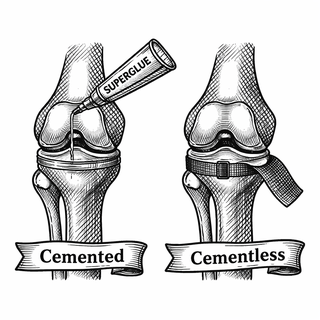
It's like choosing between superglue and Velcro, except the stakes are considerably higher and the decision could affect how your knee performs for the next two decades.
Welcome to the great cemented vs. cementless debate - and a fascinating clinical trial (NCT05630053) that's trying to settle the score once and for all.
The Classic Approach: Cement (Not the Sidewalk Kind)
When total knee arthroplasty (TKA) first became a thing in the 1970s, surgeons used bone cement - specifically polymethyl methacrylate (PMMA) - to stick the metal and plastic components to the bone. It's the equivalent of using construction adhesive, and it works really well.
Cemented TKA has been the gold standard for decades. The long-term data is excellent. Registry studies from around the world show outstanding survival rates at 15, 20, even 25 years. Your grandma's cemented knee replacement from 1995? Still probably going strong.
So why would anyone want to mess with success?
The Cementless Revolution: Let Biology Do the Work
Here's the thing about cement: it doesn't biologically integrate with your bone. It's a mechanical fixation. The cement essentially fills the gaps between your bone and the implant, creating a stable construct. But over time, the cement-bone interface can weaken. Cement particles can cause inflammation. And if you ever need a revision surgery, getting that cemented implant out is... challenging.
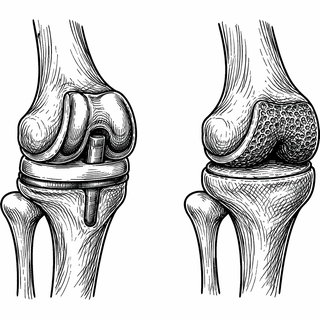
Cementless implants take a different approach. Instead of glue, they rely on biological fixation - your bone actually grows into the implant's surface. This requires:
1. A porous surface that bone can infiltrate
2. Extremely tight initial fit to prevent micromotion
3. Time for bone ingrowth to occur (typically 6-12 weeks)
When it works well, you end up with an implant that's essentially part of your skeleton. The theoretical advantages include better long-term stability, easier revision surgery if ever needed, and no cement-related complications.
Enter the Persona OsseoTi Keel
Zimmer Biomet, one of the big players in orthopedic implants, received FDA clearance in November 2022 for their Persona OsseoTi Keel Tibia - a cementless knee implant with some seriously cool technology.
The "OsseoTi Porous Metal Technology" uses 3D printing to create a surface that mimics the architecture of human cancellous (spongey) bone. We're talking about a structure designed at the microscopic level to encourage bone cells to move in and set up shop.
The "keel" design is also significant. Traditional cementless tibial components relied on pegs or screws for initial fixation. The keel provides more surface area for bone ingrowth and better initial stability - think of it like the difference between a fence post and a small stake.
The Trial: NCT05630053
This brings us to the clinical trial at hand. Researchers are conducting a prospective, multi-center, randomized controlled trial comparing the Persona Keel cemented system against the Persona OsseoTi Keel cementless system.
Here are the key details:
- Participants: Up to 300 patients (150 per arm) across up to 10 sites
- Design: Randomized, with patients blinded to which implant they received until after surgery
- Follow-up: 3 months, 1 year, 2 years, and 5 years
The researchers are looking at EQ-5D scores (a quality of life measure), pain levels using a numerical rating scale, and clinical outcomes at various time points. The five-year follow-up is particularly valuable because that's when differences between cemented and cementless fixation might start to become apparent.
What Does the Current Research Say?
A 2024 meta-analysis published in the Journal of Orthopaedic Surgery (DOI: 10.1177/10225536241267270) analyzed 16 randomized controlled trials with 2,358 participants. The verdict? "No significant differences between cemented and cementless fixation for infection, aseptic loosening, or revision rates."
Well, that's not exactly a thrilling conclusion, but it's actually good news. It means cementless fixation has caught up to the cemented gold standard in terms of reliability.
But here's where it gets more nuanced. A 2024 meta-analysis in the Bone & Joint Journal analyzed 23 RCTs and 45 observational studies and found that "newer designs of cementless implants may offer improved survival in patients aged under 60 years."
Why younger patients? They're more active, put more stress on their knees, and - here's the big one - they're more likely to outlive their implants and need revision surgery. If cementless makes revision easier, that's a significant advantage for someone who might need a second knee replacement at age 75.
The Operative Time Factor
One thing the research consistently shows: cementless surgery is faster. A 2024 study found that total operative time was 82.1 minutes for cementless versus 93.7 minutes for cemented - that's about a 12-minute difference.
Why does this matter? Less time in the OR means less anesthesia, potentially lower infection risk, and better operating room efficiency (which hospitals care about a lot). It's not going to change your life, but if you're the one on the table, every minute counts.
The Potential Downsides
Let's not pretend cementless is perfect. The same research found that cementless TKA had a higher rate of postoperative manipulation for stiffness (8% vs 3%) and a slightly higher rate of early aseptic loosening requiring revision (1% vs 0% in one study).
These are relatively small numbers, but they're real. The theory is that the biological fixation process can sometimes lead to more initial stiffness as the bone integrates with the implant. And if the bone doesn't ingrow properly - due to poor bone quality, micromotion, or just biology being biology - you can end up with a loose implant that needs to be redone.
Who Might Benefit Most?
Based on current evidence, cementless TKA might be particularly suitable for:
- Younger patients (under 60) who are likely to outlive their implants
- Active patients who put high demands on their knees
- Patients with good bone quality where ingrowth is more likely to succeed
- Surgeons with high-volume experience in cementless technique
On the flip side, cemented TKA might still be the better choice for:
- Elderly patients where long-term biological fixation matters less
- Patients with osteoporosis or poor bone quality
- Revision surgery (though this is changing)
- Settings where cemented technique is well-established
The Robotic Wrinkle
As if this weren't complicated enough, robotic-assisted surgery is entering the picture. A 2024 study comparing robotic-assisted cemented vs. cementless TKA found no significant difference in patient-reported outcomes between the groups.
Robotic systems offer incredibly precise cuts and implant positioning, which might help optimize outcomes for both cemented and cementless approaches. It's possible that as robotic surgery becomes more widespread, the differences between fixation methods will matter less because the implants are placed so precisely.
What This Trial Means for You
If you're facing knee replacement surgery, this trial (and others like it) are working to answer the question you probably want to know: "Which option will give me the best chance of a pain-free, active life for the longest time?"
The honest answer right now is: for most patients, both options work really well. The differences are at the margins. But those margins matter if you're the one whose knee failed early or who needed a difficult revision.
The Persona OsseoTi Keel trial is exactly the kind of rigorous, long-term study we need to tease out those differences. With five-year follow-up and careful randomization, it should give us meaningful data about whether the latest cementless technology truly delivers on its promise.
The Bottom Line
Knee replacement technology has come remarkably far. Whether your surgeon uses cement or lets your bone grow into a 3D-printed porous surface, your odds of getting a functional, long-lasting new knee are excellent.
But if you want to have an informed conversation with your surgeon about which approach might be best for your specific situation - your age, activity level, bone quality, and preferences - knowing about trials like this can help you ask the right questions.
After all, it's your knee. You should have a say in how it gets rebuilt.
Disclaimer: This blog post is for informational purposes only and does not constitute medical advice. Surgical decisions should be made in consultation with qualified orthopedic surgeons who can evaluate individual circumstances. Clinical trials have specific eligibility criteria, and outcomes vary based on many factors. Images and graphics are for illustrative purposes only and do not depict actual medical devices, procedures, mechanisms, or research findings from the referenced studies.