
Things I learned this week: proteins can be turned into tiny analyte detectors, biosensors keep getting smarter, and many of them still fail the moment we ask them to leave the lab and behave in public. Which, honestly, makes them sound a bit like brilliant medical students on their first overnight call.
A recent review, Metric-driven biosensors for analyte detection, makes a simple but very useful argument. We should stop admiring biosensors mainly for being clever and start judging them by whether they actually meet the performance metrics needed in the real world. That means asking less “is this scientifically elegant?” and more “does it work fast enough, clearly enough, and reliably enough to matter?”
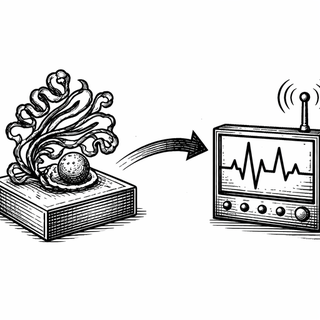
That shift may not sound glamorous, but it is where a lot of progress lives.
What exactly is a biosensor?
At the most basic level, a biosensor is a device or system that recognizes a biological or chemical target, called an analyte, and turns that recognition into a signal we can detect. The analyte might be a toxin in water, a metabolite in a fermentation tank, or a disease-related molecule in a clinical sample.
The review focuses on protein-based biosensors. Proteins are especially useful here because they are nature’s exquisitely fussy little recognition machines. They bind specific molecules, change shape, catalyze reactions, and generally act as if they have read the instructions in advance. Engineers then exploit those behaviors to create readable outputs such as fluorescence, electrical signals, or some other measurable change.
That is the romantic version, anyway. The less romantic version is that a biosensor can look terrific in a figure panel and still be far too slow, too unstable, too nonspecific, or too impractical for actual use. Science is full of dazzling prototypes. Translation is where the paperwork starts.
The paper’s central idea: metrics first
The review argues for a metric-driven framework. I like this because it treats biosensor development less like an art project and more like medicine. In clinic, no one is impressed that a test is conceptually interesting if it gives murky answers, takes forever, or falls apart in ordinary conditions. Biosensors deserve the same skepticism.
The authors highlight two big design questions.
First, how does molecular recognition get coupled to a detectable output? In other words, once the protein notices the analyte, how does that become a signal we can actually measure?
Second, which engineering levers can tune performance? That includes the sensor protein itself, the surrounding system, and the way the sensor is deployed.
This sounds technical because it is technical. But it is also refreshingly practical. A biosensor is not just “does binding happen?” It is “does useful information emerge, on time, in the right setting, without collapsing into noise?”
The five metrics that matter
The review discusses several key performance metrics, and these are worth translating into plain English.
Dynamic range is how much the output changes between low and high analyte levels. If a sensor barely budges when the target concentration changes, it is not much help. You want a clear, readable difference, not the biochemical equivalent of someone shrugging.
Response speed matters because a sensor that detects the right thing next Tuesday may not be much use today. Fast response is especially valuable for diagnostics, environmental monitoring, and industrial process control, where delays can turn manageable problems into expensive ones.
Specificity asks whether the sensor is actually detecting the intended analyte and not getting distracted by chemical look-alikes. Biology is a crowded room. If your biosensor starts greeting the wrong guests, the whole exercise becomes awkward.
Detectability refers to whether the signal is strong enough to distinguish real presence from background noise. This is the eternal problem in measurement science: nature whispers, equipment hisses, and we pretend those are easy to sort out.
Stability may be the least flashy metric and one of the most decisive. A sensor that works beautifully for a short, pampered existence under ideal lab conditions is not necessarily useful in a field setting, a clinic, or a manufacturing process. Plenty of biological tools are excellent until exposed to temperature changes, storage time, or the rude reality of nonsterile environments.
Format matters more than we sometimes admit
One of the more interesting points in the review is that biosensor implementation itself is a design variable. The same sensing concept can be deployed in different formats, including whole-cell, cell-free, and immobilized systems.
Whole-cell biosensors use living cells as part of the sensing machinery. These can be powerful because cells are already good at processing signals and supporting protein function. The downside is that living systems come with all the usual fine print, including variability, maintenance, and regulation. Cells, inconveniently, insist on being alive.
Cell-free systems remove much of that complexity by using biological components outside living cells. This can improve control and reduce some practical barriers, though it may introduce other tradeoffs in robustness or scalability.
Immobilized formats attach sensing components to a surface or material. That can help with portability and integration into devices, especially when the goal is something field-ready or clinic-friendly.
This is a useful reminder that there is no single “best biosensor” in the abstract. There is only a biosensor that fits a specific job. A system optimized for wastewater monitoring may not be ideal for bedside diagnostics, and vice versa. Context is not a footnote here. It is half the design brief.
Why this matters outside the lab
What makes this paper interesting is not just the science, but the discipline it demands. Biosensors are often discussed as futuristic tools for rapid diagnostics, environmental surveillance, and smarter bioprocessing. All of that is plausible. But plausibility is cheap.
A metric-driven approach forces developers to identify the bottleneck. Is the sensor not specific enough? Too slow? Not stable enough for deployment? Does the molecular recognition work but fail to generate a clean readout? Once the problem is named clearly, protein engineering can be applied more intelligently.
That is the part I suspect will matter most over time. Not every biosensor needs reinvention. Many need refinement, with engineering focused on the weakest performance parameter instead of adding complexity for its own sake. There is a certain maturity in that approach. Slightly less cinematic, perhaps, but much more likely to survive contact with reality.
The bigger irony
The irony, of course, is that biosensors are meant to measure the world with precision, yet the field itself sometimes advances by fuzzy standards. This review is a gentle but firm push toward better discipline: define the performance goal, understand the signal pathway, identify the limiting factor, and engineer accordingly.
That may not sound revolutionary. Then again, some of the most useful revolutions in medicine begin with someone finally asking the painfully obvious question in a systematic way.
If this framework catches on, it could help more biosensors make the jump from elegant prototype to dependable tool. And that is where real impact lives - not in the promise that a sensor might one day be useful, but in the day it quietly is.
This blog post discusses research findings and should not be taken as medical advice. If you have concerns about diagnostic testing, environmental exposures, or related health conditions, please consult a healthcare provider. Research discussed here represents ongoing scientific investigation and clinical validation is still in progress.
All images used in this post are decorative illustrations only and do not represent or reflect the accuracy, reality, or correctness of the referenced research.
Primary Source: Metric-driven biosensors for analyte detection. PubMed record 42019290. https://pubmed.ncbi.nlm.nih.gov/42019290/