
Why does digestion even work? Seriously. We toss food into a sloshing acid vat, send it through a muscular tube system that looks like plumbing designed during a caffeine emergency, and somehow the whole arrangement still manages to nourish us. Even stranger, some of the helpful microbes we eat, called probiotics, are supposed to survive that journey and do good things along the way.
That is where this paper gets fun.
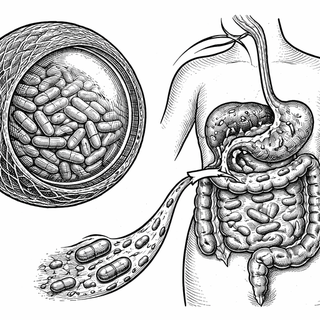
A review in Food Research International looks at a very practical problem: probiotics can be beneficial, but they are also, scientifically speaking, a bit fragile. Processing, storage, heat, oxygen, moisture, and the stomach’s famously rude environment can all reduce their activity. So researchers are working on ways to wrap probiotics in protective coatings, creating tiny capsules that help them survive until they reach where they are needed. Think less “pill capsule” and more “microscopic bubble wrap designed by food scientists.”
What are probiotic microcapsules, exactly?
The basic idea is simple. Probiotic microencapsulation means surrounding live beneficial microbes with a protective outer material, often called a wall material. That wall acts like a shield during food manufacturing, storage, and digestion. Ideally, it protects the bacteria when conditions are harsh, then releases them when conditions are better.
If that sounds like overengineering for microbes inside yogurt, I had the same thought. But the problem is real. A probiotic does not do much good if most of it dies before it reaches the gut.
This review focuses on polysaccharides as the wall material. Polysaccharides are long chains of sugar molecules, and they show up all over biology and food science. Some come from plants, some from algae, some from microbes. Many are already familiar in food as thickeners, stabilizers, or fibers. In microcapsules, they can form gels, films, and network structures that help protect delicate probiotic cells.
Why polysaccharides are getting so much attention
The review argues that polysaccharides have some attractive features compared with more traditional food-grade wall materials.
First, they tend to have good biocompatibility and safety, which is exactly what you want in something going into food. Nobody wants a probiotic delivery system that sounds like it belongs in a jet engine.
Second, polysaccharides often have useful functional properties. They can form barriers, respond to pH changes, hold water, interact with other food components, and sometimes even offer physiological benefits of their own. That means the coating is not just passive packaging. In some cases, it may actively help the final product perform better.
Third, different polysaccharides can be chosen or combined to tune what the capsule does. Need stronger protection during storage? Need release in the intestine rather than the stomach? Need compatibility with a beverage, dairy product, or baked food? The wall material matters a lot, and polysaccharides give researchers a fairly large design toolbox.
The wall matters more than it sounds
One of the more interesting points in the review is that the wall material is not some side detail. It directly affects both protection and release.
That means researchers are asking questions that sound niche but are actually pretty important:
- Can the coating survive food processing?
- Can it protect the probiotic during storage?
- Will it hold up in stomach acid?
- Will it release the microbes at the right place in the gastrointestinal tract?
- Can it do all that without wrecking the texture, taste, or stability of the food?
That last part matters. Food science lives in the land of compromise. A microcapsule that protects probiotics beautifully but turns a drink into wallpaper paste is probably not headed for supermarket glory.
These capsules are not all built the same way
The review also summarizes different forms of probiotic microcapsules. The details can get technical fast, but the broad point is easy to grasp: there is no single capsule design that works for everything.
Different physical and chemical preparation methods can produce different capsule structures, sizes, and release behaviors. Some may be better suited for dry foods, some for liquids, some for refrigerated products, and some for surviving especially harsh digestive conditions.
This is one reason the field is interesting. It is not just “put bacteria in coating, problem solved.” It is more like a continuing engineering puzzle where the bacteria, the coating, the food product, and the digestive tract all get a vote.
Why this could matter in the real world
If this line of research keeps improving, it could make probiotic foods more reliable.
That sounds modest, but it is actually a big deal. The promise of probiotics depends on viable microbes making it through processing, shelf life, and digestion. Better microcapsules could help manufacturers produce foods that deliver more consistent probiotic activity by the time people actually consume them.
That could expand where probiotics can be used, too. Instead of being limited mostly to products that are naturally gentle on microbes, improved encapsulation might support broader use in different food formats. The review notes applications in different foods, which hints at a future where probiotic delivery is less fragile and more adaptable.
There is also a bigger scientific theme here: food is becoming more engineered in a good way. Not fake, not futuristic slop, but thoughtfully designed so ingredients survive long enough to do what they are supposed to do.
The challenges are still very real
Before we all start imagining immortal yogurt bacteria in every snack aisle, there are still hurdles.
A capsule has to protect probiotics without interfering too much with food quality. It should be safe, food-grade, scalable, and cost-effective. It should perform consistently in the chaotic real world, not just in neat laboratory conditions where everything behaves politely.
Researchers also have to sort out which polysaccharides work best for which probiotics and which foods. Not every beneficial microbe responds the same way, and not every food matrix is equally friendly. A capsule that works in one product may behave differently in another.
And, as always, better survival does not automatically mean better health outcomes. Protecting probiotics is a necessary step, but it is not the final word. The field still needs careful work connecting encapsulation strategies to meaningful effects in actual consumers.
Why I find this research so appealing
There is something delightfully elegant about solving a biological problem with a food material. Instead of treating probiotics like tiny superheroes who should simply toughen up, researchers are asking a more realistic question: what if we gave them armor?
That shift matters. It turns probiotics from fragile ingredients into designed systems. And it shows how much innovation can hide inside everyday things like fermentation, fiber, and food texture.
So yes, this paper is about polysaccharides and microcapsules, which might sound like the sort of topic that causes dinner guests to mysteriously remember they left the oven on. But underneath that technical language is a genuinely human goal: helping helpful microbes survive a rough trip through manufacturing and digestion so they can actually do their job.
Tiny passengers. Smarter packaging. A surprisingly big idea.
This blog post discusses research findings and should not be taken as medical advice. If you have concerns about digestive health, please consult a healthcare provider. Research discussed here represents ongoing scientific investigation and clinical validation is still in progress.
All images used in this post are decorative illustrations only and do not represent or reflect the accuracy, reality, or correctness of the referenced research.
Primary Source: Research progress on preparation of polysaccharide-based probiotic microcapsules and their application in food. Food Research International. PubMed record 41687367.